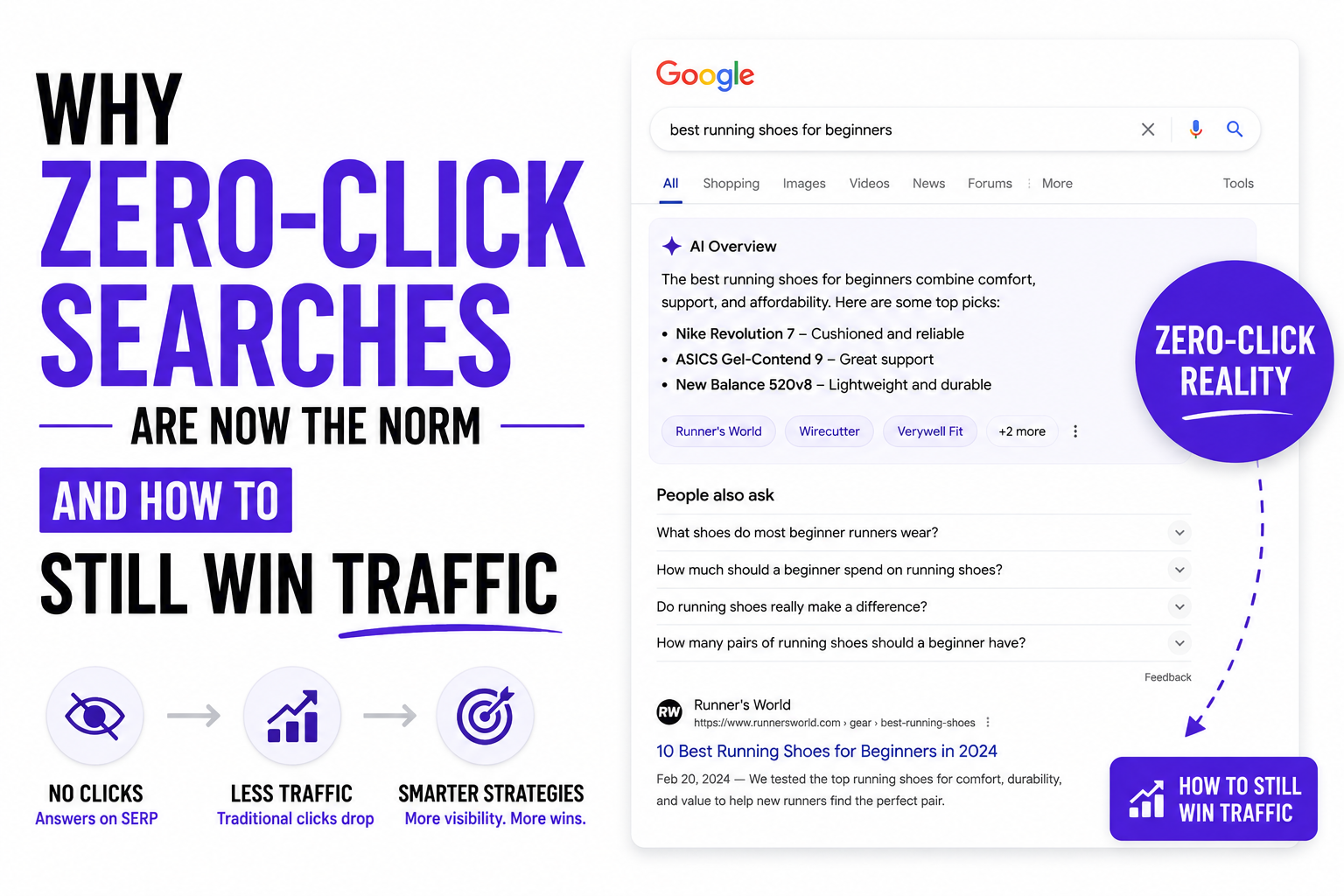
Your rankings are holding. Your clicks are not. If that sentence describes what you are seeing in Google Search Console right now, zero-click search is almost certainly the reason.
A zero-click search is any search that ends without the user visiting an external website. Google answers the query directly on the results page through featured snippets, knowledge panels, People Also Ask boxes, local packs, or AI Overviews, and the user moves on without clicking anything. This is not a new problem. It has been growing steadily since 2019. What changed in 2025 and 2026 is the speed of that growth, driven almost entirely by the expansion of AI Overviews across more query categories.
This article explains what is driving zero-click growth in 2026, how to diagnose which of your specific queries are affected using GSC and Semrush, which content types carry the most risk, and what a zero-click SEO strategy for informational content looks like when clicks are no longer guaranteed. No vague advice. Just what the data shows and what to actually do about it.
Table of Contents
What Zero-Click Search Actually Means?
Before getting into numbers and fixes, it helps to be precise about the term, because most articles use it loosely.
The Simple Definition You Skip
A zero-click search is not a single feature. It is the outcome that happens when a search ends without a user clicking through to any external website. The cause can be a featured snippet, a knowledge graph answer, a local pack, a People Also Ask result, an AI Overview, or an AI Mode response. What matters is the outcome, not the feature producing it.
Most business owners conflate zero-click search with AI Overviews specifically. That confusion leads to the wrong fixes. If a page is losing clicks to a People Also Ask result, adding FAQPage schema is the lever. If an AI Overview is absorbing the query, the fix is about content structure and citation signals. Same symptom, different cause.
Why This Trend Predates AI Overviews?
Zero-click has been climbing for years. According to Digital Applied’s 2026 data, 64.82% of all Google searches now end without a click, up from roughly 50% in 2019 and 60% in 2024. That growth predates generative AI entirely. Featured snippets, knowledge panels, and instant answers started this. AI Overviews are the latest and sharpest acceleration, not the original cause.
Understanding this matters for one practical reason: if zero-click was climbing before AI, waiting for AI features to “calm down” is not a strategy. The baseline is shifting permanently.
Two Types of Zero-Click and Why One Is Actually Fine
Not all zero-click searches are a problem for your business.
There is good zero-click and bad zero-click. Good zero-click is a branded query, someone searching your name or your product, that gets answered on the SERP without a visit. The user gets confirmation, your brand gets the impression, and when that user is ready to act, they already know you. No click, but real brand value.
Bad zero-click is an informational query where a user gets a complete answer from Google and has no reason to ever come to your site. If your traffic model depends on users reading your “what is X” posts before converting, that type of zero-click eats directly into your funnel.
Most sites have both types in their GSC data. Most treat them identically. That is where the diagnosis goes wrong.
Facts You Need to Know
These are not estimates or projections. This is what the data published in 2025 and 2026 actually shows.
How Far Organic CTR Has Actually Fallen
The numbers vary slightly across studies depending on methodology, but the direction is consistent across every published dataset.
According to Digital Applied’s 2026 research, position-one CTR drops from 31.7% to 19.8% when an AI Overview appears, a 37.5% relative decline for what was previously the most valuable spot on the SERP. Positions two through five lose roughly 12% of their CTR with an AI Overview present. Lower positions take less of a hit, because users who scroll past the AI summary are already signalling higher intent.
Ahrefs found that top organic results can shed up to 58% of their clicks when an AI Overview sits above them. Seer Interactive, measuring 25.1 million impressions, found a similar 61% fall. Two independent studies landing in the same range is meaningful. This is not a measurement artefact.
For SEO teams still benchmarking against historical CTR averages, those benchmarks are now broken. A 2% CTR for a position-two result that used to expect 7% is not underperformance on your end. It is the new reality of an AI Overview SERP.
Which Industries Are Hit Hardest Right Now?
AI Overview coverage is not uniform across topics. According to BrightEdge’s 16-month tracking study, healthcare queries show AI Overview rates of 88%, education at 83%, and B2B tech at 82%.
For Indian consultants, D2C brands, and service businesses, zero-click search impact on small business websites is sharpest in the informational and comparison query categories. If your content answers questions like “how to choose X,” “what is the difference between A and B,” or “best Y for Z,” those query types are exactly where AI Overviews concentrate. Transactional queries with clear purchase or booking intent remain largely protected, because AI cannot complete the transaction itself.
The Citation Paradox No One Explains Clearly
Here are two numbers that seem to contradict each other. According to Semrush’s 2025 AI Overviews study, only 1% of users click on sources cited within AI Overviews. Yet brands cited inside AI Overviews get 35% higher organic CTR and 91% higher paid CTR compared to non-cited brands on the same SERP.
Both numbers are accurate. They measure different things.
The 1% figure measures direct citation clicks, the immediate traffic from someone reading the AI answer and clicking your source link. That traffic is genuinely low. The 35% higher CTR figure measures what happens across subsequent searches, after a user has seen your brand cited in an AI answer and then searches again. The citation builds familiarity. Familiarity generates branded searches. Branded searches convert at dramatically higher rates. The value of an AI citation is not in the immediate click. It is in what happens to your brand’s click performance over the following days and weeks.
One Number That Reframes the Panic
Digital Applied’s 2026 research found that AI Overviews reduce organic CTR by an average of 18%, but the clicks that survive convert 23% better. The users who click through after reading an AI summary are not casual browsers. They have already received a basic answer and are looking for something the AI could not give them: depth, trust, or a transaction.
If your traffic is falling but your leads per session or conversion rate per visit is rising, you are likely experiencing this filter effect. Total sessions down, quality up. Measuring only sessions misses the story.
How to Find Your Zero-Click Queries in GSC?
This is where most zero-click articles stop short. They describe the problem clearly and then offer vague advice about “improving content quality.” What follows is the actual workflow I use when auditing a site’s AI visibility and CTR loss.
The Filter Logic That Isolates the Problem
Open Google Search Console and go to the Performance report. Set the date range to the last 90 days. Then apply these three filters simultaneously:
- Impressions: greater than 500
- CTR: less than 0.5%
- Average Position: between 1 and 10
This filter combination surfaces pages that rank well and get seen frequently but earn almost no clicks. That specific pattern, high impressions, good rankings, minimal clicks, is the clearest available signal in GSC that an AI feature is sitting above your result and satisfying the query before users reach your link.
The 500-impression threshold matters. Below that, sample size is too small to draw conclusions. The 0.5% CTR ceiling is conservative; a well-ranked informational page that is not being affected by AI features should expect 2% to 5% CTR at minimum. Pages falling below 0.5% at position one through ten are worth investigating first.
Export that list. That is how to use GSC to find zero-click keywords affecting your site, and it is your starting point for every audit conversation from here.
Reading the Impressions-vs-Clicks Gap Correctly
Once you have that list, the next step is understanding what the gap between impressions and clicks is actually telling you. There are two different patterns, and they require different responses.
Pattern one: impressions are stable or rising, but CTR is falling. This is the AI absorption signal. Your page is getting seen as Google processes the query into an AI Overview, but the AI answers the question and users stop there. Your ranking has not changed. The SERP around your ranking has.
Pattern two: impressions and clicks are both falling together. This is a ranking drop, not a zero-click problem. If impressions are falling, your page is getting seen less, which means the issue is indexation, content freshness, or ranking position, not AI Overview absorption. This pattern is also often why organic clicks dropping with rankings unchanged confuses site owners. The rankings looked the same. But if impressions also fell quietly, it is a different problem with a different fix.
Treating pattern two as a zero-click problem leads to content restructuring work that misses the actual cause. These two patterns look similar in the headline traffic numbers but are completely different in the data, and the fix for one does nothing for the other.
One GSC Data Issue That Skewed 2026 Readings
Worth flagging before you draw conclusions from your own GSC data: in early 2026, a known GSC Impression Bug inflated impression counts across many sites without any corresponding increase in actual traffic. As documented by multiple SEO practitioners, the bug caused CTR to appear artificially lower than it was, because inflated impressions in the denominator compressed the percentage.
If your CTR drop dates specifically to January through March 2026 and your actual click numbers did not fall correspondingly, check whether you were affected by that reporting error before treating the pattern as a zero-click problem. A reporting bug and AI Overview absorption look identical in the CTR metric but require entirely different responses. Always confirm that clicks actually dropped, not just the ratio.
Using Semrush to See AI Overview Trigger Rates
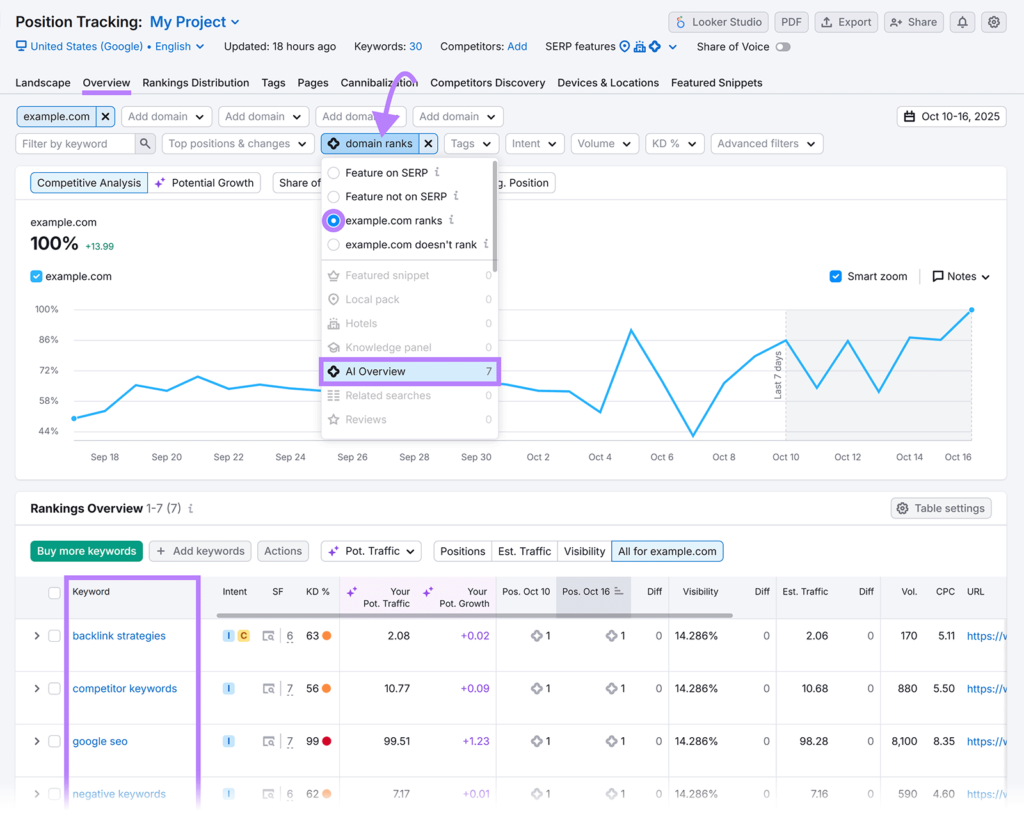
After running the manual GSC filter, the next step is cross-referencing those queries with Semrush’s Position Tracking.
In your Semrush Position Tracking campaign, the AI Overviews column shows which of your tracked keywords currently trigger an AI Overview on the live SERP. Take the high-impression, low-CTR queries you exported from GSC and check each one against Semrush’s AI trigger data. Queries that appear in both lists, ranking well in GSC and triggering an AI Overview in Semrush, are your confirmed zero-click targets. These are the pages where content restructuring for citation, not for ranking, is the right next move.
This cross-reference is the step most site owners skip. Without it, you end up restructuring pages that do not actually have an AI Overview above them, wasting effort on the wrong diagnosis. The combination of GSC’s impression-to-click gap and Semrush’s trigger data gives you a prioritised fix list rather than a general hunch about which content is affected.
Get your 14-Day Semrush One trial now!
Which Content Is Most at Risk and Which Is Not?
Knowing your queries are affected is step one. Step two is knowing whether the content producing those queries is worth restructuring for citation, worth leaving alone, or worth replacing with a different format entirely.
Content That AI Overviews Absorb Completely
The categories most exposed to zero-click absorption are:
- Definition and explainer posts (“what is X,” “what does Y mean”)
- Standard how-to guides answering questions with widely known answers
- Roundup lists that compile information available elsewhere (“top 10 tools for X”)
- News summaries and recaps
What these have in common: an AI system can generate a complete, accurate answer from publicly available information without needing to send the user anywhere. If your content falls primarily in these categories, the zero-click impact on your organic traffic is structural. Improving content quality or title tags does not change the underlying pattern.
Content That Still Earns Clicks Reliably
Three categories still send clicks reliably, and they share a common property: the user cannot get what they need without visiting your site.
Branded and navigational queries. Transactional queries where the user intends to purchase, book, or contact. Content with original data, first-person case studies, or proprietary findings that exist nowhere else on the web.
Beyond those three, tools and calculators are particularly durable. If a user needs to input their own variables to get a useful answer, a static AI response cannot replace the interaction. Comparison pages that are genuinely opinionated, rather than balanced roundups, also hold their click rates better, because the user wants a recommendation from a real perspective, not a synthesised summary.
How to Still Win Traffic When Clicks Are Not Guaranteed?
The practical question for anyone asking how to get traffic with zero-click search as the new default: if zero-click is structural and not fully reversible, what does a working traffic strategy actually look like? The answer is not to fight for clicks that AI has permanently absorbed. It is to zero-click searches win traffic on a longer loop than a direct SERP click.
Optimise for Citation First, Clicks Second
The reframe that changes everything: in a zero-click environment, the goal of informational content is to earn a citation, not a click. The citation is the distribution. The click comes later, from a user who has already seen your brand mentioned, and is now searching with commercial intent.
Understanding how AI Overviews reduce organic CTR gives you clarity on which pages need a citation-first fix versus a ranking fix. To earn citations, and to learn how to get cited in Google AI Overviews specifically, content needs to be structured for passage-level extraction. Open each section with a two to three sentence answer before adding context. Keep each section self-contained enough that a paragraph lifted out of the article still makes complete sense. Use FAQPage and Article schema. Include verifiable statistics with source links in the content body, not buried in a references section at the bottom.
The Google AI Mode vs Google Search article covers the full structural breakdown of what makes content citable versus what merely makes it rank, if you want to go deeper on the mechanics.
Build Brand Queries That Bypass Zero-Click Entirely
Branded search is the most protected traffic category in 2026. An Amsive study of 700,000 keywords found that CTR for brand queries with an AI Overview increases by 18.68%, while CTR for non-brand queries drops by 37% in the same conditions. The AI Overview helps branded queries by confirming the brand before the user clicks.
This is the reinforcing loop: informational zero-click content builds brand exposure, brand exposure generates branded searches, branded searches convert at high rates and are resistant to AI Overview interference. Brand visibility in a zero-click search era is not built by avoiding the zero-click SERP. It is built by appearing consistently inside AI answers until users start searching for you by name.
The businesses pulling ahead on organic traffic in 2026 are not avoiding zero-click content. They are using it intentionally to build branded search volume, and then measuring success by branded query growth rather than by informational content sessions.
Shift Measurement Away from Sessions Alone
The measurement change matters as much as the content change.
A user who never clicked your article because an AI Overview answered their question may still have converted three days later via a branded search. Under last-click attribution in GA4, that session does not connect to your informational content. Under assisted conversion reporting or a multi-touch model, it does.
If you are using sessions on informational pages as the primary success metric for your content programme, you are reading a metric that no longer reflects the actual contribution of that content to your business. Move the measurement upstream to branded search volume, and downstream to conversion rate on the traffic that does arrive. Those two metrics tell a more accurate story in a zero-click environment.
Content Types Worth Building Specifically for This Era
If you are planning new content in the next quarter, these formats earn clicks that AI cannot easily intercept:
- Original research using your own client data, audit findings, or tracked observations: data that exists nowhere else forces attribution
- Interactive tools and calculators where the output depends on user input
- First-person case studies with specific, named outcomes
- Genuinely opinionated comparison posts that make a clear recommendation and explain the reasoning
One of these per quarter is more valuable than four generic how-to guides that will be absorbed into AI Overviews within a few months of publication.
What Winning Looks Like Now
Winning in 2026 is not about getting every lost click back. That is not possible, and targeting it as the goal leads to the wrong work.
Winning is being the brand a user has already encountered by the time they are ready to make a decision. The businesses doing well right now are not the ones with the most informational content. They are the ones whose brand appears consistently in AI answers for their topic area, whose branded search volume is growing, and whose conversion rate on actual site visits is higher than it was when they had more sessions.
One check worth running: if your sessions are down but your lead-to-visit ratio is flat or falling, the problem is on your landing page or in your offer, not in your zero-click count. If sessions are down and your lead-to-visit ratio is rising, the filter is working in your favour and the total traffic drop is less damaging than it looks.
The metric that cuts through the noise is not sessions per month. It is leads per month, tracked alongside the content activity and AI citation data that fed into them.
Conclusion
Zero-click search is not going to reverse. The underlying driver, AI systems becoming better at answering common questions directly on the SERP, is getting stronger, not weaker. The sites that adapt fastest are the ones that stop measuring success by sessions alone and start measuring by citation frequency, branded search growth, and conversion quality on the traffic that does arrive.
That shift in measurement forces a shift in content strategy. Less generic informational content designed to capture a click. More structured, citation-worthy content designed to build brand presence across AI answers, and more original work that AI systems cannot replicate or summarise without attributing you.
If your GSC data shows the high-impression, low-CTR pattern on multiple pages and you want to understand exactly which queries are being absorbed, which content is worth restructuring, and where AI Overviews are affecting your specific traffic, that is exactly the kind of audit I run for clients. The GSC and Semrush workflow described here is part of every AI visibility review I carry out. Reach out at my LinkedIn profile.
Is your traffic dropping while rankings stay the same? I will tell you exactly why in 30 minutes. Book a free call.

Ankit Prajapati
Digital Marketing Professional | SEO Consultant | Teetotaller | Music Buff | Early Bird. "Love to do SEO for Humans, not for Bots." As an SEO Consultant, I will identify the opportunities to make your website user-friendly, improve visibility, traffic and leads. I also help SEO freshers and experienced SEO professionals in resolving their SEO errors and their queries for free, which extends my skill sets.
Comments are closed