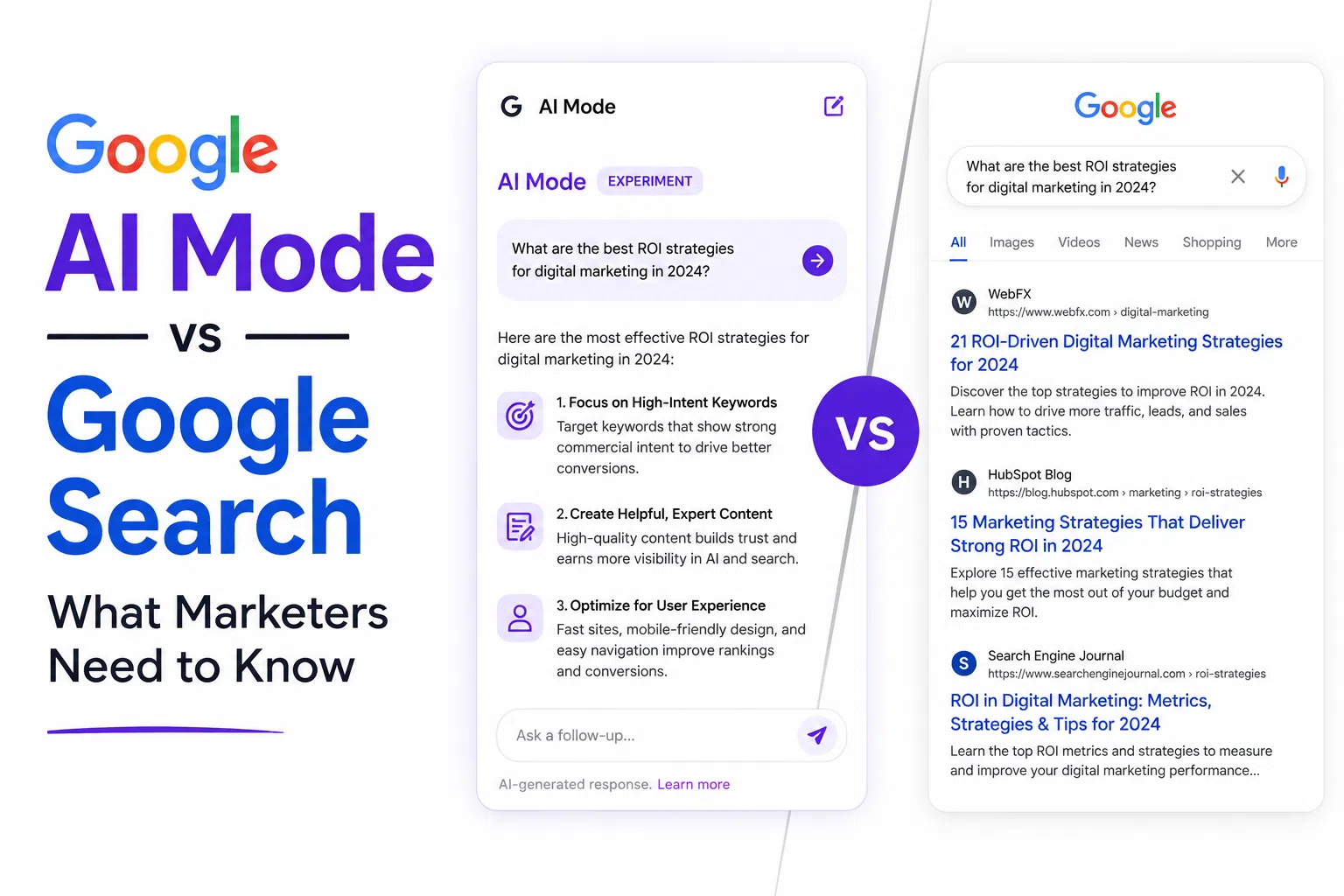
If your Google rankings have stayed the same over the past few months but your organic clicks keep dropping, you are not imagining it. Google AI Mode and AI Overviews are now sitting between your content and your audience, answering queries directly before users even see your link.
This article covers what Google AI Mode actually is, how it differs from AI Overviews and traditional search, what the 2026 data shows about traffic and click-through rates, which types of content are most at risk, and what practical steps you can take right now. No theory. No predictions. Just what the numbers show and what to do with them.
What Google AI Mode Actually Is?
Most people use “AI Overviews” and “AI Mode” as if they mean the same thing. They do not, and that distinction matters more than most marketers realise.
Before getting into the differences, it helps to understand the broader shift happening inside Google. Traditional search returned a list of links and left the user to figure out the answer. AI Mode generates the answer itself. That single change affects how content gets found, cited, and clicked.
It Is Not the Same as AI Overviews
AI Overviews appear inline on a standard Google search results page. The blue organic links still appear below the AI-generated summary. A user can scroll past the overview and click a result in the usual way.
AI Mode is a separate experience entirely. When a user switches to AI Mode, the traditional results page disappears. There are no ten blue links. The interface functions like a conversation, where Google’s Gemini model generates a detailed response, and users can ask follow-up questions inside the same thread.
Here is the number that catches most SEOs off guard: according to a Search Engine Journal analysis citing Ahrefs research, AI Mode and AI Overviews cited the same URL only 13.7% of the time for the same query. Ranking well in one does not carry over to the other. If you are optimising solely for traditional organic rankings, you are missing a large portion of the citation picture.
How Query Fan-Out Changes Everything?
In traditional search, a user types a query and Google matches it against indexed pages. One query, one SERP.
AI Mode works differently. It uses what Google calls “query fan-out,” breaking a single user question into up to 16 sub-queries that run simultaneously. Each sub-query pulls relevant passages from across the web. The model then synthesises those passages into one cohesive answer.
What this means for your content: optimising for a single keyword is not enough. Your content can miss half the searches that matter, not because it ranks poorly, but because it only answers one dimension of what the user was really asking. Passage-level retrieval is the mechanism here, not page-level ranking. A model can lift a single strong paragraph from your article, even if the rest of the page is not especially relevant.
Where Google AI Mode Stands in India Right Now?
A lot of the published data on AI Mode focuses on the US market. India is already in this.
Google AI Mode has been available in India via Search Labs since June to July 2025 for English-language users. As of April 2026, it is integrated directly into the Android search bar. And AI Overviews, which affect a wider share of searches than AI Mode itself, already appear on 26.8% of Google queries in India, according to SeoProfy’s 2026 data, placing India among the higher-exposure markets globally.
For Indian business owners still treating AI search as something happening elsewhere, that number is a reality check.
The Traffic Numbers Marketers Need to See
Traffic data from 2026 tells a split story. Some businesses are panicking over drops that look worse than they are. Others are under-reacting to drops that are genuinely structural. The way to tell the difference is to look at what type of traffic is falling and why.
CTR Drops by Query Type and Intent
Not all content is equally at risk. The impact of AI Overviews on click-through rates varies sharply depending on what the user is searching for.
Seer Interactive’s study of 25.1 million impressions found that organic CTR for queries with AI features dropped 61%, falling from 1.76% to 0.61%. For pages ranked in position one, the drop is steeper than for lower positions, because the AI Overview appears directly above position one, pushing the top organic result further down the page.
The queries most affected are:
- Definitions and explainers (“what is X,” “how does Y work”)
- Basic how-to guides
- Listicles and roundups
- News summaries
Transactional queries (“buy X,” “X pricing,” “X near me”) are far less affected. Ahrefs’ analysis of 300,000 keywords confirms that commercial intent searches see a much smaller CTR reduction, because AI-generated answers cannot replace the act of actually purchasing or visiting a local business.
If your site relies heavily on top-of-funnel informational content, you are more exposed. If most of your organic traffic comes from bottom-of-funnel queries, your risk is lower than the headlines suggest.
The Zero-Click Reality in AI Mode
This is the statistic that stops business owners mid-sentence: Seer Interactive’s study of AI Mode queries found that 93% of AI Mode sessions end without a single click to an external website.
Ninety-three percent.
For anyone whose business model depends on organic traffic, that number sounds catastrophic. But there is a counter-argument worth sitting with. According to data compiled by Exposure Ninja, visitors who arrive at a website through an AI search citation convert at 14.2%, compared to 2.8% for traditional organic traffic. That is roughly five times the conversion rate per visit.
The users who do click through from AI citations are later in the decision journey. They have already had their initial question answered by the AI. They are clicking because they want more depth, more proof, or because they are ready to act. Fewer visits, but far more qualified ones.
The practical implication: a drop in total sessions from informational content does not necessarily mean a drop in leads or revenue. Measuring by sessions alone gives you the wrong picture.
Why Your GSC Data Hides the Full Picture?
Google Search Console does not currently separate AI Mode traffic from standard organic traffic. An AI Mode visit shows up as an organic visit. A click on a source link inside an AI Overview is counted as a regular organic click.
This creates a visibility problem. You may be losing AI Mode impressions and not seeing it clearly in your data.
The diagnostic signal to look for: queries where impressions are stable or even rising, but clicks are falling. That pattern, specifically impressions holding steady while CTR drops, is the clearest indicator that an AI Overview is answering the query above your organic result. Your page is getting seen in the process that generates the answer, but users are not making it to your link.
Compare January to March 2025 (pre-full rollout) against January to March 2026 in your GSC performance report. Pages showing an organic traffic decline are your most exposed. Pages holding steady likely have content that is harder for AI to fully synthesise without a click.
AI Mode vs AI Overview vs Traditional Search: Side by Side
To make this concrete, here is how the three experiences compare across the signals that matter most for marketers.
| Factor | Traditional Search | AI Overview | AI Mode |
|---|---|---|---|
| Where it appears | Standard SERP with blue links | Top of SERP, above organic results | Separate conversational tab |
| Organic results visible? | Yes | Yes, below the overview | No |
| Zero-click rate | ~34% | ~60% | ~93% |
| Citation overlap with organic top 10 | 100% by definition | 17–54% (varies by study, 2026 data) | 13.7% overlap with AI Overview citations |
| Ads present? | Yes | Yes, on 25.56% of AI Overview SERPs | Yes, new formats confirmed in 2026 |
| Retrieval method | Page-level ranking | Passage-level extraction | Fan-out multi-query synthesis |
The column that surprises most people is the citation overlap row. Ranking in the top 10 no longer means appearing in AI answers.
Where Ads Now Sit in These Experiences?
One aspect of AI Mode that the industry has underreported is how aggressively Google is integrating advertising into these experiences.
By October 2025, Google Ads appeared on 25.56% of search results that included AI Overviews, up from 5.17% in March 2025, according to Semrush data. At Google Marketing Live in May 2026, Google confirmed four new ad formats inside AI Mode itself: Conversational Discovery Ads, Highlighted Answers, AI-powered Shopping Ads, and Business Agent for Leads.
For paid search teams, this changes the equation. If AI Mode generates the majority of zero-click behaviour, but ads appear within that same experience, then paid visibility inside AI Mode becomes a separate opportunity from organic citation visibility. The two strategies no longer share the same real estate.
Which Content Types Survive Each Surface?
The distinction is actually simpler than most articles make it:
High risk across AI Overviews and AI Mode:
- Generic how-to guides that answer common questions (these get synthesised completely)
- Definition posts and explainer content
- Roundup lists (“best tools for X”)
- News summaries
Lower risk or actively rewarded:
- Original research with data that does not exist elsewhere
- First-person experience and case studies
- Deep technical analysis with specific, verifiable claims
- Transactional and product pages with real inventory or pricing
- Local service pages with specific geographic intent
If your content can be fully summarised in three sentences by an AI, it probably will be.
What This Means for Your Organic Strategy?
The temptation here is to declare that rankings no longer matter. That is wrong. Strong traditional SEO remains the foundation. According to data from jigsawkraft.com, 92% of AI citations come from sites already ranking in the top 10. The difference is that ranking in the top 10 is now necessary but not sufficient. You also need to be citable.
Ranking Is Not the Same as Being Cited
A brand that ranks on page one may not appear in AI Overviews or AI Mode at all. The reverse is also true. A brand with modest traditional SEO performance can consistently appear in AI Mode responses if its content is structured in a way that AI models find easy to extract and synthesise.
Brands cited inside AI Overviews see 35% more organic clicks than non-cited brands on the same SERP, per Seer Interactive research reported in SeoProfy’s 2026 data. The citation is not just about AI visibility. It feeds back into traditional click-through as well. Appearing inside the AI answer builds familiarity, and familiarity converts better when users do eventually click.
Citation overlap between the organic top 10 and AI Overviews has weakened considerably. In mid-2025 it was around 76%, meaning most AI Overview sources also ranked in the top 10. By early 2026 that figure had dropped to between 17% and 54% depending on the study and query category. The systems are drifting apart.
Content That Earns Citations vs Content That Just Ranks
What makes content citable by an AI system is different from what makes it rank.
For ranking, the traditional signals still apply: backlinks, authority, on-page keyword relevance, site structure, E-E-A-T signals.
For citation, the structural signals matter most. AI systems retrieve at the passage level, not the page level. A model scanning your article is not reading it from top to bottom. It is identifying paragraphs that are self-contained, factually grounded, and directly relevant to a specific sub-query. Long, meandering paragraphs that take four sentences to arrive at a point are skipped. Short, direct passages that open with the answer get lifted.
Structural changes that actually move the needle:
- Open each section with a 2 to 3 sentence answer before adding context
- Keep each section self-contained enough that it makes sense without reading the paragraph above it
- Use FAQPage and Article schema to signal structure to crawlers
- Include verifiable statistics with source links in the body of the content, not just in a footnotes section
- Write concise comparison tables where you are contrasting concepts
The goal is for each paragraph to work as a standalone answer capsule, not just as a continuation of your narrative.
Building Topical Authority Across a Cluster
Single-article strategies do not work as well in AI search as they used to. AI Mode’s query fan-out retrieves passages from multiple sources on a topic. If your site has deep, structured content across a topic cluster, you increase the probability that multiple fan-out sub-queries pull from your domain.
This is the principle behind Hybrid Engine Optimisation (HEO), which is about building content that covers a topic in enough depth that AI systems recognise your domain as authoritative across the cluster, not just for one page. A pillar page supported by well-structured cluster articles gives AI systems more extractable passages to choose from across a wider range of sub-queries.
Diagnosing Your Own AI Visibility Right Now
You do not need a paid tool to start understanding where you stand. There are free diagnostic steps available to any marketer with GSC access and fifteen minutes.
Three GSC Signals Worth Checking Today
Open Google Search Console and go to the Performance report. Look for:
1. Queries where impressions are stable but clicks are falling. This is the clearest sign of AI absorption. Your page is being crawled and considered in the AI retrieval process, but users are satisfied by the generated answer and not clicking through.
2. Branded queries with unusually low CTR. If someone searches your brand name and clicks through less than 20% of the time, an AI Overview is likely appearing above your homepage. Branded queries historically convert at very high CTR because intent is clear and specific.
3. Average position unchanged while total clicks drop. If your rankings have held steady but click volume is falling, the SERP has changed around your result, not below it. AI features above position one are doing the work.
These three patterns together give you a rough map of where AI features are eating into your specific traffic, without needing any specialist tool. If you want keyword-level data on which of your queries are triggering AI Overviews, Semrush’s AI Visibility feature covers exactly that, showing trigger rates and citation presence across your tracked keywords.
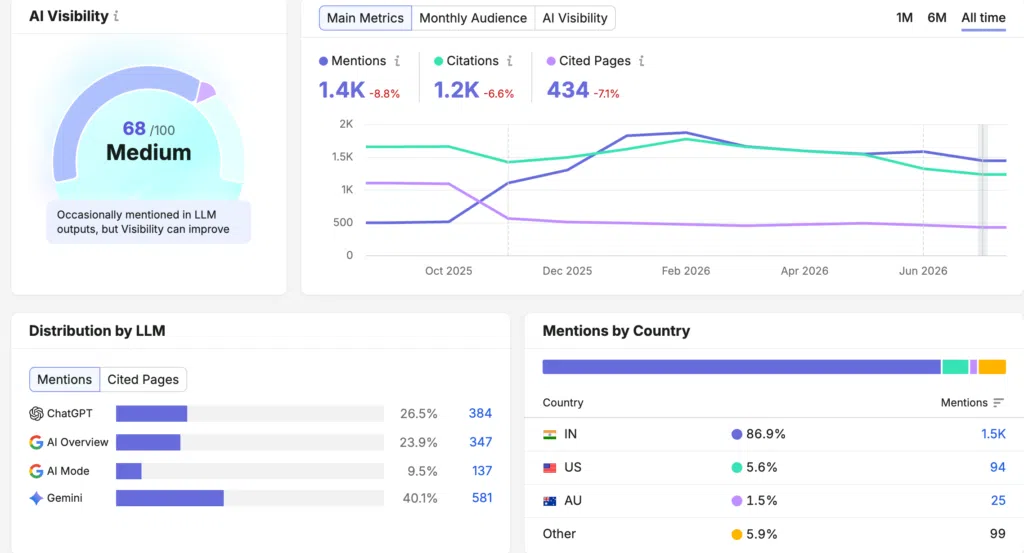
If you want keyword-level data on which queries are triggering AI Overviews, Semrush’s AI Visibility Toolkit shows trigger rates and citation presence across your tracked keywords, then connects that visibility data with SEO and web signals so you can diagnose gaps rather than just observe them.
Get your 14-Day Semrush One trial now!
Manual AI Prompt Testing Without Paid Tools
Pick five queries you expect to rank for. Type each one into Google AI Mode, ChatGPT, Perplexity, and Google Gemini. For each one, note:
- Is your domain cited by name?
- Is your content paraphrased without attribution?
- Is a competitor cited where you expected to appear?
- What kind of content did the AI use to build the answer?
This takes about twenty minutes and gives you a direct read on your current AI citation share for your most important queries. Most businesses have never done this check. For a deeper look at how to track AI visibility across tools, there is a full diagnostic checklist available.
Practical Steps to Stay Visible in 2026
The businesses responding well to this shift are not abandoning SEO. They are building on top of it. Strong technical SEO and good content remain the foundation. What is changing is the layer above that.
Restructure Content for Passage-Level Extraction
This is the most actionable change most sites can make without rebuilding anything from scratch.
Go to your highest-traffic informational pages. For each H2 section, check whether the opening paragraph answers the section’s implied question in two to three sentences before adding detail. If it does not, rewrite the opener so that it does.
The goal: any paragraph on your page, lifted in isolation, should still make sense and answer something specific. AI retrieval systems pull passages out of context. If your paragraph only makes sense after reading the one before it, it is not extractable.
Also vary your formats. Some sections work better as short prose. Some work better as a comparison table. Some work as a numbered list. AI systems handle all three formats and are more likely to extract a clearly structured passage than a long undifferentiated block of text.
Schema Types That Reduce Friction for AI Retrieval
Google’s own documentation on AI features is clear on this point: there are no special technical requirements for appearing in AI Overviews or AI Mode beyond standard SEO best practices. You do not need new files, special markup, or AI-specific optimisations.
That said, structured data reduces ambiguity for the systems parsing your content. FAQPage schema, Article schema, and HowTo schema all help a crawler identify what type of content is on a given page and which sections correspond to which type of intent. They do not guarantee a citation. They make it easier for the system to decide in your favour.
If you have FAQ sections without FAQPage schema, that is a straightforward fix with meaningful upside.
Original Data as Your Citation Moat
This one takes more effort but pays the highest returns.
AI tools synthesise from existing content. If a statistic, finding, or case result exists nowhere else on the web, the AI has no choice but to attribute it to you. Proprietary data is not optional for most small sites, but documented observations are.
If you are an SEO consultant, that might mean:
- Auditing 20 client pages and recording which content patterns appeared in AI Overviews
- Tracking AI referral traffic in GA4 over three months and publishing the real numbers
- Testing different paragraph structures and noting which ones earned citations in your own manual prompt testing
The data does not need to be peer-reviewed. It needs to be real, specific, documented, and genuinely not available anywhere else. That combination makes you a necessary citation rather than an optional one.
Conclusion:
Google AI Mode vs Google Search is not really an either/or question. Both matter. But the way you earn visibility in each one is different enough that treating them as the same problem will cost you.
Traditional SEO gets your content indexed and ranked. That part has not gone away. What has changed is that ranking is now the entry ticket, not the prize. The prize is being cited inside the AI-generated answer that sits above your link, inside a conversation your potential customer is having with Google before they ever decide to click.
The businesses getting this right are not doing anything exotic. They are writing cleaner content, structuring it so any paragraph stands on its own, adding schema where it is missing, and actually testing what AI tools say about them. That last one, the manual prompt check across AI Mode, ChatGPT, Perplexity, and Gemini, takes twenty minutes and most teams have never done it even once.
If you are seeing the traffic drop pattern as described here and want a second opinion on what specifically is causing it, that is exactly the kind of diagnostic I run as part of an SEO and AI visibility audit. You can DM me on LinkedIn.

Ankit Prajapati
Digital Marketing Professional | SEO Consultant | Teetotaller | Music Buff | Early Bird. "Love to do SEO for Humans, not for Bots." As an SEO Consultant, I will identify the opportunities to make your website user-friendly, improve visibility, traffic and leads. I also help SEO freshers and experienced SEO professionals in resolving their SEO errors and their queries for free, which extends my skill sets.
Comments are closed