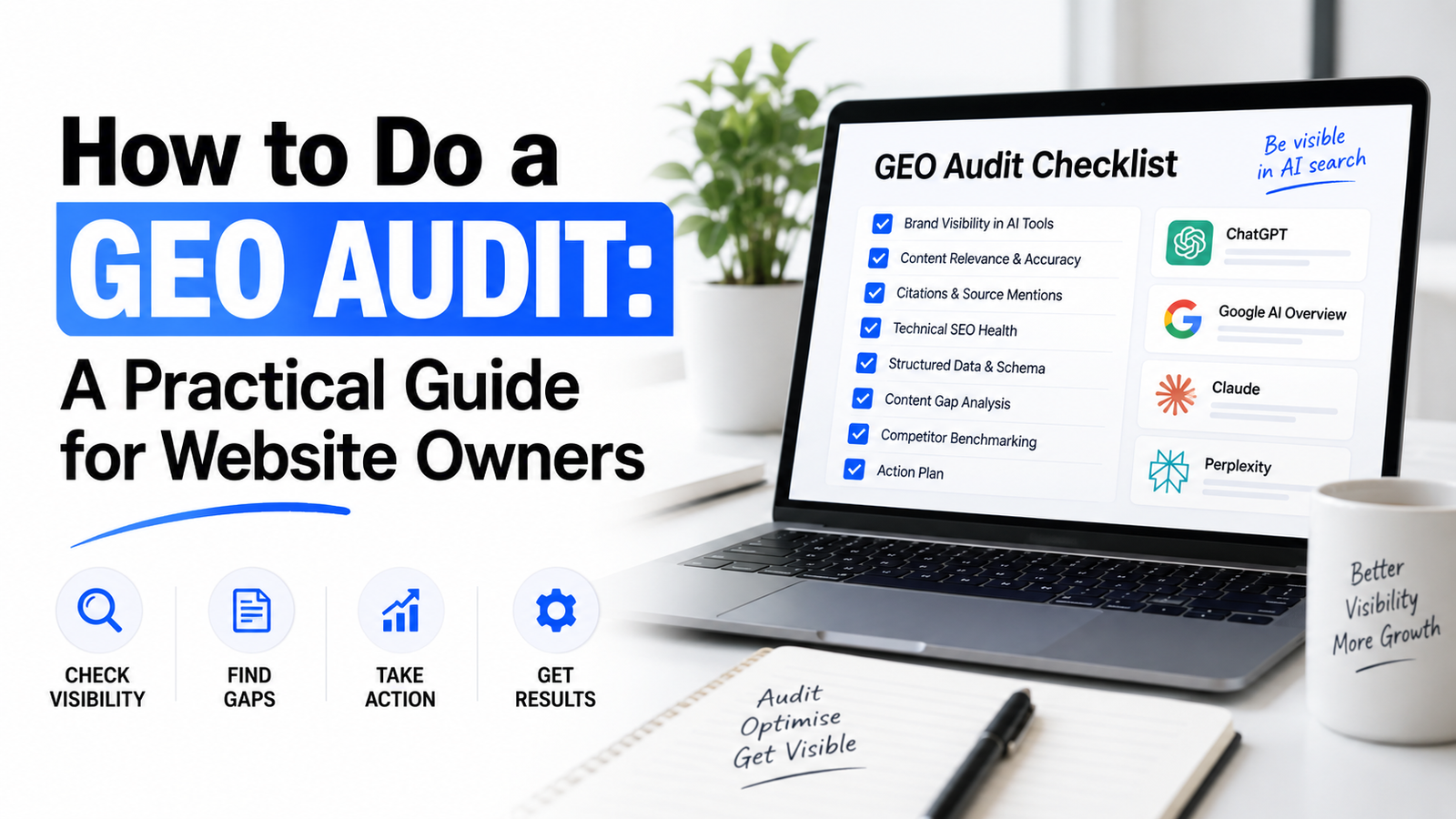
Your website can rank on the first page of Google and still be invisible to ChatGPT, Perplexity, and Google AI Overviews. That is not a hypothetical. It happens because AI search engines use a completely different set of criteria to decide what to cite. A GEO audit checks whether your website passes that test.
This guide walks through six audit areas in order of priority: AI crawler access, content extractability, entity clarity, E-E-A-T and trust signals, off-site brand consistency, and prompt testing. By the end, you will know exactly where your site stands, what to fix first, and what a passing GEO audit actually looks like.
Table of Contents
What a GEO Audit Actually Checks?
Most people assume a GEO audit is just an SEO audit with a different label. It is not. The diagnostic questions are fundamentally different. An SEO audit asks whether your page can rank in a traditional search engine. A GEO audit asks whether an AI system can extract a passage from your content, attribute it to your brand with confidence, and cite it in a generated response.
A page can rank at position one on Google and remain completely invisible in ChatGPT. A page sitting on page three of Google can be cited daily by Perplexity. These two outcomes are possible simultaneously, because they measure different things.
GEO Audit vs SEO Audit: The Core Difference
SEO operates at the page level. The ranking system evaluates your full page against hundreds of signals: backlinks, keyword relevance, authority, technical health. GEO operates at the passage level. An AI retrieval system scans individual paragraphs for relevance, factual density, and self-contained clarity. It does not read your page from top to bottom the way a human does.
A 2023 Princeton University research paper titled “GEO: Generative Engine Optimization” (Aggarwal et al., arXiv:2311.09735) tested nine optimisation strategies across 10,000 queries and found that adding statistics and verifiable data points improved AI visibility by up to 41%, while adding authoritative quotations improved it by 28%. The same study found that keyword stuffing, a staple of traditional SEO, reduced generative engine visibility by 10%.
The implication is direct. If your content is built entirely around keyword signals and page-level authority, it may rank well and still be structurally invisible to AI retrieval systems that need clean, self-contained, fact-dense passages to work with.
The Six Areas Every GEO Audit Must Cover
Before going through each area in detail, here is the map. A complete GEO audit for website owners covers:
- AI crawler access: can the bots reach your pages at all?
- Content extractability: can a single paragraph be lifted and cited without losing meaning?
- Entity clarity: does the AI know who you are and what you do?
- E-E-A-T and trust signals: does the AI have reason to trust you as a source?
- Off-site brand consistency: does what appears about you elsewhere match what is on your site?
- Prompt testing: what do AI tools actually say about your brand right now?
The sections below work through each area in this order. Do not skip to step three because step one seems too basic. Blocked AI crawlers make everything else irrelevant.
When to Run a GEO Audit and How Often
A one-off audit makes sense before launching a content strategy, after a significant traffic drop, or before investing in a content cluster. A recurring audit is a different need.
For most sites, quarterly is the right cadence for a full GEO audit. Ahrefs data shows that citation overlap between AI platforms sits below 15%, meaning what earns a citation on Perplexity does not automatically carry over to ChatGPT or Google AI Overviews. Each platform’s retrieval behaviour evolves on its own schedule. For sites covering fast-moving topics like AI, finance, or healthcare, monthly prompt testing (not a full audit, just a check of your core queries) is worth adding between full audits.
Step 1: Check AI Crawler Access First
This is non-negotiable. If AI crawlers cannot reach your pages, the rest of this audit is theoretical.
Every fix described in the following sections assumes AI bots can actually access and read your content. Before reviewing content structure or entity signals, open your robots.txt file.
Reading Your robots.txt for AI User-Agents
The AI crawler access check begins with your robots.txt file. Go to yourdomain.com/robots.txt. You are looking for rules that block specific user-agents, including GPTBot and others listed below. There are two distinct categories worth understanding.
Training crawlers visit your site to feed future model training. They do not generate immediate citations. Blocking them affects how future AI models learn about your brand. The main ones are: GPTBot (OpenAI), ClaudeBot (Anthropic), Google-Extended (Google’s opt-out for AI training), Applebot-Extended, and CCBot (Common Crawl).
Answer crawlers are different. These visit your site to retrieve content that feeds live AI-generated answers. Blocking them prevents your content from being cited right now. The main ones are: OAI-SearchBot and ChatGPT-User (for ChatGPT with web search), PerplexityBot, Claude-SearchBot, and Googlebot (which also powers AI Overviews).
Most site owners either block none of these or block all of them through a blanket Disallow rule without realising the distinction. If your robots.txt contains Disallow: / for any of the answer crawlers listed above, your content cannot be cited in live AI responses regardless of how well it is structured. Fix this before anything else.
Checking Your llms.txt File Status
The llms.txt standard, proposed by Jeremy Howard, is a plain text file at yourdomain.com/llms.txt. It tells large language models what your site is about, who you are, and which pages are most important. Think of it as a brief, human-readable summary specifically for AI systems, separate from your sitemap and robots.txt.
The audit check here is simple: does your file exist, and if so, is it complete? A well-structured llms.txt includes a blockquote summary anchored to your name, location, and expertise; a short description of your primary services or content focus; and links to your most important pages. If the file is absent or contains only a placeholder, that is a straightforward fix that costs very little time.
Step 2: Audit Content for AI Extractability
AI systems retrieve at the passage level. This is the step that separates GEO from traditional content optimisation, and it is where most sites fail without realising it.
The practical question is not whether your page is well-written. It is whether an individual paragraph, lifted out of the page entirely, still makes complete sense and answers something specific. If the paragraph only makes sense after reading the three sentences before it, an AI retrieval system cannot use it.
The Answer-First Paragraph Test
For each H2 and H3 section on your top pages, read the first two to three sentences in isolation. Cover everything else on the page. Ask: do these sentences answer the implied question of that section heading?
If the answer is no, that section is not extractable. The opening goes somewhere else before arriving at the point. That is the most common GEO failure on otherwise well-built sites, content that reads well from top to bottom but cannot be parsed by passage-level retrieval.
This is also the answer to how to fix content for AI Overview citations without rebuilding pages from scratch. The fix is not a full rewrite. It is reordering. Put the answer first, then the context and detail. This one structural change, applied consistently across your top pages, does more for AI citation readiness than almost any other single intervention.
Fact Density and Citation Signals
The Princeton GEO research found that adding verifiable statistics and named citations improved AI visibility by 41%. That number points to a practical audit action: count the data points, named sources, and specific statistics per 500 words across your top pages.
If a page contains fewer than two to three verifiable, sourced claims per 500 words, it is low-priority material for AI citation systems. Unsupported assertions are not useful to an AI trying to generate a factual response. The AI needs something it can attribute. If your content consists mostly of general statements without supporting data, it will be skipped in favour of sources that give the AI more to work with.
This check does not require a tool. Read your own pages with this question in mind: could an AI fact-check this paragraph? If the answer is no, it is under-sourced for citation purposes.
Schema Markup That Actually Helps
The audit check here is fast. Use Google’s Rich Results Test on your key pages and confirm which schema types are present and valid.
In the context of a generative engine optimisation audit checklist, the schema types that matter most are: Article (confirms the content type and author), FAQPage (extracts structured question-answer pairs), HowTo (for process content), Person (for author pages), and Organisation (for your brand). If these are absent on pages where they clearly apply, that is a gap. If they are present but throwing errors, that is actually worse than having no schema, because conflicting signals tell AI retrieval systems the page is unreliable.
One thing most guides miss entirely: schema on a page with thin or vague content does not improve AI visibility. Schema confirms content type. It does not compensate for weak content.
Step 3: Evaluate Entity Clarity
AI systems build their understanding of a brand by cross-referencing multiple sources. If those sources describe your brand differently, or if some describe it vaguely, the AI’s picture of you becomes unreliable. Unreliable sources get cited less.
Entity clarity is the measure of how consistently and precisely your brand is described across every place it appears online. It is also the foundation of website entity clarity for AI search engines of every type, from Google AI Overviews to Perplexity to ChatGPT.
What Entity Clarity Means for a Small Website
For a small business or individual consultant, entity clarity means this: any AI tool should be able to answer basic questions about your business accurately, using only publicly available information. What do you do? Who do you serve? Where are you based? What is your expertise?
These answers need to match across your homepage, your About page, your author bios, your LinkedIn profile, and any third-party directory listings or press mentions. If your homepage describes you as an “SEO Consultant” but your LinkedIn says “Digital Marketing Specialist,” that inconsistency is a weak entity signal. AI systems notice it, even if humans barely register it.
For website owners and GEO audit steps for small business sites specifically, entity clarity is often the first thing to fix, and it is often the quickest win. It is also what makes a website visible in ChatGPT answers at all, because it affects every AI platform simultaneously.
Four Places to Check for Entity Consistency
Do not try to audit everything at once. Start with these four:
Your Google Business Profile. Is the business name, category, and description consistent with what appears on your website? Outdated GBP information is a very common source of entity inconsistency.
Your LinkedIn company or personal profile. The description, role title, and area of expertise need to match your site’s About page and author bio.
Your website’s author bio versus your external profiles. If you write under your own name, the bio that appears on your blog posts should match what appears on your LinkedIn and any guest posts you have published elsewhere.
Any Wikidata or Wikipedia entry. If one exists for your brand, check it. These sources carry significant weight in how AI systems build entity understanding. Outdated or incorrect Wikidata entries are often unnoticed for months.
Cross-reference these four. Where information differs, that is where your entity signal weakens.
Step 4: Review E-E-A-T and Trust Signals
This step overlaps with what good SEO has always required, but the emphasis shifts when AI systems are the reader.
Google’s Quality Rater Guidelines place significant weight on Experience, Expertise, Authoritativeness, and Trustworthiness. AI systems trained on web data follow similar logic when deciding whose content to cite in a generated response. The difference is that AI systems parse these signals at scale, across passages, not just at the page or domain level.
Author Credentials Visible to Crawlers
The practical audit check: can a crawler identify who wrote each page on your site? Is there a named author with a bio that includes verifiable credentials? Is the author bio linked to an external profile that confirms those credentials?
This is the experience and expertise layer of E-E-A-T. A page that was written by “Admin” or has no author attribution gives an AI retrieval system no basis for weighting the content by expertise. A page with a named author, a professional bio, and a link to a LinkedIn profile with relevant experience gives the system something to work with.
If your site has no author schema and no linked author profiles, this is a high-impact fix that takes very little time to implement.
Original Data and Proprietary Proof
Short version: AI tools synthesise from existing content. If every claim on your page is a restatement of something already published elsewhere, you are one of many possible sources, and there is no particular reason for an AI to cite you over anyone else.
The pages most likely to earn consistent AI citations are the ones containing data that exists nowhere else. A case study result. A tracked observation from your own client work. An audit finding documented with specific numbers. These are not just good for E-E-A-T. They are citation moats. An AI that wants to reference that specific data point has to attribute it to you because no other source has it.
Audit check: identify which pages on your site contain proprietary data, case study results, or documented findings. Those are your highest-value GEO assets, and they should be updated, maintained, and linked to prominently.
Content Freshness and Update Signals
AI platforms favour recently updated content, particularly for topics where information evolves quickly. This preference is especially pronounced in categories like AI tools, digital marketing, and technology, where last year’s information may already be outdated.
The audit check here is straightforward. For each key page, when was the content last genuinely revised? Not just the publication date, and not a minor meta update. When did the actual content change to reflect current information? Pages that have not been substantively updated in over 12 months on fast-moving topics carry a higher risk of being deprioritised in AI retrieval in favour of more recently updated sources.
Step 5: Audit Off-Site Brand Consistency
A GEO audit is not limited to what lives on your website. AI systems learn about your brand from every place it is mentioned across the web: directories, social profiles, review platforms, media mentions, and other websites that reference you.
If those external sources describe your brand inconsistently, or contain outdated information, they dilute the entity signal you are trying to build. This is one of the most overlooked parts of a generative engine optimisation audit checklist, and often the easiest to improve once you know where to look.
Checking Third-Party Brand Mentions Manually
Search your brand name in Google, Bing, ChatGPT, and Perplexity. Not all at once. Run each search separately and look for the same four things in every response:
Is the brand description consistent with how you describe yourself? Is the service or product category accurate? Is there any outdated information about your pricing, location, or offerings? Are there any factual errors that an AI tool has stated with apparent confidence?
That last one is particularly important. AI tools sometimes generate confident but incorrect information about brands, especially smaller or newer ones with limited training data. If you find an AI stating something incorrect about your business, the fix is not to contact the AI company. The fix is to add clear, accurate information to enough credible sources that the AI’s retrieval has better material to draw from.
Using Semrush to Map Brand Visibility Gaps
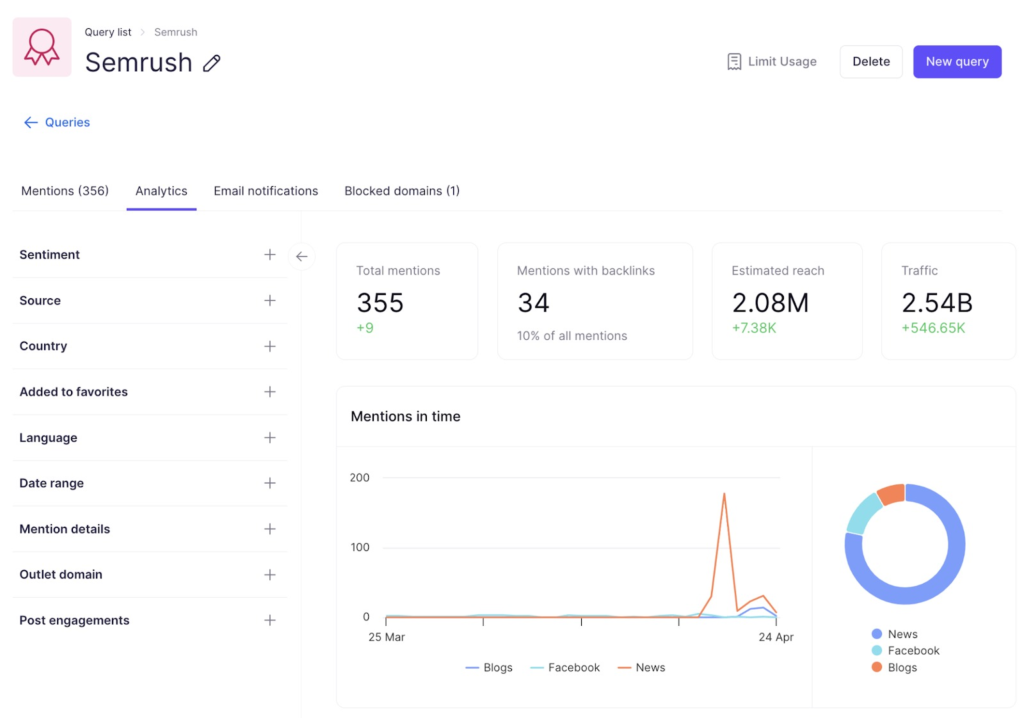
After the manual check, Semrush’s Brand Monitoring tool lets you track where your brand is mentioned across the web and which of those mentions are linking back to your site versus appearing without attribution. In a GEO audit context, this surfaces the off-site content and PR gaps that weaken your brand signal.
The AI Visibility dashboard in Semrush shows which of your tracked keywords trigger AI-generated responses and whether your domain appears as a cited source in those responses. Cross-reference the keywords where competitors are consistently cited but your brand is absent. Those gaps are your off-site content priorities for the next quarter: getting your brand mentioned accurately on sources that AI retrieval systems already trust in your niche.
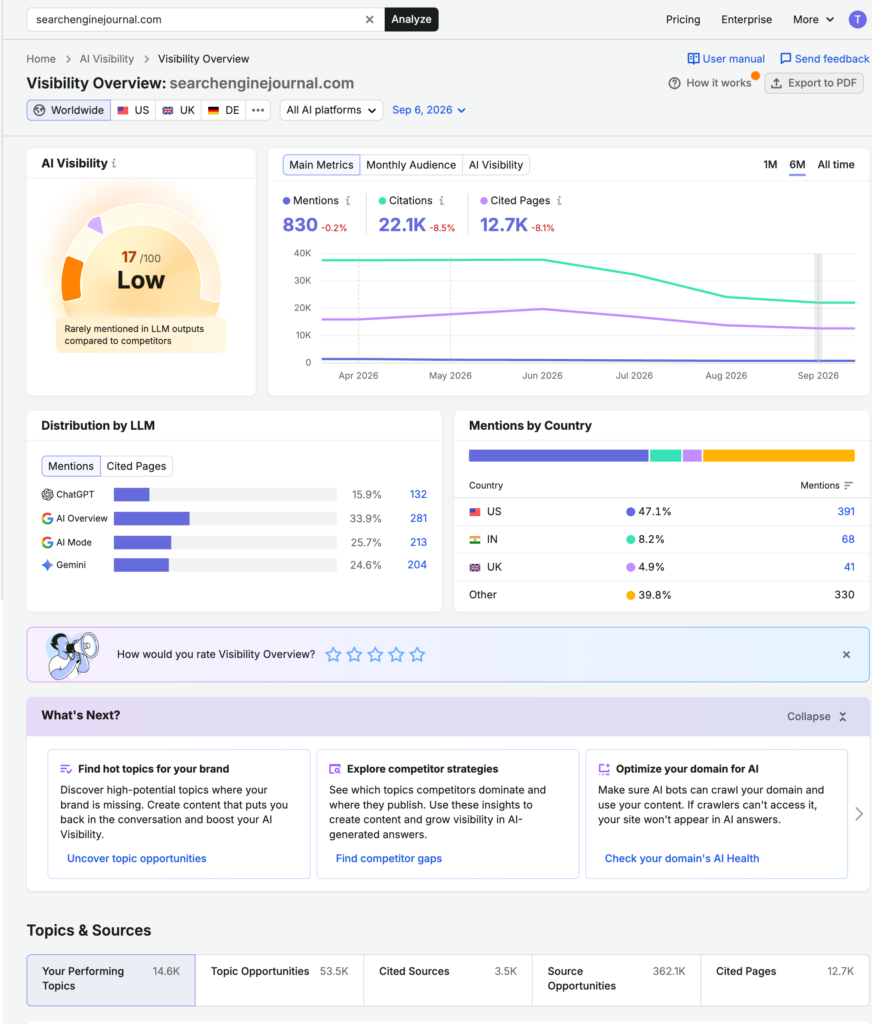
This workflow answers the practical question of how to track brand mentions in Perplexity, ChatGPT, and other platforms systematically. Combining the manual brand search with the Semrush AI Visibility data gives you a prioritised list of off-site improvements rather than a vague instruction to “build more mentions.”
Get your 14-Day Semrush One trial now!
Step 6: Run the Prompt Test Yourself
The most direct GEO audit step is also the one most commonly skipped. Running your own queries through multiple AI platforms gives you real evidence of your current AI search visibility, not an estimate based on proxies.
No tool replaces this check. If you have been wondering how to check if AI tools cite your website, this is the answer: you run the queries yourself. Automated platforms help with tracking at scale. But understanding what ChatGPT, Perplexity, and Google AI Overviews are actually saying about your brand and topic area requires running the prompts yourself.
The Five-Platform Prompt Test Method
Choose 10 to 15 queries your target audience would genuinely ask about your topic area or your brand. Run each one across five platforms: ChatGPT, Perplexity, Google AI Overviews, Claude, and Gemini.
For each query, run it twice. First with web search disabled if the platform allows it (this tests native training data), and second with web search enabled (this tests live retrieval). The gap between the two results tells you something important: if you appear only in live retrieval mode but not in native knowledge mode, your brand exists in current indexes but has not yet made it into model training data. That makes your visibility fragile and dependent on real-time indexation staying consistent.
This native versus RAG distinction is something most guides targeting website owners skip entirely, but it changes how you interpret the results and what you prioritise fixing.
What to Look for in Each AI Response
For every prompt response, log four things:
Is your brand named at all? Is your domain linked as a cited source? Is the information presented about your brand accurate? Is a competitor cited in a position where you expected your brand to appear?
That third check is the one with real consequences. According to AI Labs Audit’s 2026 GEO methodology, hallucinated URLs (links to pages on your domain that do not exist) are a common AI output that most brands never catch. Any URL a model produces that returns a 404 is fabricated. If an AI is generating confident but false information about your products, services, or pricing, that is a trust problem even if the brand is being mentioned.
The fix is not a complaint to the AI provider. It is giving retrieval systems better-sourced, clearly structured information on your own site and on authoritative third-party sources, so future retrieval draws from accurate material.
Prioritising What to Fix After the Audit
A completed GEO audit for website owners typically surfaces more findings than a team can address at once. Fixing everything simultaneously is not realistic. Prioritising by impact and effort is what makes the audit usable.
High-Impact Fixes to Address Immediately
Blocked answer crawlers in robots.txt. If OAI-SearchBot, PerplexityBot, or ChatGPT-User are blocked, fix this before anything else on this list. It takes five minutes and the impact is immediate.
Missing or broken schema on key pages. Particularly Article, FAQPage, and Person schema, which directly support AI retrievability and authorship attribution.
Author bios without credentials or external links. Adding a proper author bio with a name, credentials, and a LinkedIn link is low effort and meaningfully improves the expertise signal on every page that author wrote.
Pages with no verifiable data points. Identify your top five traffic pages. If any contain zero sourced statistics or cited facts, add at least two to three verifiable claims with source links. That single change improves citation candidacy significantly.
Medium-Term Improvements for Sustained Visibility
These take more time but produce durable results rather than quick fixes.
Content restructuring for answer-first paragraph openings is the highest-value medium-term fix. Going through your top 20 pages and rewriting section openers so each one delivers the answer in the first two sentences is meaningful work, but it fundamentally changes how extractable those pages are.
Creating or completing your llms.txt file. Building or correcting entity consistency across Google Business Profile, LinkedIn, and Wikidata. These off-site corrections do not show results overnight, but they strengthen the entity signal that AI systems rely on when deciding how much to trust a source.
For anyone building how to measure AI search visibility for their website into a regular workflow, monthly prompt testing across three to five platforms is the minimum recurring check worth running between full audits.
What a Passing GEO Audit Looks Like
Most guides describe the problems without defining what success looks like. A site passes a basic GEO audit when it meets these conditions:
Answer crawlers are not blocked in robots.txt. Key pages have valid, error-free schema. Each main section opens with a self-contained, answer-first paragraph. Author credentials are visible and linked from a named author bio. The brand description is consistent across at least four public sources. A prompt test across three AI platforms returns accurate, attributed information about the brand for at least half of the core topic queries tested.
That is not a perfect score. It is a working baseline. A site meeting all of these conditions has addressed the structural reasons why AI systems might ignore or misrepresent it.
Conclusion
A GEO audit is not a one-time task. AI platform behaviour changes independently of Google, with each platform updating its retrieval logic, training data, and citation patterns on its own schedule. A site that passes a GEO audit today may need specific updates in three months as model updates shift what gets cited and what does not.
What the audit gives you is a diagnostic baseline. Before running one, most site owners have a rough sense that their AI visibility might be low. After running one, they know which specific layer is the problem: crawler access, content structure, entity signals, trust evidence, off-site consistency, or simply not yet being in the training data of key platforms. Each of those problems has a different fix, and the fix is useless unless you know which layer you are actually dealing with.
For the full picture of how GEO fits alongside traditional SEO and zero-click search strategy, the zero-click search guide covers what happens to your traffic when AI answers the query before anyone clicks, and what to do about it.
If this audit has surfaced gaps across multiple areas and the fixes feel like a significant project to manage alone, that is exactly what a structured AI visibility audit covers. Reach out at my LinkedIn profile.

Ankit Prajapati
Digital Marketing Professional | SEO Consultant | Teetotaller | Music Buff | Early Bird. "Love to do SEO for Humans, not for Bots." As an SEO Consultant, I will identify the opportunities to make your website user-friendly, improve visibility, traffic and leads. I also help SEO freshers and experienced SEO professionals in resolving their SEO errors and their queries for free, which extends my skill sets.
Comments are closed