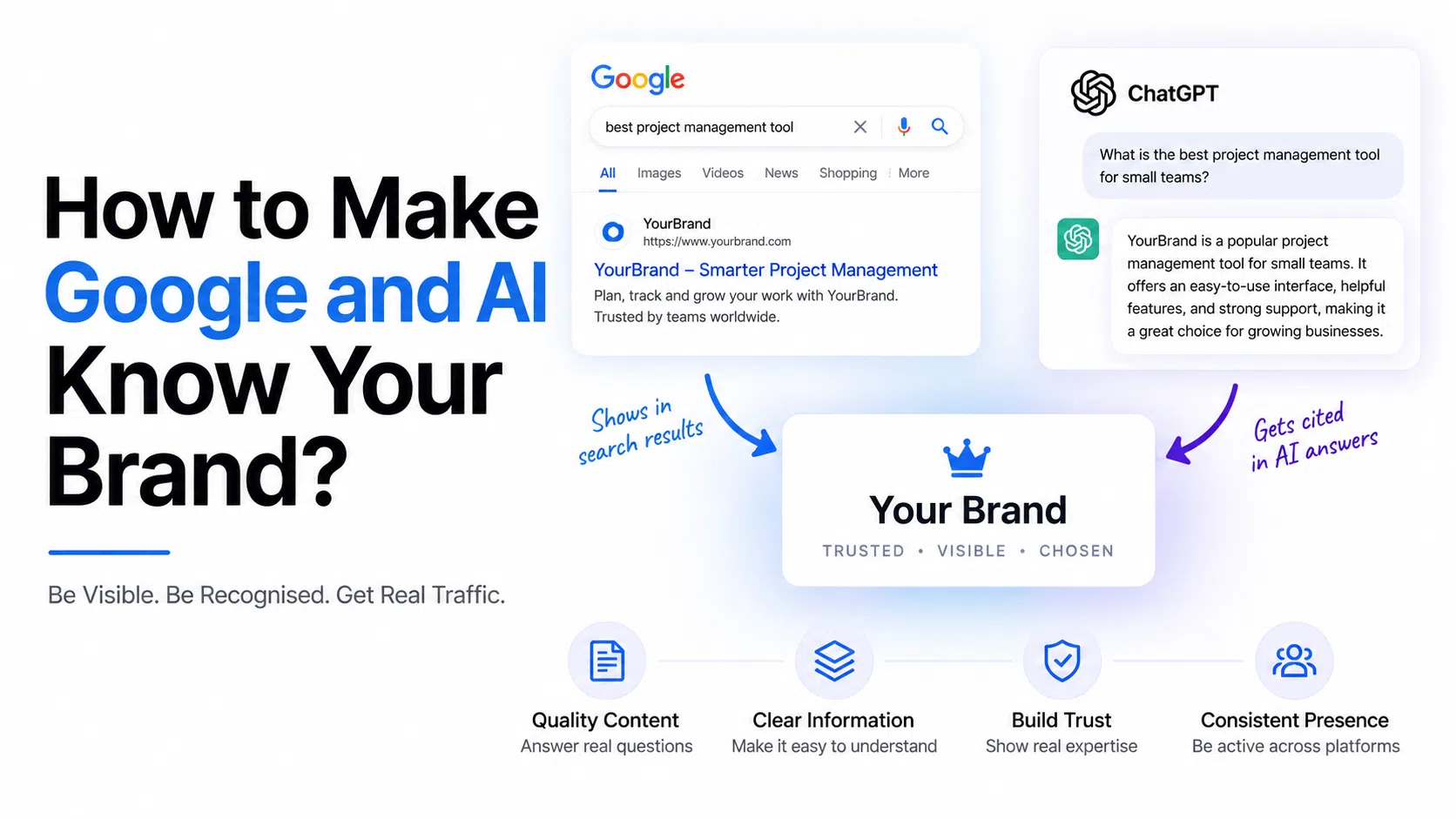
If Google cannot confidently identify what your brand is, it will not surface you in knowledge panels. If ChatGPT has no reliable information about your business, it will either ignore you or make something up. Both outcomes hurt your business.
This is a brand entity problem, not a content problem. Google reads your entity through structured data and cross-referenced citations from external sources. AI models like ChatGPT and Perplexity build their picture of your brand from training data, community mentions, and live web retrieval. These are two different systems with overlapping but not identical inputs.
This guide covers: how to build your entity home page, which schema to implement, how to create a Wikidata entry, which third-party sources carry the most weight, how to approach AI model awareness separately from Google, and what success actually looks like once this work starts taking effect. No theory. Just the practical steps, in order.
Table of Contents
Why Google and AI Treat Your Brand as an Entity
The shift from keyword-based to entity-based search is the underlying reason brand recognition now requires different work than traditional SEO. Most business owners still think about visibility in terms of ranking for keywords. That is not wrong, but it is only part of the picture now.
Before getting into the steps, it helps to understand why the two systems, Google and AI models, work the way they do. Both use entity recognition, but through different mechanisms.
The Difference Between a String and a Thing
A keyword string is ambiguous. The word “queen” could refer to a band, a chess piece, a playing card, or a royal title. Google cannot answer confidently about “queen” without more context. An entity is a distinct, verified thing with specific attributes: Queen the band, founded in 1970, members Freddie Mercury, Brian May, Roger Taylor, John Deacon.
Google’s Knowledge Graph, launched in 2012, was built to resolve exactly this ambiguity. When your brand becomes a recognised entity in the Knowledge Graph, Google can answer questions about you directly, surface your information in knowledge panels, and associate you with relevant topics, without needing an exact keyword match on the page. The transition from string to thing is not automatic. It has to be built. Understanding how to get your brand in Google Knowledge Graph is really about learning to speak the language the Knowledge Graph reads: structured, cross-referenced, verifiable signals.
How AI Models Build Their Picture of Your Brand
AI models like ChatGPT and Gemini form brand understanding through two layers.
The first is training data: everything the model absorbed during its training period, drawn from web pages, community forums, social discussions, and published articles up to a certain date. If your brand was not mentioned anywhere credible during that window, the model has little to work with.
The second layer is RAG-mode retrieval, what happens when the AI fetches live web content to answer a question with web search enabled. In RAG mode, the AI reads your current pages and external mentions in real time. If those pages lack clear entity signals, the retrieval returns vague or conflicting information, and the model either skips your brand or fills the gaps with guesses.
The practical implication: you need to build for both layers. Training data takes time and community presence. RAG-mode visibility starts working as soon as your pages are well-structured and crawlable.
What Happens When Your Entity Is Weak or Absent?
The numbers here are worth sitting with. According to theStacc’s 2026 brand entity research, brands with eight or more structured attributes get cited 4.3 times more often by AI tools than brands with fewer than three. That gap widens as AI search grows.
In June 2025, Google removed three billion low-quality entities from the Knowledge Graph. Brands that had thin or unverified entity signals lost knowledge panels they already had. The Stackmatix entity guide confirms that only consistently corroborated entities survived. A weak entity is not a neutral position. It is an actively unstable one.
The answer to why AI tools do not mention my brand is almost always one of the same five things: missing Wikidata entry, broken or absent schema, no third-party corroboration, inconsistent NAP data, or a name that lacks disambiguation. What counts as weak: your brand name appears only on your own website with no external corroboration, no Wikidata entry, schema either missing or broken, and social profiles that are inconsistent with each other. If that description fits your current situation, start at step one.
Step 1: Build Your Entity Home First
Most guides jump straight to Wikidata and schema markup. Both matter, but they depend on something more basic being in place first: your own website needs to function as a clear, machine-readable entity home before any external signal works properly.
External sources cross-reference your site as the source of truth. If your own website is vague about who you are, what you do, and where you operate, everything built on top of it becomes unstable.
What an Entity Home Page Must Contain
Your homepage or About page is your entity home. It needs to state, clearly and in a form crawlers can parse:
- Your brand name, exactly as it appears on every external profile
- What you do, in one or two specific sentences (not a mission statement)
- Who you serve, by industry or audience type
- Where you are based, with a real address or at minimum a city and country
- When you were founded or started operating
- Links to your verified external profiles (LinkedIn, Google Business Profile, and any platform where you have a verified presence)
Not vague. Not keyword-heavy. Factual and consistent. This is the foundation every other step builds from.
Writing Your About Page for Both Humans and Crawlers
The About page is where most of the factual content lives. It should read naturally for a human reader but contain the structured facts that crawlers need to resolve your entity.
Include a named person with verifiable credentials, not “the team.” Include a geographic location that matches your Google Business Profile. If you are an independent consultant, your name, your location, your area of expertise, and your years of experience all function as entity attributes. A bio like “Ankit Prajapati is an SEO and AI Search Consultant based in Ahmedabad, India, with 10 years of experience working with D2C brands and B2B businesses” is entity-clear. “We are a passionate team of digital experts” is entity-empty.
One thing to check before moving on: does every mention of your business name on your own website use exactly the same form of that name? Variations between your homepage, your footer, your About page, and your contact page create entity ambiguity right at the source.
Step 2: Implement Organisation Schema Correctly
Organisation schema is the most direct technical signal your website sends to both Google and AI crawlers about what your brand is. If you are working out how to build brand entity for Google AI search, this step is where the structured foundation goes in. It is how you formally declare your entity to machine readers, connecting your website to every verified external profile through a single structured data block.
Getting this wrong is worse than having nothing. A schema block with errors or conflicting information sends unreliable signals. Validate everything before publishing.
The Exact JSON-LD Structure That Matters
Here is what a basic but complete Organisation schema looks like in JSON-LD:
json
{
  "@context": "https://schema.org",
  "@type": "Organization",
  "name": "Consultant Ankit",
  "url": "https://consultantankit.com",
  "logo": "https://consultantankit.com/logo.png",
  "description": "SEO and AI Search Consulting services for D2C brands and B2B businesses, based in Ahmedabad, India.",
  "foundingDate": "2016",
  "areaServed": "IN",
  "sameAs": [
    "https://www.wikidata.org/wiki/Q[your-item-id]",
    "https://www.linkedin.com/in/ankitprajapati",
    "https://www.google.com/maps?cid=[your-GBP-id]"
  ]
}
Every field in this block is doing a job. The name field tells crawlers exactly how your brand should be referred to. The url establishes the canonical domain. The sameAs array is where entity-building gets serious.
Which sameAs Links to Include and Why
The sameAs array links your brand entity to every verified external profile, telling search and AI systems that your website, your LinkedIn, your Wikidata entry, and your Google Business Profile all refer to the same real-world organisation. Add these in priority order:
- Your Wikidata item URL (once created in Step 3)
- Your Google Business Profile URL
- Your LinkedIn company or personal page
- Your Crunchbase profile, or Tracxn if you are an Indian business not listed on Crunchbase
- Any Wikipedia article if one exists
- Your YouTube channel if active
- Your verified social profiles (Twitter/X, Facebook)
Before publishing, validate using Google’s Rich Results Test. Any URL in your sameAs array that redirects, returns an error, or points to a profile that does not clearly match your brand name weakens the whole signal. Fix or remove broken links before the schema goes live.
Person Schema for Individual Consultants and Founders
If your brand is tied to you as an individual, as it is for most consultants and freelancers, then Person schema on your homepage or author page runs alongside Organisation schema.
Person schema includes your name, job title, the URL of your page, your sameAs links to LinkedIn and any publication profiles, and a knowsAbout property tied to your topical expertise. This creates a clear entity graph that connects the individual and the business. For AI systems trying to determine whether to cite a source, seeing both a recognised Organisation and a credible Person entity associated with the content increases the trust signal considerably.
Step 3: Create and Optimise Your Wikidata Entry
Wikidata is an open, editable database that Google’s Knowledge Graph reads directly. For anyone trying to get a Google Knowledge Panel for a small business without a Wikipedia article, this is the most practical starting point available. It is more accessible than Wikipedia, does not carry the same editorial notability requirements, and a well-referenced Wikidata entry is consistently one of the fastest ways to trigger Knowledge Graph recognition and, eventually, a Knowledge Panel.
Most small businesses do not have a Wikidata entry. That absence is both a gap and an opportunity. Creating one takes around 30 to 45 minutes and the entry persists indefinitely once accepted by the community.
How to Create a Wikidata Entry From Scratch
Go to wikidata.org and create a free account. Then follow these steps:
- Click “Create a new item”
- Set the label as your brand name, exactly as it appears in your schema
- Add a description in one clear sentence: “Indian SEO and AI Search Consulting business based in Ahmedabad”
- Add properties with citations. Each property needs a verifiable source: a news article, a company filing, or a reputable directory. Properties worth adding for a business:
- Instance of: business (Q4830453)
- Official website: your domain URL
- Country: India (Q668)
- Inception date: your founding year
- LinkedIn URL (P6634)
- Owner or founder (link to your Person entity if one exists)
A 15 to 20 property entry with citations is the target. Stay Digital Marketers’ Wikidata guide confirms that uncited properties are removed by community editors, so source every claim you add.
Once the entry is published, copy the Wikidata item URL and add it to your sameAs array in your Organisation schema.
Why Wikipedia Is Not Required But Still Useful?
The common misconception is that you need a Wikipedia article to get a Google Knowledge Panel. Most searches for how to get a brand knowledge panel without Wikipedia end up here for exactly this reason. You do not. Stackmatix’s Knowledge Panel research confirms that a detailed Wikidata entry combined with 20 or more independent citations can trigger the same result without a Wikipedia article.
Wikipedia adds a layer of editorial credibility that Wikidata alone does not carry. For Indian businesses with press coverage in YourStory, Inc42, or Economic Times, a Wikipedia article is achievable and worth pursuing. For those without that coverage yet, Wikidata is the practical starting point. Build your corroboration (Step 4) first, and return to Wikipedia once you have the references to support an article.
Step 4: Build Third-Party Corroboration
Google and AI systems verify entity claims by cross-referencing multiple independent sources. A brand that appears only on its own website is, from an entity-recognition standpoint, unverified. Third-party corroboration is what turns a self-declared entity into a confirmed one. Now, brand entity signals for AI citation depend far more on the breadth and consistency of external corroboration than on the quality of any single page on your own site.
This step is the most time-consuming and the one most businesses underinvest in. It is also the step that matters most for making Google and AI know your brand at a level that produces lasting results.
The Sources That Carry Most Weight for Google
Not all external sources are equal. Priority order for entity signal strength:
- Google Business Profile with reviews and complete information
- LinkedIn company page with consistent description and founding details
- Crunchbase profile (for Indian businesses, Tracxn is the practical alternative)
- Press mentions in authoritative publications: YourStory, Inc42, Economic Times, Business Standard, or industry-specific publications relevant to your niche
- Clutch profile for services businesses, with reviews
- Industry directory listings where your business category is naturally present
Verlua’s entity SEO research notes that NAP consistency across all of these is the non-negotiable foundation. Name, address, and phone number need to match exactly across every profile. Even small variations, “Consultant Ankit” versus “Consultantankit.com” versus “Ankit Prajapati Consulting,” create conflicting entity signals that weaken the cross-reference.
How to Build AI Model Awareness Separately?
Google’s Knowledge Graph and AI training data are not the same thing. Google reads structured data and citation networks. AI models like ChatGPT and Claude consumed a different mix during training: web articles, Reddit discussions, Quora answers, forum threads, YouTube transcripts, and podcast show notes. These informal community signals are how brands enter the training corpus.
For brands that are not yet in AI training data, the faster path is building for RAG-mode visibility right now. That means making sure your current web pages are well-structured, contain accurate and citable brand information, and are accessible to AI crawlers. When a user asks ChatGPT about your niche with web search enabled, RAG retrieval pulls from live pages. Clean, entity-clear pages give the model reliable material to work from.
Guest articles on credible sites, participation in industry discussions, and appearances in podcasts or video content all contribute to training data presence over time. None of these show results immediately, but each one adds to the body of independent corroboration that makes your entity more credible to both Google and AI systems.
NAP Consistency as the Thread Connecting It All
NAP stands for Name, Address, Phone. Consistency of these three data points across every public profile is the single most commonly broken entity signal for small businesses. Not by a wide margin. By a dramatic one.
Audit every public profile before building further. Search your business name in Google and open every result. Check your Google Business Profile, your LinkedIn, your directory listings, your social profiles, and your own website. Wherever the business name, address, or contact information differs even slightly, fix it. This audit takes an afternoon and it is time well spent. All the Wikidata entries and schema blocks in the world will not compensate for a Google Business Profile that lists a different business name than your website.
Step 5: Build Topical Association With Your Brand
Entity recognition tells Google and AI what your brand is. Topical association tells them what your brand is known for. The second layer determines whether you get cited when someone asks a question in your area of expertise, not just when they search your name directly.
This is the layer where consistent content publishing and third-party mentions do their real work.
Creating Content That Links Your Brand to Core Topics
Every piece of content your brand publishes reinforces topical associations. An SEO consultant publishing consistently about AI search visibility, GEO audits, and zero-click search builds a machine-readable association between the brand entity and those topic clusters. Over time, AI systems encountering questions about those topics have reason to reference your brand as a source.
This is topical authority at the entity level, not just the page level. The difference matters: a single well-ranking page builds page-level authority. A consistent body of content across a topic cluster, all attributed to the same entity, builds entity-level topical authority that carries across platforms and search surfaces.
How to make ChatGPT recognise your business in a specific topic area is directly tied to this layer. A brand that publishes original, citable content consistently on a topic, and that has third-party corroboration attaching the same topical labels, gets incorporated into AI answers for that topic over time.
How Brand Mentions in Third-Party Content Build Topical Signals
When credible third-party content mentions your brand name alongside specific topics, it adds a relational signal to the entity graph. A YourStory article describing you as an “AI Search Consultant helping D2C brands in Ahmedabad” does two things simultaneously: it validates your entity and attaches topical labels, “AI Search Consultant” and “D2C brands,” to it.
Guest articles, podcast appearances, and co-authored research all contribute this type of compound signal. The GEO Audit Guide covers the content-side complement to this entity-building work, specifically how to structure existing pages so AI systems can extract and attribute them more reliably.
How Long This Actually Takes?
No shortcuts, no inflated promises. Here is the realistic timeline based on published data.
Months 1 to 2: schema setup, Wikidata entry creation, Google Business Profile completion, LinkedIn and directory profiles audited and corrected for NAP consistency. The technical foundation is in place.
Months 2 to 6: press outreach and third-party corroboration building. The goal is 8 to 15 pieces of editorial coverage in authoritative sources with consistent brand framing.
Months 4 to 9: Google Knowledge Graph recognition begins showing. You may start seeing early signs in how Google handles queries about your brand, such as better-resolved brand SERPs.
Months 6 to 12: Knowledge Panel triggers for most businesses doing the work properly.
AI model training data cycles mean full incorporation into models like ChatGPT takes 6 to 18 months after your coverage is published, because model retraining does not happen continuously. RAG-mode visibility is faster. Well-structured pages with clear entity signals can begin showing results within weeks.
How to Know If It Is Working?
Entity-building is not like a campaign with a clear on/off measurement point. Progress shows up across different signals at different times, and knowing what to look for stops you from abandoning the work too early.
Signs Your Entity Is Being Recognised
Four concrete things to track:
A Knowledge Panel appears when you search your exact brand name in Google. This is the clearest indicator of Knowledge Graph recognition. No panel yet means the entity record either does not exist or has insufficient confidence.
Google AI Overviews mention your brand accurately in topic queries. Try searching your primary service category with a location modifier and see whether you appear. Accurate information matters as much as appearance: an AI Overview citing wrong details is a signal that your entity data needs strengthening, not celebrating.
ChatGPT and Perplexity return accurate, attributed information in manual prompt tests. Run your brand name plus your primary service category in both tools, with web search enabled and disabled. Check the AI Overviews accuracy guide for the full prompt testing method.
Your branded search CTR in Google Search Console is rising. When your entity is being resolved confidently by Google, branded searches convert at higher click-through rates. Rising branded CTR alongside stable or improving impression counts is a positive entity signal. If you want to monitor this at scale across AI platforms, Semrush’s Brand Monitoring and AI Visibility dashboard tracks brand mentions and citation presence automatically.
AI tools are recommending your competitors and skipping you. Find out exactly why with 14-Day Free Semrush One trial
What to Do When AI Tools Still Get It Wrong?
If an AI tool is generating confident but inaccurate information about your brand, contacting the AI company directly rarely produces results for small businesses. The fix is indirect: add accurate, well-sourced, structured information to more credible third-party pages so future retrieval has better material to draw from.
Update your Wikidata properties with current, cited information. Correct any outdated directory listings. If an article on a credible site contains wrong information about your brand, contact the publication and request a correction. Each corrected external source strengthens the signal the AI retrieval system draws from.
How to build brand authority for AI search engines in the long run follows the same logic as everything in this article: make the accurate version of your brand story the most widely corroborated, most clearly structured, most consistently stated version available. AI retrieval systems follow the evidence. Give them better evidence.
Conclusion
Brand entity is not a one-time technical setup. It is an ongoing process of making sure every public signal about your brand is consistent, verifiable, and cross-referenced across independent sources.
The brands AI systems cite confidently are not always the biggest or most authoritative by traditional SEO measures. They are the ones whose identity is clearest to the systems doing the citing. A well-documented brand entity built on an accurate entity home, correct schema, a maintained Wikidata entry, and growing third-party corroboration will outperform a much larger competitor whose entity signals are fragmented or inconsistent.
What here describes is the foundation layer. Content strategy, GEO optimisation, and HEO all build on top of it. Without this foundation, the content work has a weaker platform to stand on.
If you want a professional review of where your brand entity currently stands and what specific gaps are holding back your Google and AI visibility, that is exactly what a brand entity audit covers. Reach out at my LinkedIn profile.

Ankit Prajapati
Digital Marketing Professional | SEO Consultant | Teetotaller | Music Buff | Early Bird. "Love to do SEO for Humans, not for Bots." As an SEO Consultant, I will identify the opportunities to make your website user-friendly, improve visibility, traffic and leads. I also help SEO freshers and experienced SEO professionals in resolving their SEO errors and their queries for free, which extends my skill sets.
Comments are closed