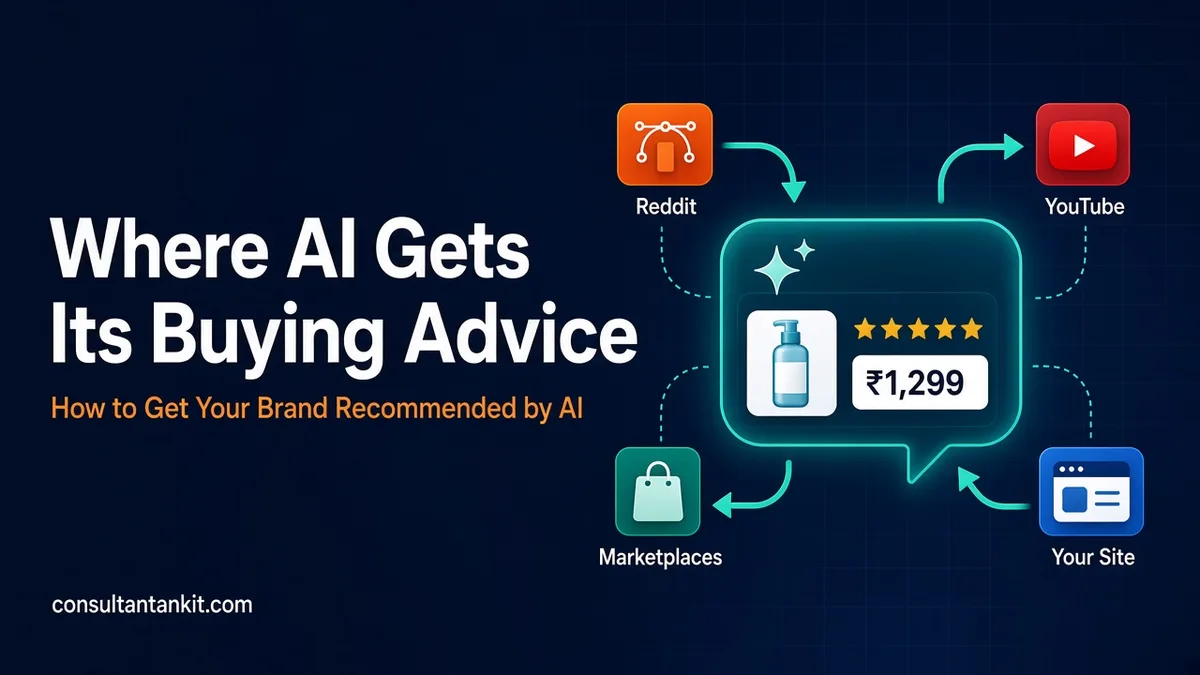
AI shopping answers have two parts. The product cards come from shopping data, such as Google’s Shopping Graph and merchant feeds. The written advice comes mostly from other people’s pages: Reddit threads, YouTube reviews, best-of lists and marketplace category pages. Your own site is one of those sources, but for most buying questions it isn’t the main one.
That’s the uncomfortable bit. In a study of about 1,000 decision-stage prompts, Reddit appeared in roughly 62% of AI answers by Siege Media, although those prompts were mostly about software, not sunscreen or kurtas.
If you’re working out how to get your brand recommended by AI, this guide covers what the citation studies actually say, how ChatGPT, Google AI Mode, Gemini and Perplexity differ, and what an Indian D2C brand should do on Reddit, YouTube, marketplaces and its own website.
KEY TAKEAWAYS:
- AI shopping answers have two inputs: product cards from shopping data such as Merchant Center feeds, and written advice from third-party pages. (Google Shopping Help)
- In 480 Indian skincare and fashion answers, ChatGPT linked YouTube twice and Reddit three times in 408 links, while Perplexity produced 518 of the 534 YouTube citations. (Depra AI)
- 39.6% of the citations in that India study went to “best” or “top” list pages. (Depra AI)
- In Semrush’s 100 test runs, ChatGPT’s top product was in Google Shopping’s first three results 75% of the time.
- Nearly every AI citation study is published by a company selling AI visibility tools or services. Treat the numbers as signals, not laws.
Table of Contents
Where Does AI Get Its Buying Advice From?
When clients ask me how does AI recommend products, my answer is: from two places at once. Most brands only ever work on one of them, and it’s usually the smaller one.
AI buying advice is the answer an AI tool such as ChatGPT, Google AI Mode, Gemini or Perplexity gives to a shopping question. It combines product data (titles, prices, ratings, availability) from shopping feeds and catalogues with written guidance drawn from pages the tool trusts, such as forums, video reviews, editorial lists, marketplaces and brand websites.
This is the off-site half of what we call HEO (Hybrid Engine Optimisation): being found on Google and chosen by AI engines from the same body of work.
Different Sources
Ask Google AI Mode for “best sunscreen under ₹600 for oily skin” and you get two things on one screen: a row of products with prices, and a few paragraphs on what to look for, with small source links.
The products come from shopping data. Google says brands and retailers send product information through Merchant Center and Manufacturer Center, and that this Shopping Graph data is used to “power AI-driven experiences like review summaries, buying guidance, or product recommendations” (Google Shopping Help). The graph also pulls in reviews and YouTube videos from across the web.
OpenAI says ChatGPT picks products using structured metadata from first-party and third-party providers, and already includes Shopify stores through Shopify Catalog (OpenAI Help Center). The paragraphs are a different story. They lean on pages other people wrote.
| Part of the answer | Where it gets its data | What you control |
| Product cards | Merchant Center feeds, Google’s Shopping Graph, Shopify Catalog, other product data providers | Your feed, your product facts, your prices and ratings |
| Written advice | Reddit threads, YouTube reviews, best-of lists, marketplace category pages, brand websites | Only your own pages directly. The rest you have to earn. |
What Do AI Citation Studies Actually Show?
Mostly that third-party pages win, and that the exact numbers swing a lot. These studies from the last year have a clear method and a page that still loads.
| Study | Published | Sample | Market | Headline finding | Who ran it |
| Siege Media (https://www.siegemedia.com/research/ai-buying-advice) | Mar 2026 | ~1,000 decision-stage prompts, 57,095 citations | Mostly B2B software | Reddit in ~62% of answers, YouTube in ~25% | GEO agency (data from Peec AI) |
| Semrush (https://www.semrush.com/blog/most-cited-domains-ai/) | Nov 2025 | 230K prompts, 100M+ citations | Global | ChatGPT’s Reddit citations fell from close to 60% of responses to around 10% within weeks | SEO and AI visibility tool |
| LLM Pulse (https://llmpulse.ai/blog/where-ai-sends-shoppers/) | Aug 2026 | 391,073 citations | US shopping questions | 64.7% to brand, manufacturer and long-tail sites; 2.9% to major retailers | AI visibility tool |
| Depra AI (https://depra.ai/blog/ai-shopping-answers-india-citation-sources) | Sep 2026 | 480 answers, 4,640 citations | India, skincare and fashion | ChatGPT barely cites Reddit or YouTube; Perplexity cites them heavily | AI visibility tool |
| Cited (https://www.getcited.in/blog/get-d2c-brand-recommended-by-chatgpt-india) | Aug 2026 | 742 ChatGPT citations, 7 categories | India D2C | Editorial 28%, brand sites 27%, community 23%, marketplaces 8% | AI visibility tool |
| Pallix (https://pallix.in/blog/ai-visibility-report-india-2026) | May 2026, updated Oct 2026 | 23 brands | India, health and nutrition | Brand sites were the top source cluster in 0 of 23 audits | AI visibility tool |
Reddit and YouTube top most global studies
In the large global datasets, two community platforms keep coming out on top. That holds even though each study counts in its own way.
Profound tracked citations across answer engines from August 2024 to late October 2025 and found Reddit at 3.11% of all citations and YouTube at 2.13%, both ahead of Wikipedia. Three percent sounds tiny. It isn’t, for a single domain.
For decision-stage prompts the share gets much bigger. Siege Media put third-party sources at 80 to 95% of citations depending on the industry, with product pages and homepages at single-digit citation rates. That one stings a bit, if you’ve spent the year polishing PDPs.
What India studies found in D2C categories
India now has a small but useful set of studies. They look at the categories D2C founders actually sell in, and they don’t fully agree with each other.
Depra AI asked 10 skincare and fashion questions from inside India on 14 August 2026, in English and Hinglish, across ChatGPT, Gemini and Perplexity: 480 answers and 4,640 citations. Nykaa was the one site all three engines cited often.
Cited’s August 2026 index found editorial pages were ChatGPT’s biggest D2C source in India, just ahead of brand websites. In Pallix’s audit of 23 health and nutrition brands, community and discussion sources led in 12 audits and commerce and review sources in 9.
Different methods, same direction: your website is in the mix, but it rarely leads.
Why the numbers disagree so much
Because each study measures a different slice. Category, engine, prompt type, date and counting method all change the result.
Take ChatGPT in India. Cited puts community sites at 23% of its D2C citations; in Depra’s data, social platforms were just 1.2% of its links. Cited covered seven categories, Depra two, on a single day. Neither is wrong. They aren’t measuring the same thing.
Timing matters too. Semrush watched ChatGPT cite Reddit in close to 60% of responses in early August 2025, then around 10% by mid-September. And “share of citations” vs “share of answers” gives very different numbers from the same data. So anyone handing you one neat list of the most cited domains in AI Overviews is simplifying.
How to read vendor studies without being misled
Nearly every study here comes from a company selling AI visibility tracking or GEO services, Semrush included (its affiliate link appears later). That doesn’t make the data useless. It changes how you read it.
Before quoting a figure, I check the sample, the dates, the country, the engines, the counting method and what the publisher sells. Reddit itself asked Profound for its Reddit analysis, and Profound says so on the page.
Which Sources Does Each AI Engine Lean On?
Each engine has its own habits. Treating “AI” as one channel is the most common mistake I see Indian D2C teams make.
| Engine | Shopping in India | Leans on most |
| Google AI Overviews and AI Mode | AI Mode shopping live in English (Apr 2026) | YouTube, Reddit, review sites, brand buying guides |
| ChatGPT | Product results in answers; don’t assume in-chat checkout | Google Shopping for cards; brand sites and publishers for text |
| Perplexity | Answered India-based questions in Depra’s study | Reddit, YouTube, Amazon.in, Flipkart |
| Gemini | Gemini app shopping in English and Hindi (Apr 2026) | “Best” and “top” list pages |
| Amazon Rufus | All Amazon.in customers | Amazon listings, reviews and Q&As, plus the web |
Google AI Overviews and AI Mode favour YouTube
Google’s AI features cite YouTube more than any other domain, according to Ahrefs. Given who owns YouTube, nobody should be shocked.
Hasmord’s October 2026 test of 60 shopping questions found YouTube in 47 of 55 AI Overviews (85%), Reddit in 28, and a brand’s own site in 27. Every “how to choose” Overview cited at least one brand’s page, usually a buying guide.
Small sample, one run. But if you’re working out how to get cited in AI Overviews as a brand, that buying guide format is the clearest lead I’ve seen.
ChatGPT pulls product cards from Google Shopping
This one surprised a lot of people. When ChatGPT shows a product carousel, the products track Google Shopping closely.
Semrush ran the same shopping prompt 100 times and found ChatGPT’s top product sat in Google Shopping’s first three results 75% of the time (Semrush (https://www.semrush.com/blog/chatgpt-searches-google-shopping/)). For the written part in India, 33.1% of ChatGPT’s links in Depra’s data went to brand websites, led by Minimalist’s own site (Depra AI (https://depra.ai/blog/ai-shopping-answers-india-citation-sources)).
So if you’re figuring out how to get your product recommended by ChatGPT, start with your Google Shopping listing. Not a Reddit campaign.
Perplexity cites Reddit and YouTube far more
Perplexity is the most community-heavy engine in the India data. It also links far more sources per answer than ChatGPT does.
In Depra’s study, Perplexity produced 3,068 of the 4,640 citations, including 518 of the 534 YouTube citations and 182 of the 191 Reddit ones (Depra AI (https://depra.ai/blog/ai-shopping-answers-india-citation-sources)). Depra used Perplexity’s Sonar model rather than the app, so treat it as directional. If Perplexity matters to your buyers, community and video are where you need to be.
Gemini leans heavily on best-of list pages
Gemini’s habit is lists. If someone asks me what sources does Gemini use for shopping questions, the honest answer from the India data is “best X” and “top X” articles, mostly.
In Depra’s study, 65.0% of Gemini’s citations pointed to URLs with “best” or “top” in the path, against 39.5% for ChatGPT (Depra AI (https://depra.ai/blog/ai-shopping-answers-india-citation-sources)). One article on the best kurta set brands collected 113 citations across the three engines. Google says shopping in the Gemini app works in English and Hindi in India, with AI Mode shopping live in English (Google India Blog (https://blog.google/intl/en-in/products/explore-communicate/new-ways-google-is-using-ai-to-make-shopping-easier/)).
Amazon Rufus starts from Amazon’s own catalogue
Rufus is a different animal. It lives inside the Amazon app, and its answers lean heavily on Amazon’s own listings, reviews and Q&As.
Amazon says Rufus is available to all customers in India and, on a product page, answers from listing details, customer reviews and community Q&As, adding information from across Amazon.in and the web (About Amazon India (https://www.aboutamazon.in/news/retail/rufus-ai-shopping-assistant-launch-in-india)). So for Rufus, your listing copy, reviews and Q&A section are the source. Your own website is a weak lever there.
How Should a D2C Brand Show Up on Reddit?
Carefully, and as yourself. Reddit is cited a lot, but it’s also the easiest place to damage a brand in a week. Here’s what Reddit SEO for AI looks like done honestly.
Find the Indian subreddits AI already cites
Don’t start by posting. First find out which communities AI already pulls from for your category, and what people there actually say.
In Depra’s India data, the cited threads came from Indian subreddits such as r/IndianSkincareAddicts (82 citations), r/IndianFashionAddicts (42), r/BuyItForLifeIndia (16) and r/SneakersIndia (10) (Depra AI (https://depra.ai/blog/ai-shopping-answers-india-citation-sources)). Your category will have its own.
Ask your top buying questions on Perplexity and Google AI Mode, note every Reddit thread linked, and read them properly. That’s your brief.
Answer as yourself and disclose your connection
Reddit’s own rules make this simple. Rule 2 asks you to “participate authentically in communities where you have a personal interest” and not to manipulate content, and Rule 5 says “do not intentionally mislead others or impersonate an individual or entity in a deceptive manner” (Reddit Rules (https://redditinc.com/policies/reddit-rules)).
So answer from an account that says who you are. Answer the question actually asked, mention your product only when it fits, and say plainly that you work for the brand. Many subreddits ban self-promotion outright, so read their rules first.
Profound found the average Reddit post cited by AI is about one year old (Profound (https://www.tryprofound.com/blog/the-data-on-reddit-and-ai-search)), so a good answer you write this month may only start getting cited next year.
What gets brands banned or quietly ignored
Most shortcuts are exactly what Reddit’s rules forbid, and they tend to backfire in the very threads AI reads.
| Do | Don’t |
| Reply from a clearly named brand or founder account | Create fake “customer” accounts |
| Answer the question, even when a competitor fits better | Seed threads asking about your own brand |
| Share specifics: ingredients, sizes, price in ₹, return terms | Buy upvotes or comments |
| Take complaints in public and fix them | Argue with every negative comment |
| Follow each subreddit’s self-promotion rules | Paste the same link across ten subreddits |
Depra notes that nothing in its data shows seeded threads get cited. The brand risk is very real, though.
How Do You Get Your Products Into YouTube Answers?
By getting talked about on YouTube, by name, in videos your buyers actually watch. YouTube is the one source that shows up strongly in Google’s AI answers and in the correlation research.
Ahrefs studied 75,000 brands and found YouTube mentions had the strongest correlation with AI visibility of any factor it tested, about 0.737, ahead of branded web mentions at 0.66 to 0.71. Correlation, not proof. In a Google-commissioned Ipsos study, 94% of Indian festive shoppers who used AI chatbots also turned to Google Search, and 87% to YouTube.
Send products to creators your buyers watch
Start with review channels your buyers already trust. For a skincare brand, maybe a dermatologist’s channel; for a ₹2,000 earbud brand, a Hindi tech reviewer.
Send product, not scripts, and accept that some reviews will be mixed. The same Google India research says 73% of festive shoppers surveyed look to online creators for inspiration. A lukewarm but honest review from a trusted channel beats a glowing one nobody believes.
Say the product name clearly in videos
Sounds obvious. It gets missed all the time, even by big channels, and it’s the cheapest fix in this post.
Ahrefs counts a YouTube mention as the brand name appearing in a video’s title, transcript or description. If a creator says “this serum” for ten minutes and never names it, the transcript has nothing to match. Ask for the full product name at least once on camera.
Write titles, descriptions and chapters people search
Titles, descriptions and chapters are text, and text is what machines read most easily. Write them the way a buyer would phrase the question out loud.
“[Brand A] vs [Brand B] sunscreen for oily skin, 30-day test” beats “My honest thoughts!!” every time. Add chapters like “Price in ₹” and “Who should skip it”. Google’s Shopping Graph pulls in YouTube videos, so clear text helps match a video to the right product.
Publish your own comparison and how-to videos
Your own channel counts too, even a small one. Brand videos that answer real buying questions can be cited like anyone else’s.
The best formats are boring on purpose: how to choose, how you compare with the category leader, how to use it, what it’s not good for. Put the price in ₹ on screen and use variant names exactly as they appear on your listings.
Make Hindi and Hinglish versions where buyers are
Plenty of Indian buyers search and ask in Hinglish. AI answers to those questions don’t always cite the same sources as English ones.
In Depra’s study, Gemini showed a citation in 72 of 80 English answers but only 33 of 80 Hinglish ones, while YouTube’s citations held steady across both languages. That makes Hindi or Hinglish video a safer bet, especially if many orders come from outside the metros.
Label paid deals under ASCI and YouTube rules
If money, free product or any perk changed hands, the video has to say so. In India this isn’t optional.
ASCI’s influencer guidelines require a clear disclosure label such as #Ad whenever there is a “material connection” between brand and creator, and that includes free or discounted products, not just payment (ASCI (https://www.ascionline.in/social/wp-content/uploads/2025/04/ASCI-Influencer-Guidelines.pdf)). YouTube separately asks creators to select the paid promotion option, which adds a disclosure label at the start of the video (YouTube Help (https://support.google.com/youtube/answer/154235?hl=en)).
Do Marketplaces and Best-Of Lists Still Matter?
Yes, but not the way most D2C teams assume. Marketplaces get cited through category pages, and best-of lists quietly carry a big share of AI buying advice.
Cited found marketplaces were only 8% of ChatGPT’s D2C citations in India. In the US, LLM Pulse found ChatGPT cited amazon.com just 6 times in its whole sample. Your Amazon A+ content still sells. It’s just not your main AI lever.
Fix category, price band and titles on listings
When AI does cite an Indian marketplace, it usually links a category or price-band page, not your product page. So the filters matter more than the copy.
Depra found the cited Nykaa, Amazon.in, Flipkart and Meesho pages were category, search and price-band listings, such as a Nykaa page for face wash under ₹500. If your product sits in the wrong category, or your price puts it just outside a common band, it isn’t on the page the answer links to. Check the category is the most specific correct one, the title states product type, key attribute and size in plain words, and price and pack size match your own site.
Get into the best-of lists AI already cites
List pages are the quiet giant here. 39.6% of all citations in Depra’s India study went to URLs with “best” or “top” in the path, many of them on small Indian review blogs and other brands’ blogs.
Find the lists cited for your top questions and send the authors samples and facts they can verify: ingredients, test results, price, return terms. Paid placements need a disclosure. Consistent mentions on independent sites also help Google and AI recognise your brand as an entity in the first place, which I’ve covered in how to make Google and AI know your brand.
Some brands publish their own “best X in India” lists, and Depra saw those cited too. Include competitors honestly, or it’s just an ad in list format.
What Should Your Own Website Do Differently?
Your site still matters. It’s just not the whole game. Publish the pages AI is happy to quote from a brand, and keep your product facts clean everywhere.
LLM Pulse‘s US shopping data found 64.7% of citations went to brand, manufacturer and long-tail sites, so brand-side pages do get cited. But Hasmord found only 1 of 11 “X vs Y” AI Overviews cited one of the compared brands’ own sites. In comparisons, other people describe you.
Publish how-to-choose guides for your category
This is the page type with the best evidence behind it. Every “how to choose” AI Overview in Hasmord’s test cited at least one brand’s own page, usually a buying guide.
Write the guide a good shop assistant would give: how to choose a sunscreen for oily skin, or what size of pressure cooker a family of four needs. Answer first, explain trade-offs, give price ranges in ₹, and recommend your product only where it genuinely fits.
Write honest comparison pages that name competitors
Comparison pages were the most cited URL type in Siege Media’s study. The catch: a brand comparing itself rarely gets cited for “X vs Y” questions, as Hasmord’s data showed.
So make yours worth citing. Name competitors, use a fair table, and say where the other product is better. A page that wins every single row reads like an ad. Because it is one.
Keep product facts identical across site and feed
AI tools pull product facts from feeds and pages and compare them. When your site says ₹799 and your feed says ₹849, you’ve given them a reason to doubt both.
Price, stock, size, variant names, GTIN and ratings should match on your page, in your structured data and in your feed. My product page SEO checklist covers how to check each one.
Get products into Google Shopping via Merchant Center
If you skip everything else here, don’t skip this. Google Shopping data feeds Google’s AI answers and, going by the Semrush test, ChatGPT’s product cards too.
The Shopping Graph covers more than 50 billion products, with 2 billion updated every hour, according to Google (Google India Blog ()). Your catalogue should be in it, with complete and accurate data.
Let OAI-SearchBot and Googlebot crawl your pages
AI can’t cite a page it isn’t allowed to read. Check your robots.txt before you spend a rupee on new content.
OpenAI says sites that opt out of OAI-SearchBot “will not be shown in ChatGPT search answers, though can still appear as navigational links”. You can block GPTBot (training) and still allow OAI-SearchBot (search). Pallix’s audit flagged Yoga Bar for GPTBot being blocked or not clearly allowed, so this isn’t hypothetical.
Collect reviews and leave the negative ones visible
Reviews feed AI answers directly. OpenAI says ChatGPT’s review summaries are built from reviews on public websites (OpenAI Help Center, and Google’s Shopping Graph uses reviews as well.
Ask every buyer for a review and don’t hide the bad ones. India’s IS 19000:2022 standard on online consumer reviews, voluntary from 25 November 2022, exists to protect shoppers from fake and deceptive reviews (The Hindu). A 4.3 with real complaints visible is more believable than a perfect 5.0. I suspect AI thinks so too.
Answer buyer questions in English and Hinglish
Your buyers don’t all ask in English. Hinglish shopping queries are real, and Pallix built its audit around prompts like “Rs 2000 mein kaunsa whey protein acha hai?”
Add a short Q&A block to key pages, with a few Hinglish questions where it suits your audience. Depra saw Minimalist’s own site cited more often on ChatGPT for Hinglish questions than English ones, 20 times against. 9. Worth testing in your category.
Where Should an Indian D2C Brand Start?
With your own questions, not with a tool or an agency pitch. Ten buying questions, four engines, two languages. That alone will tell you more than every study in this post.
| When | What to do | Why |
| This month | Ask your top 10 buying questions on all four engines, in English and Hinglish, and log every cited domain | Shows which sources matter in your category |
| Next 3 months | Fix Merchant Center and marketplace categories, get into 2 or 3 cited lists, publish one how-to-choose guide | The quickest levers you control or can earn |
| Ongoing | Honest Reddit answers and disclosed YouTube creator reviews | Slow, but it’s what AI quotes at decision time |
To track this over time instead of in a spreadsheet, Semrush lets you track your brand’s visibility across AI platforms and compare your share of voice with competitors.
The short version: AI recommends you mostly on what other people say about you. Make that easy to find, and true.
Not sure where AI looks for your category? I’ll map it in one audit.

Ankit Prajapati
Digital Marketing Professional | SEO Consultant | Teetotaller | Music Buff | Early Bird. "Love to do SEO for Humans, not for Bots." As an SEO Consultant, I will identify the opportunities to make your website user-friendly, improve visibility, traffic and leads. I also help SEO freshers and experienced SEO professionals in resolving their SEO errors and their queries for free, which extends my skill sets.
Comments are closed