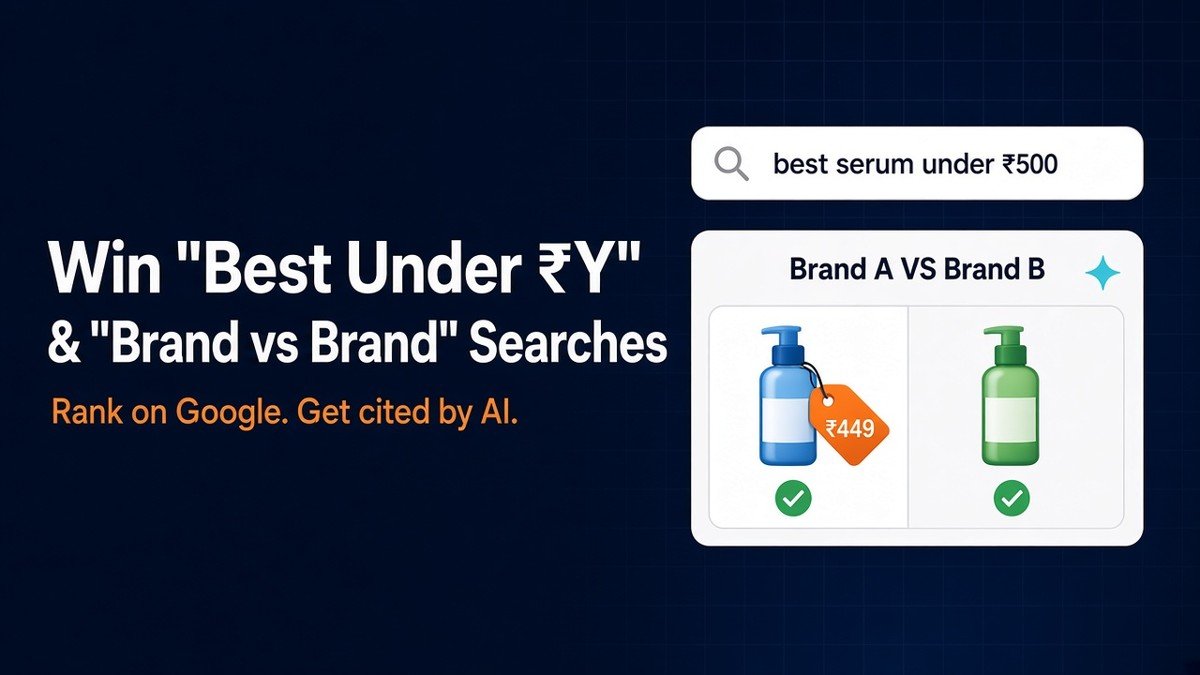
To win “best X under ₹Y” and “Brand vs Brand” searches, you need pages that give a quick verdict and back it with facts anyone can check. A budget search wants a short, dated list inside a price band. A brand vs brand search wants a fair table and a clear “pick this one if” answer.
There’s a catch, though. Right now most of these results go to publishers, affiliate blogs and marketplaces, not to brands. So winning also means showing up on the lists that already rank.
This guide is my practical answer to how to rank comparison pages on google and in AI answers. You’ll see who wins these searches today, how AI Overviews and ChatGPT treat them, how to build both page types, how to get onto other people’s lists, and how to keep prices honest.
KEY TAKEAWAYS
- Budget and comparison searches are decision searches. The page that wins gives a verdict first and proves it with dated, checkable facts.
- A D2C brand can own its price band pages and vs pages, influence third-party lists and creator round-ups, and can’t control marketplace filter pages or AI answer wording.
- AI Overviews show up on almost every “best” or “vs” search, so a page has to work as a source, not just as a ranking.
- Being cited by AI is not the same as being recommended. Pages that crown themselves get read and then overruled.
- In India, comparisons that name a competitor must follow ASCI Code Chapter IV: clear, factual, capable of substantiation, and not denigrating.
What Do “Best Under ₹Y” and “Brand vs Brand” Searchers Want?
Both are commercial investigation searches. The person has already decided what they want to buy and is now choosing which one, so they want help deciding, not a lecture on the category.
In one line: A “best X under ₹Y” search asks for a short, trustworthy shortlist inside a fixed budget. A “Brand A vs Brand B” search asks for a verdict on which of two known options suits the searcher better, with the evidence to back it.
| Query type | What the searcher has decided | What they still need | Page that answers it |
|---|---|---|---|
| Best X under ₹Y | The product type and the budget | Which few options are worth it, and why | A price band page with clear rules and dated prices |
| Brand A vs Brand B | The two finalists | Which one fits their use, and where each falls short | A fair comparison with a verdict, a table and “choose them if” |
Budget searches want a shortlist, not a catalogue
Someone typing “best face wash under ₹500” doesn’t want 87 products sorted by popularity. They want five or six good options and a reason for each.
That’s why a plain category page with a price filter often loses to a written list. The filter shows everything under ₹500. The list says which ones are worth the money and for whom, oily skin, sensitive skin, a student budget.
Brand vs brand searches want a verdict first
“Minimalist vs The Derma Co” is not a research project for the searcher. They’re one click away from buying one of them, and they want someone to say which suits them.
So the verdict has to come first, in plain words. Everything after it is proof for the reader who doesn’t fully trust you yet, which, honestly, is most readers.
Who Wins These Searches Today, and What Can You Own?
Search any “best under ₹500” query and count the brand sites in the top five. Usually it’s zero, and knowing why tells you where to put your effort.
On 9 November 2026 I ran a few of these through a regular web search (not a location-locked Google India check, so treat it as a sample, not a ranking report). “Best face wash under 500 in India” returned NDTV Shopping, ShopperLuxe, khadijabeauty.com, iDiva and the Flash AI blog. “Minimalist vs The Derma Co” returned review blogs, a coupon site, HealthShots and a Reddit thread. Neither brand’s own site was in the top five for its own comparison. “Best phones under 20000” went to 91mobiles, Smartprix, Beebom and Moneycontrol.
| Page type | Examples from the sample | Why it ranks | Can a D2C brand beat it? |
|---|---|---|---|
| Publisher shopping desks | NDTV Shopping, iDiva, Moneycontrol | Strong domains, constant fresh lists | Rarely head on. Better to get listed on them |
| Affiliate and review blogs | ShopperLuxe, khadijabeauty.com, thecarereview.com | Narrow topics, many products, frequent updates | Sometimes, with better evidence |
| Spec and price sites | 91mobiles, Smartprix, Beebom | Huge catalogues with dated prices | Not in electronics. Possible in niches they skip |
| Coupon sites | couponmoto.com | Brand name plus “vs” pages at scale | Yes, with a genuinely useful vs page |
| Community threads | Reddit r/KultUpdates | Real opinions, which Google and AI both like | You can’t own it. You can take part honestly |
Google isn’t against these sites. Its spam policy says good affiliate pages add value such as price information, original product reviews, rigorous testing and ratings, and product comparisons (Google spam policies). That’s the bar you’re competing against.
Publisher shopping desks and affiliate listicles hold top spots
These sites win because they publish a new list every week, on domains Google already trusts. A ₹300 face wash round-up on a big news brand’s shopping section starts with years of authority you don’t have.
You won’t outrank them on the broad version of a query. You can still get onto their lists, which section 6 covers, and you can beat them on narrower bands they don’t bother with.
Marketplace price filter pages rank without any copy
Amazon.in, Flipkart and Nykaa pages for “under ₹500” often rank with almost no written content. The page is the product grid.
You can’t control those pages. What you can control is whether your product sits in the right category at the right price, so it actually appears on them.
Reddit threads and coupon sites fill the gaps
When no good comparison exists, Google fills the space with whatever it has. For many Indian D2C pairs that means a Reddit thread from two years ago or a coupon site with a thin “X vs Y” page.
That’s a gap, not a wall. A coupon page that compares two serums without testing either is easy to beat with an honest page from someone who actually knows the products.
What a D2C brand can own, influence or not
This is the split I use when I plan these pages for a store. It stops the team from spending months on things that won’t move.
| You own | You can influence | You can’t control |
|---|---|---|
| Your price band pages and buying guides | Third-party “best under ₹Y” lists | Marketplace filter pages and their ranking |
| Your vs pages and “choose them if” sections | Creator round-up videos | Which publishers rank in the top five |
| Product facts: price, size, ingredients, specs | Reddit and forum discussion | How an AI answer words its recommendation |
This is HEO (Hybrid Engine Optimisation) in practice: on-site pages and off-site mentions working together, because neither one wins these searches alone. I’ve written about the full approach in my HEO pillar guide.
How Do AI Overviews and ChatGPT Handle These Queries?
Three beliefs keep coming up when I talk to brand teams about this. Each one is partly wrong, and the data, even with its caveats, shows where.
AI Overviews show up on almost every comparison search
The belief: AI Overviews are mostly for “what is” questions, so comparison pages are safe. Not really. In Serplify’s October 2026 study, 68 of 70 “best” or “vs” searches showed an AI Overview (Serplify). That was US desktop results on one day, and Serplify sells rank tracking, but the direction is clear.
What it means for your page: it has to work as a source. A clear verdict, a real HTML table and dated facts are the parts an AI answer can lift.
ChatGPT treats your price cap as a loose limit
The belief: if a shopper says “under ₹1,000”, AI only shows products under ₹1,000. In AEOsome’s study of ChatGPT shopping answers, 14.3% of the products surfaced for capped price questions were above the stated cap, across 20,162 priced product slots (AEOsome). The prompts used US dollar caps and AEOsome is a vendor.
So a clear, readable price on your page matters more, not less. If the AI can’t read your price, it guesses, and a guess can push you out of the band you belong in.
Being cited does not mean being recommended
The belief: if AI cites my page, it recommends my product. Geoptimizer reports that ChatGPT cited at least one of the two compared brands’ own sites in 96.8% of “X vs Y” software prompts, yet when Google AI Overviews cited a “best” list where the vendor ranked itself first, that vendor was left out of the recommendation 69% of the time (Geoptimizer). Software, not shopping, and second-hand data from Minuttia and Lily Ray, so read it as a signal.
Your page can be read and still lose the recommendation. Pages that admit where a rival wins give the AI something believable to quote.
How Do You Build a “Best Under ₹Y” Page That Ranks?
If you’re working out how to rank for best under price keywords, start with the band, not the product. I’ll use one illustrative example through every step: a skincare brand with a ₹449 niacinamide serum, targeting “best serum under ₹500”.
The example brand is made up. The steps are what I’d actually do.
Pick price bands Indians actually type into Google
People don’t search “under ₹463”. They search round breakpoints like ₹299, ₹499, ₹500, ₹999, ₹1,000 and ₹1,999, and the right ones differ by category.
Check two places before you build anything. First, your Search Console queries containing “under”, “below” or “₹”. Second, a keyword tool. I use Semrush to pull every “under ₹” and “below” modifier for a category and see which bands rivals already rank for. (Disclosure: this is an affiliate link. I may earn a commission at no extra cost to you.)
In the example: “under 500” and “under 300” both show up for serums. The ₹449 product only fits one of them, so the page targets ₹500.
Choose a collection page or a buying guide
This decision trips up a lot of stores. A collection page works when you have five or more of your own products in the band and the searcher mostly wants to browse and buy.
A buying guide works when the honest answer includes other brands. Most “best” searches are the second kind, because readers expect a fair list, not your catalogue with a new heading.
In the example: the brand has two serums under ₹500. That’s not a collection. It’s a guide.
Write inclusion rules before you pick any product
Decide the rules first and show them on the page: price at the time of checking, key ingredient strength, availability on at least one major Indian marketplace, a minimum number of reviews. Then pick the products that pass.
This one step does more for trust than any design choice. It also protects you from the quiet temptation to slip your own slow seller onto the list.
In the example: “Under ₹500 on the brand site or Nykaa on the date checked, 5% to 10% niacinamide, at least 100 reviews.”
Show rupee prices with a visible checked date
Indian shoppers are used to this already. 91mobiles shows “Prices as on 09 Nov 2026” on its phones under ₹20,000 page, and Smartprix says its list was “last updated on Nov 09, 2026”.
Do the same. A “price checked on” line under the table tells the reader and the crawler that the numbers are current.
In the example: one line under the table, “Prices checked on 9 November 2026 on brand sites and Nykaa.”
Include rival products when they genuinely fit the band
Here’s where most brand-written lists fall apart. They include four of their own products and one rival that’s clearly worse.
Google’s review guidance asks you to “cover comparable things to consider” and, when you call something best, to “include why you consider it the best, with first-hand supporting evidence” (Google Search Central). It also suggests linking to multiple sellers. If a rival’s serum is the better pick for sensitive skin, say so. Readers notice.
In the example: the list has seven serums, two from the brand, five from others, and the brand’s own product is ranked third for oily skin and isn’t the pick for sensitive skin.
Use Product markup and skip the carousel myth
Mark up your own products with Product and Offer schema, and make sure the price in the markup matches the visible price and your feed. I’ve covered the full setup in my product page SEO checklist, so I won’t repeat it here.
Now the myth. Some guides say ItemList markup will get your “best” list a carousel. Google’s carousel documentation lists only four supported types: Course list, Movie, Recipe and Restaurant (Google carousel docs). Products aren’t on it. Review stars have a limit too: Google treats reviews of your own business on Organization or LocalBusiness pages as self-serving and won’t show stars for them (Google review snippet docs). And there’s no “ComparisonTable” type on schema.org at all, whatever some posts claim.
How Do You Write a Brand vs Brand Page AI Will Quote?
If you’re figuring out how to create a competitor comparison page, start with one rule: if your page wins every row, nobody will believe it. Not readers, not Google, not the AI answer that reads it.
Here’s the page, top to bottom, with the reason each block exists.
- Verdict (first screen). Two lines: who should pick you, who should pick them. Skimmers and AI answers take this part.
- Comparison table. Six to eight rows of things buyers actually weigh, with real values. This is what gets lifted into answers.
- When to choose them. A short section on where the rival is the better buy. It makes everything else credible.
- Proof. Test notes, photos, review excerpts, lab reports where you have them.
- FAQ. The follow-up questions buyers ask, in their own words.
- Sources with dates. Where each competitor fact came from and when you checked it.
Open with a two line verdict for each buyer
Write it like you’d say it to a friend at the counter. “Pick ours if you have oily, acne-prone skin and want fragrance-free. Pick theirs if you want a lighter texture and don’t mind paying ₹100 more.”
No hedging, no “it depends” without saying on what. If the honest verdict is that the rival suits most people better, you probably shouldn’t build this page yet.
Build the table in HTML with dated rows
Use a real HTML table, not an image and not JavaScript tabs that hide rows until someone clicks. Crawlers and AI tools read plain HTML easily. Hidden or rendered content is a gamble.
Put values in the cells, not ticks. “₹449 for 30 ml” says more than a green check mark, and a “checked on” date under the table covers you when the rival changes pack size next month.
Add a section on when to choose them
This is the section brands resist most, because it feels like handing a sale to a rival. It’s also the one that makes the rest of the page believable.
Keep it short and specific: two or three situations where their product is the better buy. Then stop. You’re not obliged to argue against it.
Stay inside ASCI Chapter IV rules on comparisons
Indian brands have a clear rulebook here, and almost no ranking guide mentions it. The ASCI Code, Chapter IV, allows ads that compare with and even name a competitor, provided the comparison meets these conditions.
ASCI Chapter IV checklist for your vs page
- It’s clear which aspects of your product are compared with which aspects of theirs.
- The points of comparison aren’t picked to give you an artificial advantage or suggest a better bargain than is true.
- Every comparison is factual, accurate and capable of substantiation.
- Nothing is likely to mislead the consumer about either product.
- You don’t unfairly denigrate, attack or discredit their product, directly or by implication.
- You don’t make unjustifiable use of their name, or take unfair advantage of the goodwill attached to their trademark.
This isn’t legal advice. If a claim is borderline, like a lab result against a named rival, have a lawyer read it before it goes live.
Cover rival pairs that do not include you
Someone searching “Brand A vs Brand B” might be a better fit for Brand C, which is you. Most brands never think about these searches.
You can write a fair comparison of A and B, then add a short “if neither fits” section that mentions your product, only when it genuinely solves a gap both have. Do it with a wink and it reads as a sales trick. Do it straight and it’s useful.
How Do You Get Onto Other People’s “Best Under ₹Y” Lists?
The list you’re not on matters more than the one you write. For most budget searches, the top five belong to other sites, so your job is to be worth including.
I covered why best-of lists carry so much weight in AI answers in where AI gets its buying advice. This section is about the practical side: getting on them honestly.
Pull the list pages ranking for your price band
Search your three or four most valuable bands and note every list in the top ten. Then run the same queries in AI Overviews, ChatGPT and Perplexity and note which lists get cited.
Why it works: the overlap between the two is your shortlist. Those lists earn you both clicks and AI mentions.
Check whether each list is editorial or paid
Look for an author name, a testing note, a disclosure and some sign that products were actually used. Some lists are clearly editorial. Others are sponsored placements dressed up as reviews.
Why it works: editorial lists are worth pitching. Paid placements carry a different risk, which comes up in a moment.
Send samples with facts a writer can verify
Writers need things they can check: ingredient percentages, lab reports, MRP and current selling price, pack size, return policy. Give them that, plus a sample, with no pressure on the verdict.
Why it works: Google’s review guidance asks writers to back “best” claims with first-hand evidence. You’re making their job easier.
Offer an affiliate rate only with clear disclosure
Many Indian list sites earn through affiliate links, and that’s fine. Offer a standard rate, ask that links are disclosed and marked properly, and never tie the commission to a ranking position.
Why it works: Google’s spam policies say affiliate links “treated appropriately” aren’t a problem. Undisclosed deals are a problem for everyone involved.
Brief Indian creators on honest budget round-up videos
YouTube round-ups like “best serums under ₹500” often show up next to written lists. Brief a creator with the same facts you’d give a writer and let them say what they think, including the bad bits.
Why it works: honest round-ups get watched and quoted. Scripted praise gets skipped.
Ask writers to correct wrong prices and specs
Lists go out of date fast. If a page shows your old price or a discontinued size, email the writer with the correct details and a source.
Why it works: it’s the easiest win in this whole section, and writers usually appreciate it.
Never pay for a fake number one spot
Some sites sell top positions on “best” lists, sometimes on big publisher domains, and the pitch usually sounds great. Skip them.
Red flags before you pay for any list placement
- No author, no testing notes, no disclosure.
- The page sits on a big news site but has nothing to do with what that site normally covers.
- The same list text appears on several other domains.
Google’s site reputation abuse policy targets exactly this: third-party pages published on a host site mainly to take advantage of its ranking signals (Google spam policies). When that section gets hit, your placement goes down with it.
How Often Should You Update Prices and Comparisons?
On a trigger, not on a fixed date. A monthly calendar reminder is better than nothing, but prices in India move with launches, festive sales and pack changes, not with the calendar.
| Trigger | What to update | Where |
|---|---|---|
| Your price changes or a sale starts | Price, “checked on” date, band eligibility | Your page, Product markup, feed |
| A rival changes price or pack size | Table row, verdict if it shifts | Your vs page |
| A new product launches in the band | Inclusion check, list order | Your buying guide |
| A product goes out of stock | Remove it or mark it clearly | Your page and the lists you’re on |
| A list you’re on gets updated | Check your entry is still correct | Third-party list |
Set update triggers instead of a fixed calendar
Moneycontrol’s Diwali phone guide warns that many brands raised phone prices in 2026 and that a listed price can change within weeks (Moneycontrol). Your category may move slower, but it moves.
Indian shoppers already see the standard on 91mobiles and Smartprix, which print a “prices as on” date right on the page. So don’t put “updated 2026” in a title when nothing on the page changed. Readers check the prices. When they don’t match, the date becomes a reason not to trust you.
FAQs:
Are comparison pages still good for SEO?
Yes, if they help someone decide. A fair page with a clear verdict, an HTML table and dated facts can rank and get quoted by AI answers. A page that only praises you tends to get read and ignored, by buyers and AI alike.
Can you legally name a competitor in India?
Generally yes. ASCI’s Code allows comparisons that name a competitor if they’re clear, factual, capable of substantiation, not misleading and not denigrating. This isn’t legal advice, so check borderline claims with a lawyer.
Should brands rank their own product first?
Only if your evidence says it’s the best fit for that reader. Ranking yourself first by default reads as an ad. AI answers often cite such lists and still leave the brand out, so a fair order with reasons does more work.
How many products should a best under price list include?
Enough for a real choice, often five to ten, with no padding. Every product must pass your written rules for the band. If only four qualify, list four. Google says ranked lists should have enough useful content to stand on their own.
Do affiliate listicles still rank after Google’s spam updates?
Many do. Google is fine with affiliate links treated properly. It targets third-party pages hosted to borrow another site’s ranking signals, and thin lists with no original testing, price details or real comparisons.
Can a new D2C site rank for budget searches?
It can, mostly on narrow bands and specific uses where big publishers are thin. Start with one band where you have real products and evidence, keep prices dated, and earn mentions on the lists that already rank.
What is a commercial investigation keyword?
It’s a search from someone comparing options before buying, like “best trimmer under ₹1,500” or “Brand A vs Brand B”. They know what they want and are choosing which one, so the page should help them decide quickly.
How long does a comparison page take to rank?
There’s no fixed timeline. It depends on your site’s authority, how strong the current results are and how much better your page is. Track impressions in Search Console from week one and judge it after a few months.
How do I find which brands customers compare me with?
Check Search Console for queries with “vs” or a rival’s name, type your brand plus “vs” into Google for suggestions, and read support chats and reviews. Customers usually name the brand they almost bought instead.
Can I use a rival’s brand name in titles?
For a genuine comparison page, naming the rival is usually fine under ASCI’s rules if the comparison is fair and doesn’t misuse their name or goodwill. Don’t suggest a partnership that doesn’t exist. Unsure? Ask a lawyer.
Where Should You Start This Month?
Pick one price band and one competitor pair that already bring you impressions in Search Console. Build those two pages first, properly, with rules, dated prices and a fair table. Then pitch the three lists that rank for that band.
After that, run the same queries in AI Overviews, ChatGPT and Perplexity once a month and note who gets named. Some of these results you’ll never own, and that’s fine for a DTC brand. The ones you can win are usually narrower than the big lists, and closer to the sale.
Losing “vs” searches to coupon sites? Let’s fix that together.

Ankit Prajapati
Digital Marketing Professional | SEO Consultant | Teetotaller | Music Buff | Early Bird. "Love to do SEO for Humans, not for Bots." As an SEO Consultant, I will identify the opportunities to make your website user-friendly, improve visibility, traffic and leads. I also help SEO freshers and experienced SEO professionals in resolving their SEO errors and their queries for free, which extends my skill sets.
Comments are closed