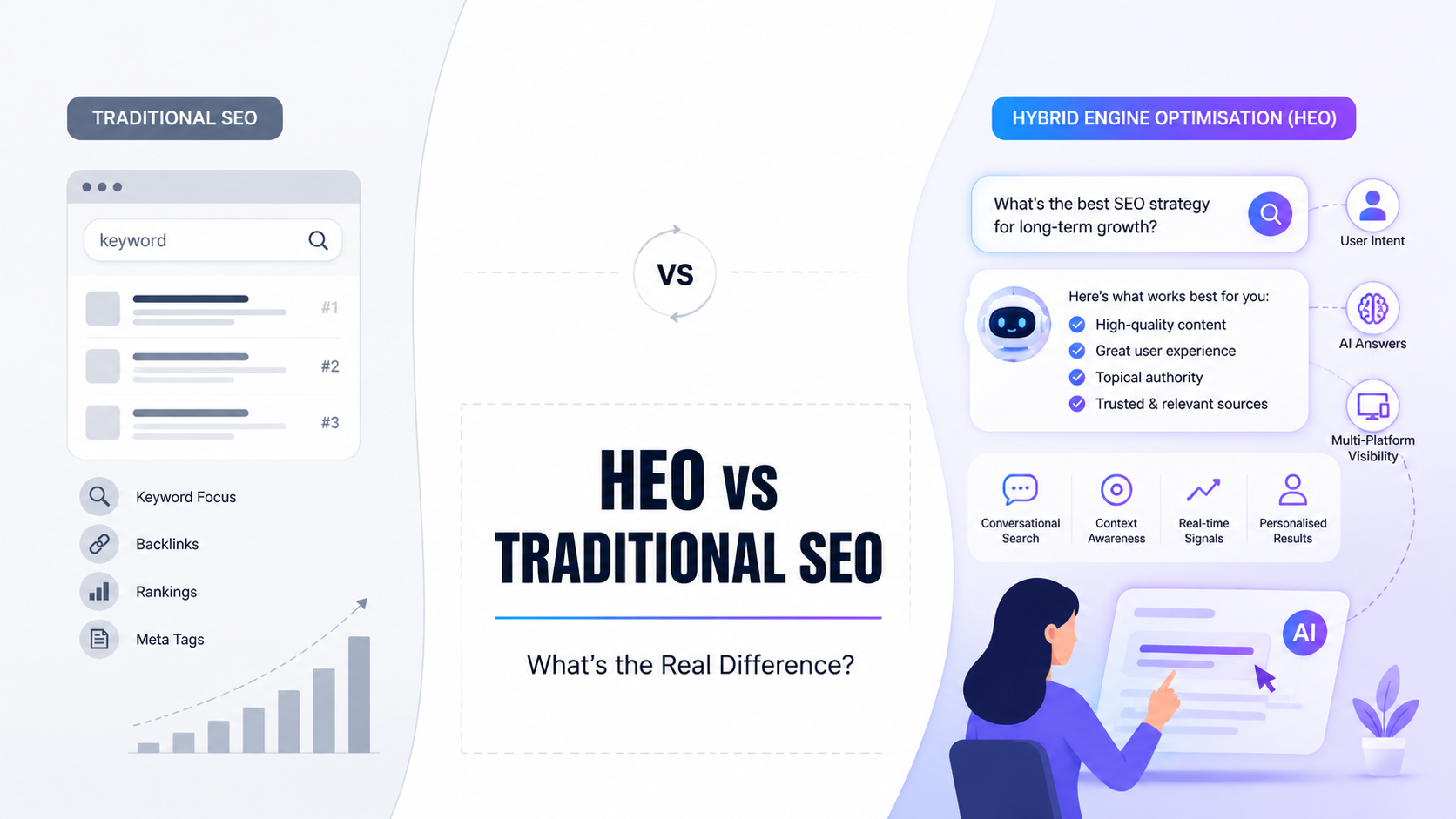
Search has changed faster in the last 18 months than it did in the previous 18 years. Buyers now ask ChatGPT before they ever open Google. Google itself shows AI-generated answers above your #1 ranking. And new acronyms like HEO, AEO, GEO, and AIO are flying around marketing teams every week.
So when someone asks me about HEO vs traditional SEO, the real question hiding underneath is usually this: “Do I throw out everything I’ve been doing, or is HEO just a new coat of paint on old SEO?”
This article gives you a straight, head-to-head comparison of Hybrid Engine Optimization vs Traditioal SEO. If you are completely new to Hybrid Engine Optimisation (HEO), read this first. If you already know the basics and want the practical comparison, you are in the right place.
Quick Refresher: What HEO and Traditional SEO Mean
Before we get into the differences, let’s make sure we’re talking about the same thing. I will keep this short because you can get the full background on the pillar.
Both approaches share the same end goal of getting more visibility, but the playing field they operate on is very different.
Traditional SEO
Traditional SEO is the practice of getting your website to rank high on search engines like Google and Bing. It runs on four classic levers: technical SEO, on-page optimisation, content, and backlinks. Success is measured in keyword rankings, organic traffic, and clicks.
Hybrid Engine Optimisation (HEO)
HEO, or Hybrid Engine Optimisation, is a broader approach that ties SEO, AEO, and GEO together so your brand shows up across both search engines and AI answer tools like ChatGPT, Perplexity, Gemini, and Google AI Overview. The term was coined by Jori Ford at SEO Week 2025. For the full origin story, history, and 7 core pillars, see my HEO pillar guide.
Why a Direct HEO vs SEO Comparison Matters Now
There is a lot of noise out there. Some marketers say SEO is dead. Others say HEO is the same old SEO with a fancy name. Both takes are wrong, and the confusion is costing businesses real visibility.
A clear, side-by-side comparison helps you make smart decisions about where to invest your time, budget, and team’s energy in 2026.
The confusion most marketers feel in 2026
Most teams I speak to are stuck in the middle. They know their Google rankings still matter, but they also see traffic dropping even when their rankings stay the same. They hear “HEO” and “GEO” everywhere but cannot tell where SEO ends and HEO begins. This article will draw that line clearly.
What changed between 2023 and 2026
Three things broke the old SEO model. First, Google launched AI Overviews and they spread fast. According to Semrush data analysed by Neotype, the share of queries triggering AI Overviews jumped from 6.49% in January 2025 to 13.14% in March 2025, a 102% increase in just two months.
Second, AI search tools went mainstream. ChatGPT now has 900 million weekly active users as of February 2026, more than double its 400 million figure from a year before. Third, click-through rates on top-ranking pages dropped sharply. Ahrefs analysed 300,000 keywords and found AI Overviews now reduce position-1 organic CTR by 58%. Ranking #1 simply does not pay what it used to.
HEO vs Traditional SEO: Side-by-Side Comparison
The fastest way to see the gap between these two approaches is to put them next to each other. This is the comparison table I share with every client during the first strategy call.
Save this section. It is the cleanest summary of the difference between HEO and SEO you will find in 2026.
Goal difference: rankings vs presence
Traditional SEO has one goal: rank as high as possible on Google. HEO has a wider goal: be present wherever your audience is searching, whether that is a Google SERP, a Perplexity answer, an AI Overview, or a ChatGPT response. Presence beats position when the search surface itself has changed.
Audience difference: searchers vs AI users
A traditional SEO audience is someone who types into a Google search bar. An HEO audience includes that same person plus the user who asks ChatGPT, the buyer who skims an AI Overview without scrolling, and the researcher who lives inside Perplexity. Same human, very different behaviour.
Success metric difference: clicks vs citations
SEO measures success in clicks and traffic. HEO adds new metrics on top: how often your brand is cited by AI tools, how many AI Overviews mention you, and how visible your brand is across all answer engines. A click is still good, but a citation inside an AI answer can be worth even more for brand recall.
| Factor | Traditional SEO | HEO |
|---|---|---|
| Primary goal | Rank #1 on Google | Be present everywhere users search |
| Target platforms | Google, Bing | Google, Bing + ChatGPT, Perplexity, Gemini, Claude, AI Overviews |
| Content focus | Keywords | Entities, brand, structured answers |
| Success metric | Clicks, traffic, rankings | Citations, mentions, visibility share |
| Schema usage | Optional bonus | Mandatory foundation |
| Authority signals | Backlinks | Backlinks + brand mentions + co-citations |
| User journey | Search to click to site | AI answer to brand recall to site |
| Tracking files | robots.txt | robots.txt + llms.txt |
8 Real Differences Between HEO and Traditional SEO
The comparison table covers the high-level shifts. Now let’s get into the practical, day-to-day differences that actually change how you plan content, build authority, and report results.
These eight points are the ones I walk every consulting client through when we map out a transition plan from a pure SEO setup to a full HEO program.
1: One channel vs every answer surface
Traditional SEO is single-channel. You optimise for Google, and that is most of the work. HEO is multi-channel by default. You optimise for Google, Bing, ChatGPT, Perplexity, Gemini, Claude, and AI Overviews at the same time. The good news is one well-built page can satisfy several of these surfaces if it is structured correctly.
2: Keywords vs entities and brand
Old SEO obsessed over keyword density and exact-match phrases. HEO cares about entities (your brand, your authors, your products, your industry) and how clearly they are connected on the open web. AI engines do not match strings of text. They understand concepts and how they relate. That is a major mindset change.
3: Backlinks vs unlinked mentions
Backlinks still matter in 2026. But HEO also tracks unlinked brand mentions, which is when someone writes about your brand without linking to you. AI tools learn about your brand from podcast transcripts, Reddit threads, YouTube descriptions, and industry roundups, even when no hyperlink is involved. Old SEO largely ignored these. HEO chases them.
4: Long content vs quotable chunks
Old-school SEO rewarded 3,000-word articles built around one keyword. HEO rewards content that is easy for an AI to lift, quote, and cite. That means short answer paragraphs under each heading, clean lists, comparison tables, and direct definitions. Long content is still fine. It just has to be structured into self-contained chunks so AI can extract value from each one.
5: Click-through vs zero-click value
Click-through rate has been the king metric of SEO for years. HEO accepts that many users will never click anymore. According to SparkToro’s 2024 Zero-Click Study by Rand Fishkin, for every 1,000 Google searches in the US, only 360 clicks go to the open web. The smart play is to win brand recall inside the answer, even when the click never happens.
6: robots.txt vs llms.txt approach
Traditional SEO has used robots.txt for decades to control how search bots crawl your site. HEO adds a new file: llms.txt. It is a proposed standard that helps large language models understand your site’s structure and important pages. Adoption is still growing, but websites that add it early get a clear head start. This is one of the cleanest examples of how HEO operates on a layer beyond traditional SEO.
7: Rank tracking vs AI citation tracking
For 20 years, SEO professionals lived inside rank trackers. In HEO, you still track rankings, but you also track how often your brand appears in ChatGPT, Perplexity, and Gemini answers. Tools like Profound, Otterly.AI, and AthenaHQ are built specifically for this. Rank tracking alone in 2026 gives you half the picture.
8: Old reports vs new HEO dashboards
The classic SEO report shows keyword positions, organic sessions, and backlink count. An HEO report adds AI Overview appearance rate, brand mentions across LLMs, branded search growth, citation share, and direct traffic from AI tools. If your monthly reporting still looks the way it did in 2022, your team is flying half-blind in the AI search era.
Content Style: How HEO Writing Differs From SEO Writing?
This is the part most articles skip, and it is honestly where the biggest practical difference shows up. The way you write a single blog post for HEO is meaningfully different from the SEO playbook that worked before 2024.
If your content team only changes one thing this quarter, it should be how they structure their writing.
SEO content structure that worked before 2024
The old playbook looked like this: pick a target keyword, write a 2,500-word article, stuff the keyword into the title, H1, first 100 words, and meta description, build a few backlinks, and wait. Content were often padded with filler to hit word count, with the actual answer buried halfway down the page.
HEO content structure that wins in 2026
HEO writing is built differently. Each section starts with a 2 to 4 sentence direct answer right under the heading. Headings are written as natural questions or clear topic statements. Lists, tables, and FAQ blocks are spread through the article. Every section is built so an AI engine can lift it as a standalone answer. Long content is still valuable, but the structure has to support both human scanning and machine extraction.
A real before-and-after rewrite example
Old SEO style intro paragraph: “In the world of digital marketing, search engine optimisation has been a topic that businesses have been talking about for many years now, and there are countless ways to approach it depending on your goals and budget.”
HEO rewrite: “Search engine optimisation helps your website rank on Google. In 2026, it is one piece of a bigger approach called Hybrid Engine Optimisation, which also covers visibility on ChatGPT, Perplexity, and Google AI Overviews.”
Notice the second version. An AI engine can quote it cleanly. A human reader gets the point fast. That is the shift.
Mindset Shift: From SEO Thinking to HEO Thinking
Tools and tactics matter, but the biggest gap between SEO and HEO is mental. Teams that move to HEO successfully do not just learn new tools. They change how they think about what “winning” means.
This shift is harder than it sounds because most of us have spent years optimising for one thing: position #1.
Old mindset: rank first, everything else later
Classic SEO thinking treats rankings as the win. You celebrate when you hit page one. You panic when you drop. Brand mentions, citations, and AI visibility feel like nice-to-haves on top of the ranking goal. This worked when Google was the only meaningful entry point to your site.
New mindset: be the answer, not just the link
HEO thinking treats presence as the win. You ask: “When my customer searches in any way, am I part of the answer?” That answer might be a Google ranking, an AI Overview citation, a ChatGPT mention, or a Perplexity source. Rankings still matter, but they are one of several outcomes, not the only one. This shift changes how you brief writers, plan campaigns, and report results.
When Traditional SEO Still Wins Over HEO?
Here is something most HEO articles will not tell you honestly: traditional SEO is still the better play for some types of search. Throwing your full budget at HEO when classic SEO would do the job is a waste.
These are the three scenarios where I tell clients to keep their SEO focus tight and not over-invest in HEO.
Local search and Google Business Profile queries
If your business depends on local searches like “plumber in Ahmedabad” or “best dentist near me”, traditional SEO and Google Business Profile work are still your strongest moves. Local pack results dominate these queries, AI Overviews appear less often, and the user usually wants a phone number or directions, not a long answer.
Transactional and product-led searches
For ecommerce queries with clear buying intent, like “buy iPhone 17 Pro 256GB”, users want product listings and prices. Google’s shopping results, product schema, and review stars matter most here. AI Overviews are rare on these queries because Google still prioritises commercial results.
Brand-name and navigational queries
When someone searches your exact brand name, classic SEO basics handle it. You want clean site structure, proper homepage optimisation, and a clear knowledge panel. HEO does not move the needle much for navigational searches because the user already knows what they want.
When HEO Beats Traditional SEO Clearly?
The flip side is just as important. There are search scenarios where pure SEO leaves a lot of visibility on the table, and HEO is the clearly better choice.
If your business falls into any of these categories, HEO is not optional anymore. It is the strategy.
B2B and high-research buying journeys
B2B buyers, especially in SaaS, finance, consulting, and enterprise services, now run their early research through ChatGPT, Perplexity, and Gemini. They ask for vendor shortlists, comparisons, and recommendations before they ever land on your website. If you are not in those AI answers, you lose them at the awareness stage.
Topics where AI Overviews dominate SERPs
Some niches now show AI Overviews on the majority of informational queries. Healthcare, finance, education, and “how to” topics are particularly affected. According to BrightEdge research cited by Neotype, longer conversational queries with 8 or more words trigger AI Overviews far more often than short queries. If your audience asks long questions, HEO is essential.
Brands competing with bigger SEO budgets
This one surprises clients. Smaller brands often win HEO faster than big brands because they can publish, restructure, and get cited quickly. AI engines reward content quality and clarity, not just domain authority. A focused small brand with sharp HEO content can show up in AI answers next to (or instead of) much bigger competitors. That is a real advantage worth taking.
Cost and Time: HEO vs Traditional SEO Investment
Budget and timeline are the two questions every client asks me in the first meeting. Let’s go through the real numbers I see in practice.
These are not exact figures for every business, but they reflect what I see across most small-to-mid-sized SEO consulting projects.
Time to see results from each approach
Traditional SEO typically takes 3 to 6 or 12 months to show steady results. AI search visibility from HEO can show early signals faster, sometimes in 4 to 8 weeks for citations or sometimes within a week, because AI engines update more frequently than Google’s main index. That said, building real entity authority for HEO is still a long-term effort, similar to SEO. Quick wins are possible. Lasting authority takes time.
Budget difference for small businesses
The good news for small businesses is that HEO does not need to cost dramatically more than traditional SEO. Most of the work overlaps. The added costs come from one or two AI visibility tracking tools and slightly more time spent restructuring content. For a small business already paying for SEO, layering HEO on top usually adds 10 to 20% to the budget, not 100%.
Common Mistakes Marketers Make in HEO vs SEO
When teams transition from SEO to HEO, a few mistakes pop up over and over. Each one creates real problems that show up in dashboards three months later.
If you can avoid these three traps, your HEO program will run cleaner from day one.
1. Treating HEO as a complete SEO replacement
Some teams think they should drop their SEO work entirely and only do HEO. This is the fastest way to lose visibility on both fronts. AI engines pull from web pages that Google already indexes, which means weak SEO directly hurts AI visibility too. HEO sits on top of SEO, not in place of it.
2. Doing HEO without an SEO foundation
The opposite mistake is also common. New websites with thin content, no schema, and slow load times try to chase AI citations before fixing their basics. AI engines need clean, well-structured pages to cite. Without solid SEO underneath, you have nothing for HEO to amplify.
3. Copying SEO tactics into HEO blindly
The third trap is assuming that everything in SEO maps directly to HEO. Keyword density tricks, exact-match anchor text obsession, and bloated long-form content do not work the same way in AI search. HEO is not a copy-paste of SEO. The principles overlap, but the execution often differs. Treat them as related, not identical.
Final Verdict: HEO vs Traditional SEO in 2026
After hundreds of client conversations and dozens of audits this year, my honest take is simple. Stop framing this as HEO vs traditional SEO. Frame it as HEO with strong SEO inside it.
The brands that win the next two years will not pick one. They will run both, with HEO setting the strategy and SEO doing the foundation work.
The honest answer for most businesses
If you have a working SEO program, do not throw it out. Layer HEO on top by restructuring your top pages, adding the missing schema, building entity authority, and tracking citations. If you are starting from scratch, build SEO and HEO together from day one. The skills overlap enough that you do not need two separate teams.
Your next step this week
Pick five queries where your brand should appear. Run each one through ChatGPT, Perplexity, Gemini, and Google AI Overview. Note where you show up and where you do not. Then take your top three traffic-driving pages and add a 2 to 4 sentence answer paragraph at the top of each section. That is your first real HEO move, done in a week.
If you want help mapping out an HEO strategy that fits your business and budget, this is exactly what I do as an HEO Consultant. Feel free to reach out and we can build a plan together.

Ankit Prajapati
Digital Marketing Professional | SEO Consultant | Teetotaller | Music Buff | Early Bird. "Love to do SEO for Humans, not for Bots." As an SEO Consultant, I will identify the opportunities to make your website user-friendly, improve visibility, traffic and leads. I also help SEO freshers and experienced SEO professionals in resolving their SEO errors and their queries for free, which extends my skill sets.
Comments are closed