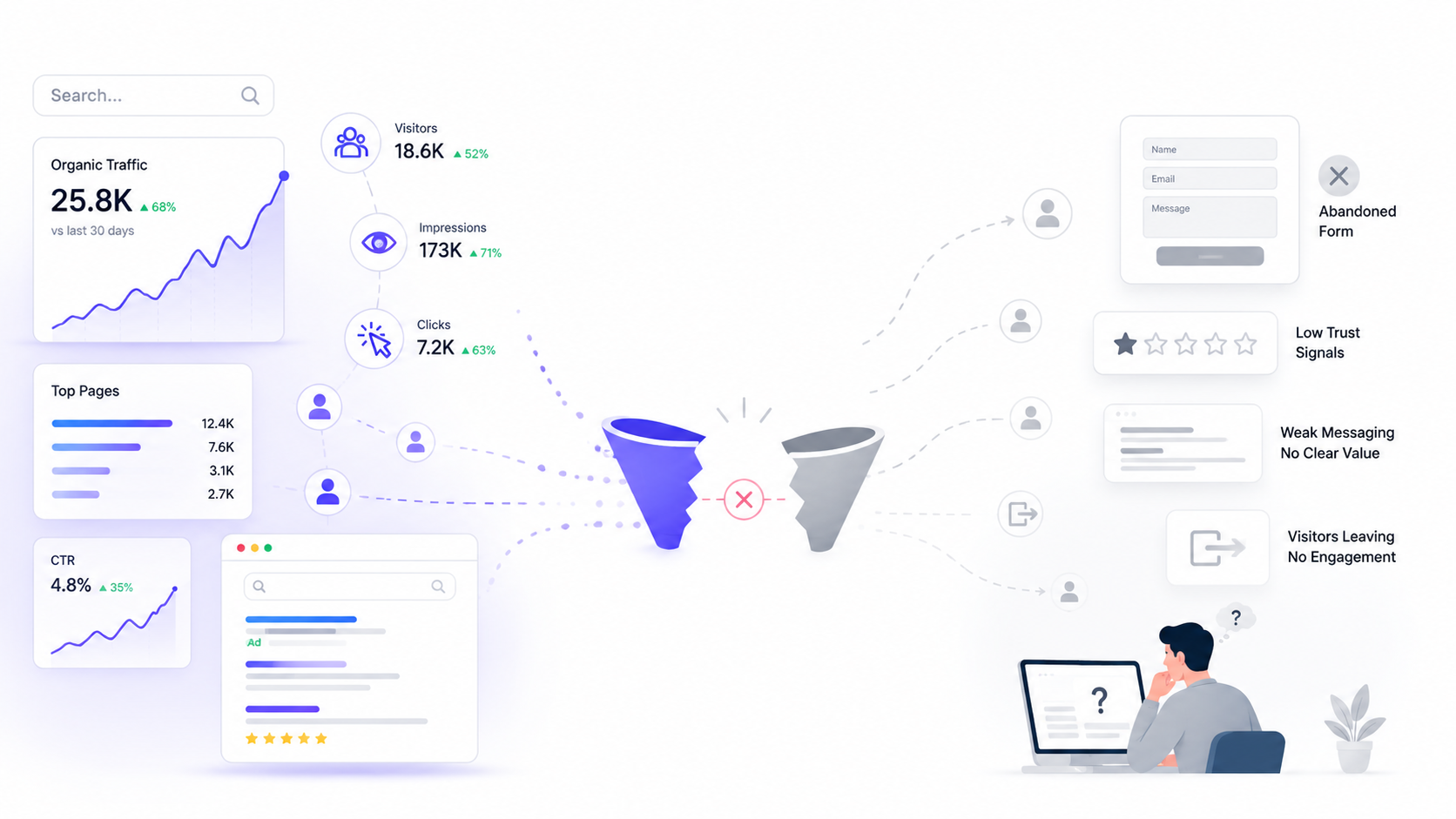
You open Google Analytics. Sessions are up. Page views are climbing. Bounce rate looks decent. On paper, your website is doing great. Then you check your inbox, your CRM, your phone. Nothing. No new inquiries. No demo requests. No sales calls.
If your website gets traffic but no leads, you are not alone, and the answer is not what most blogs tell you. The average website conversion rate across industries is only 2 to 4%, which means 96 out of every 100 visitors leave without taking any action. The deeper truth in 2026 is that the traffic-to-lead gap is not just a CRO problem anymore. It is a search behaviour problem, and the fix lives inside Hybrid Engine Optimisation (HEO).
This post shows you the real reasons your traffic is not converting, why old SEO fixes are not enough in 2026, and how HEO closes the gap. If you want the full background on what HEO is, read my guide first: What is Hybrid Engine Optimisation (HEO) and Why SEO Has Changed in 2026.
The Real Cost of Traffic Without Leads
Before we get into reasons, let’s be honest about what this problem is actually costing you. Most websites jump straight to fixes without showing the business impact, and that is exactly why teams keep underestimating how serious the leak is.
Every uncoverted visitor is paid for in some way, whether through ad spend, content investment, or your team’s time. Treating them as “just a number that did not convert” is the most expensive mistake in digital marketing.
What every uncoverted visitor actually costs you
Let’s run a simple calculation. If your website gets 5,000 visitors a month and your average customer is worth ₹15,000, even a 2% conversion rate gives you 100 leads. If your real conversion rate sits at 0.5%, you are losing roughly 75 leads a month, which is more than ₹11 lakhs in pipeline value walking off your site monthly. The cost is not theoretical. It shows up in lost revenue, wasted ad budgets, and team morale dropping every time the numbers do not move.
Why “more traffic” almost never solves the problem
This is the trap most businesses fall into. They see flat lead numbers and assume the answer is more visitors. Pouring more traffic into a website that does not convert is like filling a bucket with a hole in it. You spend more, you work harder, and the leak gets bigger. Fix the leak first. Then turn up the volume.
Why Old SEO Fixes Stopped Working in 2026
The classic playbook (better CTAs, faster pages, cleaner forms) still helps, but it is solving a 2020 problem in a 2026 world. The way people search has fundamentally shifted, and that shift is silently breaking your lead funnel.
HEO vs Traditional SEO: 8 Real Differences You Should Know
If you only treat this as a CRO problem, you will keep applying surface-level fixes to a structural issue.
AI Overviews are stealing your buying-intent clicks
Google now shows AI Overviews on a growing share of searches. According to Ahrefs analysis of 300,000 keywords, AI Overviews now reduce position-1 organic CTR by 58%. That means your high-intent visitors who used to find your service page through Google are now reading the AI summary and never clicking. The traffic you do get is often the leftover, lower-intent slice.
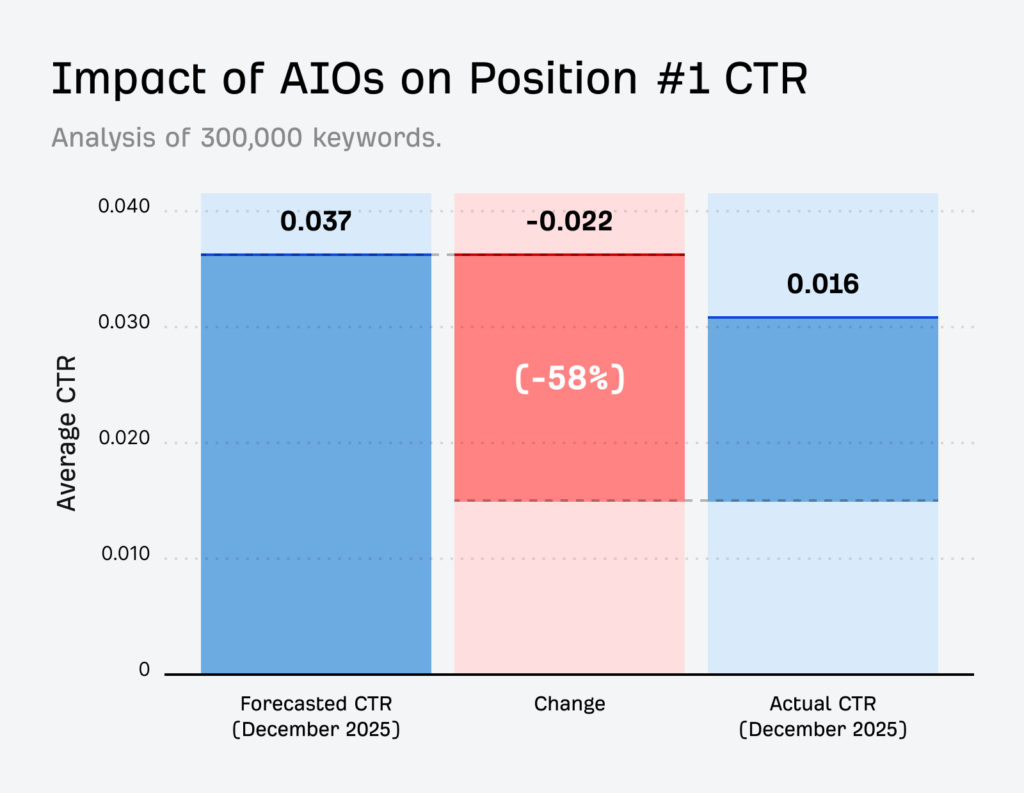
Image Source: Ahrefs
ChatGPT and Perplexity send pre-researched visitors
ChatGPT now has 900 million weekly active users as of February 2026, and Perplexity has crossed hundreds of millions of monthly queries. Buyers now run their early research through these tools before ever opening Google. By the time they hit your website, they have already shortlisted competitors mentioned in AI answers. If your brand was not in those AI conversations, your visitor arrives cold and unconvinced, no matter how good your landing page is.

Google traffic in 2026 is not what it used to be
According to SparkToro’s Zero-Click Search Study, for every 1,000 Google searches in the US, only 360 clicks go to the open web. The rest end without anyone visiting any website. So even when your rankings stay the same, the actual traffic getting to your pages keeps shrinking, and the share of high-intent buyers in that traffic drops too. This is the real reason “traffic but no conversions” feels worse year after year.
9 Real Reasons Your Website Gets Traffic But No Leads
Now let’s break down the practical reasons your visitors are not turning into leads. Some of these will sound familiar. Others, especially the last few, are not in any other “traffic but no leads” article you will find on Google.
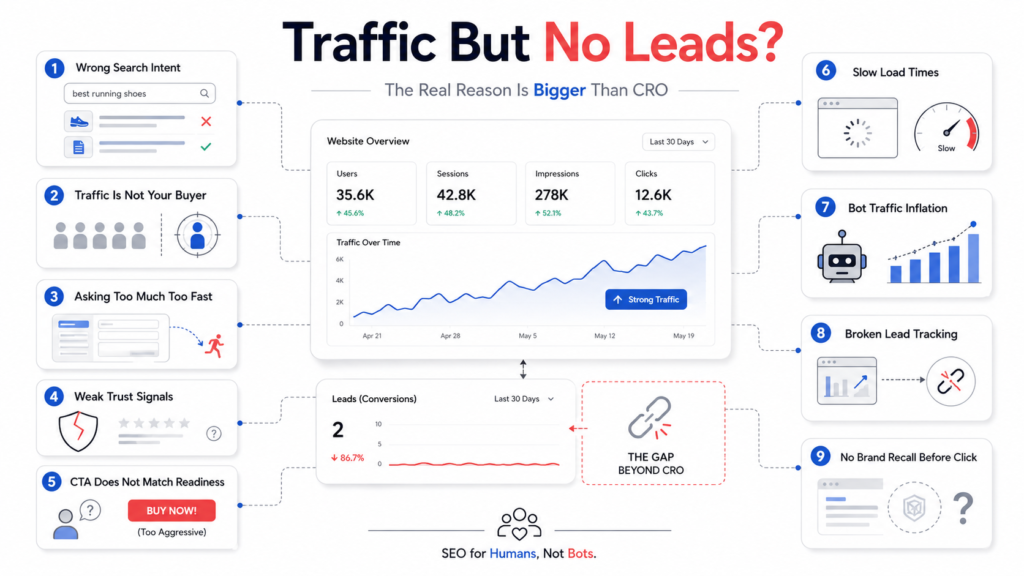
Go through these honestly. Most websites suffer from at least three of them at once.
1: You rank for the wrong search intent
If your top pages rank for “how to” and “what is” queries, you are pulling in researchers, not buyers. A visitor searching “what is conversion rate optimisation” is learning. A visitor searching “conversion rate consultant in Ahmedabad” is hiring. Different intent, different content, different outcome. Check your top 10 landing pages in Google Search Console. If they are all blog posts targeting informational queries with a “Book a Demo” CTA, the mismatch is your problem.
2: Your traffic is not your buyer
Sometimes the issue is the channel mix. Social media traffic typically converts 40 to 60% lower than search traffic because the intent is different. Someone scrolling LinkedIn is exploring. Someone Googling “fix slow website” is problem-solving. If most of your sessions come from awareness-stage social posts, your conversion rate will look weak no matter what you fix on the page itself.
3: The page asks for too much too fast
Picture a first-time visitor reading a blog post about a problem they just discovered. The only CTA on the page is “Schedule a 60-Minute Strategy Call”. The commitment gap is too large. They will close the tab. The fix is to match the CTA to the visitor’s stage. Awareness visitors need a low-commitment next step (a guide, a checklist, a short tool). Decision visitors need a clear path to sales.
4: Trust signals are missing or weak
Online, “unsure” is the default state. If your service page has no real reviews, no client logos, no case studies, no team photos, no clear address, visitors hesitate. According to Google’s Search Quality Rater Guidelines, Experience, Expertise, Authoritativeness, and Trust (E-E-A-T) carry heavy weight in modern search. AI engines follow the same logic when picking sources. Weak trust signals hurt both your ranking and your conversion at the same time.
5: Your CTAs do not match user readiness
Visitors do not all arrive at the same buying stage. Top of funnel visitors need education. Middle of funnel visitors need comparisons. Bottom of funnel visitors need pricing and contact. If every page on your site has the same generic CTA (“Contact Us”), you are missing the chance to capture leads at every stage. One clear, stage-appropriate CTA per page works far better than one generic CTA everywhere.
6: Slow load times kill momentum
Google’s Core Web Vitals are not just a ranking factor. They are a conversion factor. If your page takes 5 seconds to load on a mid-range Android phone over 4G, half your visitors are gone before they see your headline. Test your site on PageSpeed Insights and aim for LCP under 2.5 seconds, INP under 200ms, and CLS under 0.1.
7: Bot traffic is inflating your numbers
This one most are skip. A meaningful share of “website traffic” in 2026 is not human. It includes bot crawlers, AI scrapers like GPTBot and ClaudeBot, and low-quality referral spam. If your analytics shows 10,000 sessions but your CRM shows 3 leads, check how much of that traffic is actually qualified human visitors. Filter out bot traffic in GA4, segment by user behaviour, and look at engaged sessions instead of raw sessions.
8: Lead tracking is broken or missing
I have audited websites that thought they had zero leads, only to discover their contact form was silently broken for two months. Or their thank-you page event was never set up in GA4. Or form submissions were going to an inbox nobody checked. Test your contact form once a month by submitting a real test inquiry. Check that the lead lands where it should, that the auto-reply sends, and that your GA4 conversion event fires.
9: No brand recall before the click
This is the new 2026 reason. Your visitor saw your brand mentioned in an AI Overview, scrolled past five competitors in a Perplexity answer, and finally landed on your site. By that point, the brands they saw mentioned multiple times feel familiar and trusted. Your brand, not mentioned anywhere upstream, feels like a stranger. No matter how good the landing page is, brand recall built before the click is what makes the page work harder.
How HEO Fixes the Traffic-to-Lead Gap
This is where Hybrid Engine Optimisation changes the conversation. Most “fix your low-converting website” pages only think about what happens after the click. HEO thinks about the entire journey, including everything that happens before the visitor ever reaches your site.
That broader view is what fixes the lead leak at the root, not just the symptoms.
Brand recall before the visitor lands
HEO builds your brand presence inside ChatGPT, Perplexity, Gemini, and Google AI Overviews. When a buyer asks “best HEO consultant in India” or “top eCommerce SEO consultants” inside an AI tool and your brand shows up multiple times, every later visit to your site lands on a warmer, more trusting visitor. Same traffic count, dramatically better conversion. This is what HEO for lead generation actually means in practice.
Intent matching across search and AI engines
Traditional SEO matches keywords to pages. HEO matches user intent across multiple search surfaces. That means thinking about how the same buyer searches differently in Google, in ChatGPT, and on Perplexity, then making sure your content satisfies all three intent patterns. AI search visitors not converting often comes down to intent mismatch at the top of the funnel.
Content built to convert, not just rank
HEO content is structured for both AI extraction and human conversion. Each page has a short, direct answer near the top, clear next steps for different visitor stages, FAQ blocks, comparison tables, and proof elements. This structure helps AI engines cite your page and helps human visitors take action quickly. Old SEO content was optimised for ranking. HEO content is optimised for visibility plus conversion.
Entity authority that builds real trust
Visitors trust brands they have seen before, recommended by sources they trust. HEO builds entity authority by getting your brand mentioned consistently across high-quality sources, podcasts, industry blogs, Reddit discussions, and YouTube descriptions. AI engines pick up these signals and start including your brand in their answers, which creates the brand recall that makes your site convert better.
Diagnose Your Lead Leak: A 7-Point Audit
Before fixing anything, you need to know exactly where the leak is. Most teams jump straight into redesigning the homepage or rewriting the contact page without ever diagnosing the real problem. That is how money gets wasted.
Run this 7-point audit before you change a single thing on your website.
1: Search intent vs page intent match
Open Google Search Console. Pull your top 20 landing pages and the queries they rank for. For each page, ask one question: does the search intent of this query match the action the page asks for? If you have a “How to fix slow websites” blog post ranking, with only a “Book a Strategy Call” CTA, the intent does not match. Mark every mismatch and prioritise fixing those pages first.
2: Top landing pages and their CTAs
Look at the top 10 pages by organic traffic. For each one, write down the primary CTA. Then ask: is this CTA appropriate for the buyer stage of this page? An awareness page should offer a low-commitment next step. A comparison page can offer a demo or quote. A pricing page can ask for the sale.
3: Form fields and friction points
Count the fields on your main contact and demo forms. Studies consistently show that removing just two unnecessary fields can lift completions by 20 to 40%. If your form asks for more than 4 fields at first contact, you are adding friction. Trim aggressively. You can always ask for more details later in the sales process.
4: Page speed on mobile devices
Run your top 5 traffic-driving pages through PageSpeed Insights on the mobile setting. Note any page with an LCP above 2.5 seconds. Mobile users are usually more than half your traffic, and they bounce faster than desktop users. Fast mobile pages convert dramatically better.
5: Trust signals and social proof
Open each main service page and scan for trust elements: real client logos, named testimonials with photos, case studies with specific results, team bios with credentials, clear business information. If a service page has only generic “5 stars” badges and stock photos, trust is leaking on every visit.
6: GA4 tracking and lead events
Submit a test lead through your main form. Check three things: did the form actually submit, did the auto-reply email arrive, and did the conversion event fire in GA4. If any of these break, your “no leads” problem might partially be a “no tracking” problem in disguise.
7: AI search visibility for your brand
Open ChatGPT, Perplexity, Gemini, and Google AI Overviews. Run 5 buying-intent queries from your industry. Note how often your brand appears versus competitors. If your brand is invisible in AI answers, you are losing the brand-recall battle before visitors ever reach your site. This is the HEO check most agencies skip.
Page-Level Fixes That Convert Traffic Into Leads
Once you have diagnosed the leak, here are the page-level fixes that move the needle fastest. These are practical, low-cost changes you can apply this week without rebuilding anything major.
Start with the page that gets the most traffic and the fewest leads. Fix that one first.
1. Match every page to a single search intent
One page should serve one intent. If your “SEO services” page is trying to rank for “what is SEO”, “best SEO company”, and “SEO services pricing” all at once, none of them are converting well. Split the topic into separate pages, each matched to a specific search intent and visitor stage.
2. Add a clear answer above the fold
Within the first screen, the visitor should see what you do, who you serve, and what the next step is. No marketing fluff. No vague tagline. A 2-line value statement, a clear CTA, and a single supporting visual is often enough to lift conversions meaningfully.
3. Use one primary CTA per page
Multiple competing CTAs split visitor attention and reduce action. Pick one primary CTA per page (for example, “Book a Free Audit”) and make it visually dominant. Secondary actions can exist, but they should be visually quieter so they do not pull focus.
4. Cut your form fields by half
If your contact form asks for 8 fields, drop it to 4. If it asks for 4, drop it to 3. Name, email, and one qualifying question is enough for a first touch. The rest of the qualification can happen on the call or in the follow-up email.
Strategy-Level Fixes With HEO Thinking
Page fixes alone will only take you so far. The bigger wins come from strategy-level changes that pull HEO into your lead generation system. These take longer to show results, but they compound.
If you want a real lift, do not skip this section.
1. Build entity authority around your brand
Get your brand consistently mentioned across high-authority sources in your industry. Pitch guest posts, get on podcasts, comment thoughtfully on Reddit and Quora, build a clean Wikipedia-eligible presence, and make sure your Google Knowledge Panel is accurate. AI engines pull from these mentions to decide whether to recommend you.
2. Show up in AI answers for buying queries
Track how AI engines answer the buying-intent queries in your industry. For each query where you do not appear, identify why (no relevant content, weak schema, missing brand mentions) and build a focused plan to earn citations. This is the HEO playbook in action and it directly fixes the brand-recall gap that makes your traffic feel cold.
3. Create middle-of-funnel content that captures
Most websites have lots of awareness content (blogs) and bottom-funnel content (service pages) but almost nothing in the middle. Comparison guides, alternative pages, ROI calculators, audit checklists, and gated guides all capture leads at the middle stage where buyers are seriously evaluating options. This is where most “traffic but no leads” sites are losing the most revenue.
Mistakes Most Businesses Make While Fixing This
When teams realise their traffic is not converting, they often rush into fixes without thinking. These are the three most common mistakes I see in audits, and each one delays real results by months.
Avoid these three traps and your fix-it project will move much faster.
1. Adding more traffic to a leaking funnel
The most common mistake. Teams see flat leads and immediately spin up new ad campaigns or hire someone to “do more SEO”. This makes the cost per lead worse, not better. Always fix the leak before increasing the volume.
2. Redesigning the site without diagnosis
The second-most common mistake. Teams assume the site is “old” or “ugly” and commission a full redesign. Six months later, the new site launches with the same conversion problem because nobody actually diagnosed why visitors were not converting. Redesigns rarely fix lead generation. Targeted, evidence-based changes do.
3. Ignoring brand visibility outside the website
Many teams treat the website as a closed box. They optimise the homepage, the service pages, the forms, but they never look at where their brand is (or is not) mentioned across the wider web and AI engines. In 2026, brand visibility outside your website is just as important as the experience on it.
Your Action Plan to Start Generating Leads
You do not need to do everything in this post at once. The most effective way to fix a website that ranks but no inquiries are coming from is to take it one phase at a time.
Here is a simple plan to follow.
What to fix this week
Run the 7-point audit. Test your contact form. Check GA4 tracking. Identify the top 3 pages with the worst intent mismatch. Cut form fields by half. These five tasks usually take a couple of days and often catch the most expensive leaks immediately.
What to fix this month
Build 2 to 3 middle-of-funnel lead magnets matched to your top blog posts. Add intent-appropriate CTAs across your site. Improve trust signals on every service page. Start tracking your brand visibility in ChatGPT, Perplexity, and Google AI Overviews. These changes start lifting conversions within 30 to 60 days.
When to call in an expert?
If you have run the audit, fixed the obvious gaps, and your numbers are still flat after 90 days, the issue is usually deeper. It could be a topical authority problem, a tracking architecture issue, or a brand visibility gap that needs a structured HEO program. This is exactly the kind of work I do as an SEO Consultant. Feel free to reach out and we can map out the right next steps for your specific situation.

Ankit Prajapati
Digital Marketing Professional | SEO Consultant | Teetotaller | Music Buff | Early Bird. "Love to do SEO for Humans, not for Bots." As an SEO Consultant, I will identify the opportunities to make your website user-friendly, improve visibility, traffic and leads. I also help SEO freshers and experienced SEO professionals in resolving their SEO errors and their queries for free, which extends my skill sets.
Comments are closed