 View Markdown
AI is no longer a nice-to-have in organic growth programs, and around 68% of businesses already report higher content marketing ROI thanks to AI. The real gap is not adoption, it is knowing whether the AI tools, prompts, and workflows we use are actually paying back in leads, sales, and long-term profitability. In this guide, we share how we measure the ROI of AI in our own work, using real case-study style thinking, AI visibility tracking, and clear financial models that any marketing or leadership team can review.
Key Takeaways:
| Question | Short Answer |
|---|---|
| How do we define ROI of AI in organic growth programs? | Track extra revenue, leads, and time saved that come from AI-assisted work, then compare it to AI tool and implementation costs. |
| Which metrics should we watch beyond traffic and clicks? | Lead volume, assisted revenue, conversion rate, AI answer visibility, and user experience improvements tied to AI tracking. |
| How do AI visibility tools fit into ROI measurement? | They show how often brands appear in AI-generated answers and help translate that presence into traffic, brand lift, and conversions, as covered in this guide on LLM tracking tools. |
| What is the role of LLM metrics compared to classic metrics? | LLM metrics track how AI systems mention and cite your brand, which complements classic metrics, an idea we expand in our LLM vs traditional metrics article. |
| How can we check if AI answers talk about our brand? | Use AI visibility trackers that monitor AI-generated answers for your brand name, competitors, and key topics as introduced in this AI presence guide. |
| How do AI-driven UX insights affect ROI? | By using AI-based behavior tracking, you can refine layout, CTAs, and friction points and then attribute conversion lifts, which we outline in our UX and AI tracking article. |
| Where should a team start if they feel lost on AI ROI? | Begin with a clear baseline of organic performance and AI visibility, then add one LLM visibility tracker from this tools comparison and build simple revenue-based models. |
How To Define “ROI Of AI In SEO” Before You Measure Anything
We see many teams jump straight into tools and dashboards without agreeing on what “return” means for their context. For some ecommerce brands, AI ROI is incremental revenue from organic sessions, while for a services business it might be qualified leads and reduced sales cycle time.
We recommend defining ROI of AI in three buckets: extra revenue, extra leads, and cost or time savings. Every AI initiative should map clearly to at least one of these. Once that is agreed, you can connect AI work directly to business KPIs and budget decisions.
- Revenue-based ROI: orders or deals that can be traced back to organic visitors influenced by AI-assisted content or AI visibility improvements.
- Lead-based ROI: growth in qualified form fills, demo requests, or calls where organic touchpoints played a role.
- Efficiency ROI: time saved in content production, analysis, or reporting that reduces external spend or internal hours.
Building A Baseline: Traffic, Leads, And Sales Before AI
To measure ROI of AI in SEO, we always start with a clean baseline. That means three to six months of performance before AI assistance, including traffic, lead counts, and sales figures broken out by channel and page type. Without this, any “uplift” number is just guesswork.
In our ecommerce consulting work, we often see stores where organic traffic looks flat, yet revenue from organic has grown due to better product page performance and intent targeting. A baseline should therefore include both volume and value metrics for each key landing page group like categories, products, and content hubs.
| Metric | Before AI (3–6 months) | After AI (3–6 months) |
|---|---|---|
| Organic sessions | Baseline average per month | Compare for uplift |
| Leads from organic | Form fills, demo requests, calls | Track growth and lead quality |
| Revenue from organic | Per product or service line | Measure incremental gain |
| AI visibility metrics | Brand mentions in AI answers | Improved presence and citations |
How AI Changes Measurement: From Clicks To AI Answer Visibility
AI mode will replace traditional search how people access information. AI-generated answers now sit between users and websites for a meaningful share of queries. Google’s AI Overviews alone appeared for roughly 24.61% of queries at their mid-2025 peak, which reshapes how we think about impressions and branding.
A user can:
- Ask a question in an AI interface
- See your brand mentioned as a recommended product or cited source
- Remember your name
- Later search for you directly on Google or visit your site from another channel
That means you can gain brand awareness and demand without seeing a single click in your analytics from that AI platform.
We now measure not just whether a page gains a click but also whether AI systems:
- Mention the brand by name
- Show a citation or link
- Summarize your content as part of their answer
- Recommend your products over alternatives
This shifts part of SEO ROI measurement into AI visibility territory, where LLM tracking tools and Generative Engine Optimization (GEO) principles play a central role.
Using LLM Visibility Metrics Alongside Classic Metrics
Classic metrics like impressions, sessions, and conversions still matter, but they no longer tell the full story.
LLM metrics add layers such as:
- How often AI answers cite you
- How prominently you appear versus competitors
- Whether mentions are favorable or neutral
- How visibility changes over time for specific product categories
We combine these datasets to answer questions like:
- “Are AI systems using our content to answer high-value queries?”
- “When AI panels appear, does our brand gain or lose traffic, leads, and revenue?”
- “Are branded searches growing after we appear more often in AI answers?”
Over time, this shows how AI assists (or replaces) classic organic performance across products and segments.
Did You Know?: 65–70% range of ROI uplift or higher is often reported when AI is applied to SEO and content workflows, based on aggregated Semrush data.
Core AI Visibility Metrics For E-Commerce SEO ROI
To answer “how do I measure ROI from AI search visibility for e-commerce brands?” you need metrics designed for AI answers, not just blue links.
AI Citations, Share Of Citations, And Authority Weight
Start with three core metrics:
- AI Citations And Mentions
How often your brand, products, or content are referenced in AI-generated answers across tools like ChatGPT, Perplexity, Gemini, and Google AI Overviews. - Share Of AI Citations
Your share of total citations for a topic compared with competitors:Share Of Citations = (Your Citations ÷ Total Citations For All Brands) × 100If you are cited 40 times and your top two competitors are cited 30 and 30 times, your share is 40%. - Authority Weight
Not every citation is equal. Being referenced as the source (“According to [Your Brand]…”) carries more weight than being listed as one of many options. Create a simple score, for example:- 3 points = definitive source
- 1 point = supporting source
Brand Safety & Sentiment: Are LLMs Recommending You Or Competitors?
Brand safety in AI search is not just about avoiding negative mentions — it is about making sure **LLMs recommend you in the right context**:
- Track whether AI tools:
- Recommend your products explicitly
- Compare you favorably vs key competitors
- Mention outdated or incorrect information
- Use sentiment analysis from AI visibility tools, or sample manually:
- Favorable: “[Your Brand] is a leading choice for…”
- Neutral: “…including [Your Brand] among other options…”
- Negative: “Some users report quality issues with…”
- Build a small monitoring list:
- “Is [Your Brand] a good option for [category]?”
- “Compare [Your Brand] vs [Main Competitor].”
- “Best [product type] for [use case].”
Log monthly snapshots. If models start recommending competitors more often, that is a brand safety issue and an AI ROI risk — you are paying for AI tools and content, but AI engines send demand elsewhere.
Branded Search And Assisted Awareness
When AI answers mention your brand, many users will search your name later instead of clicking immediately. This creates assisted awareness that does not show as referral traffic from AI platforms.
Track this by:
- Filtering for brand queries in Google Search Console
- Watching trends in:
- Branded impressions
- Branded clicks
- Branded click-through rate
If branded search grows after AI citation share increases, that is a strong signal that AI visibility is feeding your funnel, even if analytics does not show direct AI referrals.
What LLMs Already Know About Your Brand
LLMs are trained on snapshots of the web and may hold:
- Outdated pricing
- Old product ranges
- Past brand names or domains
- Old reviews or press
Test what the big models “remember” by asking:
- “What do you know about [Your Brand]?”
- “What are the main products from [Your Brand]?”
- “Who are the main competitors to [Your Brand]?”
If the answers reference old data or miss your current positioning, prioritize:
- Fresh content that clearly states current facts
- Strong internal linking to key “About,” category, and flagship product pages
- Structured data that reinforces the latest information
This work lives at the intersection of content, technical SEO, and Generative Engine Optimization (GEO) and directly supports long-term AI search visibility.
Tools And Methods To Track AI Search Visibility
Once you know what to measure, you need ways to collect the data consistently.
AI SEO Toolkits And LLM Visibility Platforms
Platforms like Semrush, Conductor, and specialized LLM visibility trackers can help you move from manual AI checks to repeatable ROI measurement. The point is to connect AI visibility with traffic, assisted conversions, category revenue, and the SEO work that moves those numbers. Knowing your brand appears in AI answers is the starting point, not the goal.
If we had to start with one platform for AI SEO ROI tracking, our first pick would be Semrush. Semrush is a strong fit because it brings SEO data and AI visibility into the same workflow. Instead of using one tool for keyword rankings and another for LLM mentions, you can track AI visibility, prompts, citations, sentiment, competitors, backlinks, technical SEO, and content performance in one place.
The Semrush AI Visibility Toolkit is available as an add-on, and Semrush One combines SEO with AI visibility tracking in one plan. See the Semrush pricing page for current plans. This makes it a better fit for ROI measurement than a lightweight LLM tracker if your team wants to diagnose why AI systems mention competitors, which sources shape AI answers, and what SEO or content actions could improve visibility.
For larger ecommerce brands, Semrush Enterprise AIO is the stronger option. It is built for teams that need multi-brand, multi-market, or multi-language AI visibility tracking, with deeper reporting across mentions, citations, sentiment, sources, products, markets, and revenue impact.
Here is a simple way to compare the options:
| Platform Type | Best Fit | ROI Use Case |
| Semrush | Ecommerce teams that want SEO and AI visibility in one workflow | Measure AI visibility, connect it with SEO actions, and model assisted revenue through analytics exports |
| Conductor or enterprise SEO platforms | Larger teams with existing enterprise SEO operations | Connect AI search tracking with broader SEO governance and reporting |
| Specialized LLM visibility trackers | Teams focused only on AI mention monitoring | Track prompts, brand mentions, and competitors without a full SEO workflow |
| Manual LLM snapshots | Smaller teams with limited budget | Check 10–20 prompts monthly and log changes manually |
For most ecommerce teams, Semrush is the best starting point because it does not treat AI visibility as a separate reporting layer. It connects AI search performance with the SEO, content, and technical signals that can influence whether your brand gets mentioned, cited, or recommended.
How I measure ROI with Semrush?
| Step | What to Track in Semrush | How It Helps ROI Measurement |
| 1. Baseline AI Visibility Score | Start with your current AI Visibility Score before making content, SEO, or technical changes | Gives you a clear before-and-after benchmark for AI search visibility |
| 2. Prompt Tracking | Track 50–200 prompts across product, category, comparison, and buying-intent queries | Shows where your brand appears, where competitors win, and which topics matter most for revenue |
| 3. Brand Performance | Monitor brand mentions, competitor comparisons, and changes in visibility over time | Helps quantify whether AI systems are recommending your brand more often |
| 4. Narrative Drivers | Review cited sources, URLs, and sentiment behind AI answers | Shows which publishers, pages, and narratives influence how AI systems describe your brand |
| 5. Analytics Export | Export Semrush data and combine it with GA4, Looker Studio, or BI dashboards | Lets you model assisted revenue by comparing AI visibility changes with organic traffic, branded search, conversions, and category revenue |
| 6. Enterprise Scale | Use Semrush Enterprise AIO for multi-brand, multi-market ecommerce programs | Helps larger teams compare AI visibility across brands, countries, products, and revenue segments |
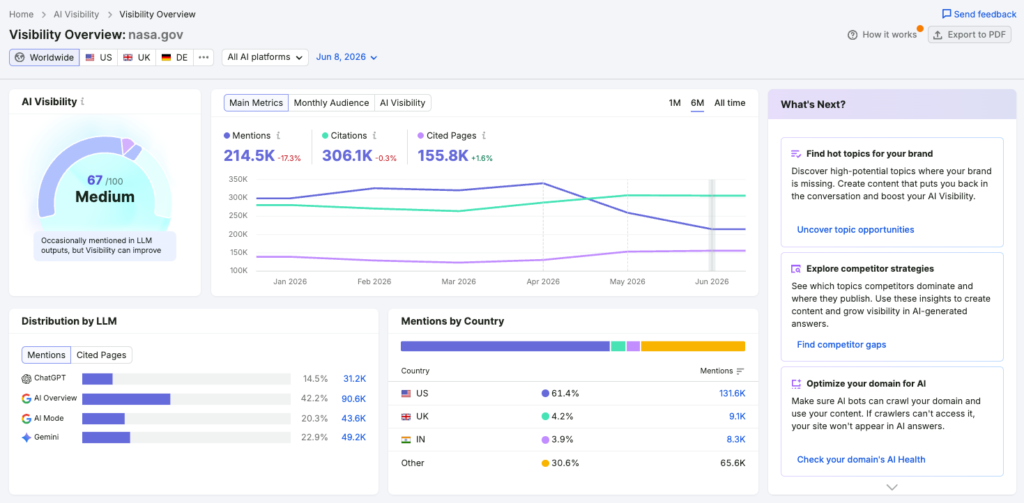
For most ecommerce brands, the practical workflow is simple: take a baseline AI Visibility Score, track 50–200 commercially important prompts, monitor which sources and narratives influence AI answers, then connect the data with GA4 or Looker Studio to estimate assisted revenue.
This gives leadership a clearer answer to the ROI question: did AI visibility improve, did the right product categories benefit, and did revenue move in the same direction?
Benchmarking Your AI Visibility Against Competitors
Your AI metrics only make sense in context, which requires understanding How to Measure Brand visibility in AI search environments where your competitors are also being evaluated. You are competing for attention not just against direct rivals but also answer competitors — sites like Wikipedia, Reddit, Quora, and large publishers that AI often cites.
Define Direct And Answer Competitors
Build two lists:
- Direct Competitors
Brands selling similar products (e.g., DTC skincare brands, other Shopify stores in your space). - Answer Competitors
Domains AI frequently cites for your topics: review sites, forums, publishers, and industry blogs.
Use AI visibility tools or manual snapshots to identify who appears alongside you, then treat these domains as part of your competitive set.
Track Share Of Citations Over Time
For each key topic cluster:
- Measure your citation volume vs competitors
- Convert it into share of citations
- Plot monthly data
Watch for:
- Surges — did a competitor publish a new guide or data piece?
- Drops — did your content fall out of date, or did you change URLs or schema?
- Consolidation — are AI tools favoring a smaller group of sources?
This helps you respond early instead of discovering six months later that a key revenue category has quietly lost AI visibility.
Find Topic Gaps And “Missing Topics”
AI visibility tools can highlight:
- Strong Topics — where you dominate citations
- Weak Topics — where you appear, but others appear more often
- Missing Topics — where competitors are cited and you are not
For missing topics, compare your existing content with top-cited pages:
- Is your content thin or outdated?
- Are you missing original data, clear pricing, or detailed specs?
- Do competitors use structured data that you lack?
Use these insights to plan focused content and technical improvements that raise your AI visibility in areas that matter most for revenue.
Choosing The Right LLM Visibility Trackers To Support ROI Measurement
Without the right tools, connecting AI activity to AI visibility tracking challenges is hard. That is where LLM visibility trackers come in. They monitor AI-generated answers, brand mentions, citations, and sometimes even downstream traffic and conversions.
In our work with eCommerce brands, we look for trackers that:
- Integrate with analytics platforms and BI tools
- Export raw data easily
- Monitor multiple AI systems and countries
- Support topic clustering and competitive views
This gives a realistic picture of how your content surfaces inside AI answers and supports ROI modeling across products, categories, and markets.
Key Features That Matter For ROI Calculations
When choosing a tracker, we prioritize:
- Brand And Competitor Tracking
Ability to monitor brand and competitor mentions across a wide set of AI engines and prompts. - Data Access
Export options or APIs that feed into GA4 or BI tools so you can join AI visibility with traffic, conversion, and revenue data. - Sentiment And Citation Detail
Clear labeling of positive/neutral/negative mentions and whether you are the main source or just one of many. - Historical Snapshots
Screenshots or stored responses over time so you can measure the impact of content updates, technical changes, or rebrands. - Topic And Query Grouping
Group prompts by product line or category to see where AI visibility aligns with your revenue structure.
With this foundation, you can stop treating AI as an “experiment” and start folding it into regular performance reviews.
Generative Engine Optimization (GEO): Technical Foundations For AI Search ROI
Generative Engine Optimization (GEO) is the technical and content work that makes your brand easier for AI systems to understand, trust, and recommend. It extends traditional SEO into the world of LLMs and AI answers.
For eCommerce brands, a GEO checklist should cover:
- Schema.org And Structured Data
- Product schema with price, availability, and reviews
- Breadcrumb and FAQ schema on key pages
- Organization schema with clear brand details
- E-E-A-T (Experience, Expertise, Authoritativeness, Trustworthiness) Signals
- Author bios with real credentials
- Transparent “About” and “Contact” pages
- Original research, comparison charts, and test results
- Clear sourcing for statistics and claims
- Content Quality And Clarity
- In-depth category and product descriptions that answer real questions
- Comparison content that explains when your product fits and when it does not
- Up-to-date information, pricing ranges, and benefits
- Technical Health
- Fast page load times, especially on mobile
- Clean URL structures with stable slugs
- Secure site (HTTPS) and consistent canonical tags
- Internal Linking And Topic Structure
- Strong internal links from guides to categories and products
- Topic clusters around high-value themes (e.g., “baby sleep essentials”)
- Clear hub pages that act as definitive resources
The better your GEO foundations, the easier it is for AI systems to cite you confidently — which directly affects how you answer “how do I measure ROI from AI search visibility for e-commerce brands?” in real revenue terms.
Connecting AI Visibility To Actual Revenue: A Simple Model
Once you have AI visibility data and classic metrics, you can start tying AI exposure to revenue. We use an assisted revenue model that attributes part of a conversion to AI visibility when:
- AI citations for a topic increase, and
- Traffic, engagement, and revenue from related pages grow in the same period
You do not need a perfect model from day one. Start directional, then refine.
For example, if AI trackers show a 50% jump in citations for “baby products in India” and organic revenue from those categories climbs 30% in the same period (with no other major changes), you can model a portion of that lift as AI-assisted.
| Step | What We Measure | How It Ties To ROI |
|---|---|---|
| 1. AI visibility change | Change in citations and brand mentions across target topics | Shows where AI exposure has increased |
| 2. Traffic and behavior | Sessions, time on site, interactions for related pages | Signals whether visibility led to visits |
| 3. Conversion outcomes | Leads, orders, revenue from those pages | Direct monetary impact |
| 4. Attribution model | Percentage of lift assigned to AI visibility | Enables ROI calculations |
A Simple ROI Formula For E-Commerce AI Search Visibility
With the model in place, you can answer the core question — “how do I measure ROI from AI search visibility for e-commerce brands?” — using a clear formula.
Basic ROI Formula For AI Search Visibility
ROI (%) = (Revenue From AI-Assisted Organic Sales − AI Costs) ÷ AI Costs × 100
Where:
- Revenue From AI-Assisted Organic Sales
Revenue you attribute to AI-influenced organic activity (based on your assisted revenue model). - AI Costs
Monthly or annual cost of:- AI and LLM visibility tools
- Content and UX work associated with AI (internal hours or agency fees)
- Any extra infrastructure specific to AI analysis
Example For A Shopify Store
Assume over 6 months you estimate:
- Extra revenue from AI-assisted organic: $120,000
- Cost of AI tools and AI-focused consulting: $30,000
Then:
- ROI = (120,000 − 30,000) ÷ 30,000 × 100
- ROI = 90,000 ÷ 30,000 × 100
- ROI = 3 × 100 = 300%
This means every dollar you spent on AI-related SEO efforts returned $3 in profit, on top of your original investment.
You can build similar formulas for:
- Lead-Based ROI
Replace revenue with estimated profit per qualified lead. - Efficiency ROI
Use time savings × hourly rate instead of revenue.
Using AI Tracking To Improve UX And Conversion Rate
AI is not only about producing content or tracking AI answers. AI-driven behavior analytics can show us how users interact with layouts, CTAs, and product flows. Those insights feed into UX experiments that often create some of the cleanest, most measurable ROI lifts.
When we analyze session recordings and heatmaps powered by AI, we focus on friction points. For instance, if AI tagging shows repeated hesitation near shipping details on a checkout page, we test clearer messaging or better positioning. Conversion gains from such tests sit squarely in the ROI bucket for AI-driven insights.
Key UX Metrics To Tie Back To AI Insights
- Click-through rate to key CTAs after AI-informed layout changes.
- Completion rate of forms and checkout flows affected by AI-identified friction points.
- Session duration and scroll depth on AI-optimized pages.
- Revenue per session for traffic segments that saw AI-driven UX updates.
Did You Know?: 65% of businesses report better SEO results when they use AI, indicating that AI-driven workflows often translate into real, measurable performance gains.
Our ecommerce consulting projects give a practical view of how AI ROI shows up in real numbers. In a baby products brand, for example, the team targeted non-branded queries, improved mobile performance, and strengthened product content using AI-supported research and content workflows. The result was a 79.7% year-on-year revenue growth from organic for that store.
From an ROI standpoint, we looked at revenue change in core product categories, cost of AI tools and consulting, and time saved per page created or optimized. When the revenue uplift vastly exceeded the combined costs, the ROI case for AI became clear for leadership.
- Track revenue by category before and after AI-assisted work.
- Estimate content production time saved with AI drafting and briefs.
- Include AI-driven user experience tests that affect checkout and product pages.
Case-Study Lens: Measuring AI ROI For Shopify Beauty & Personal Care
For a Shopify beauty and personal care store, the focus was category and product page optimization, technical fixes, and content strategy that heavily used AI for research and ideation. The store saw organic growth of around 28% in revenue and 47% in traffic.
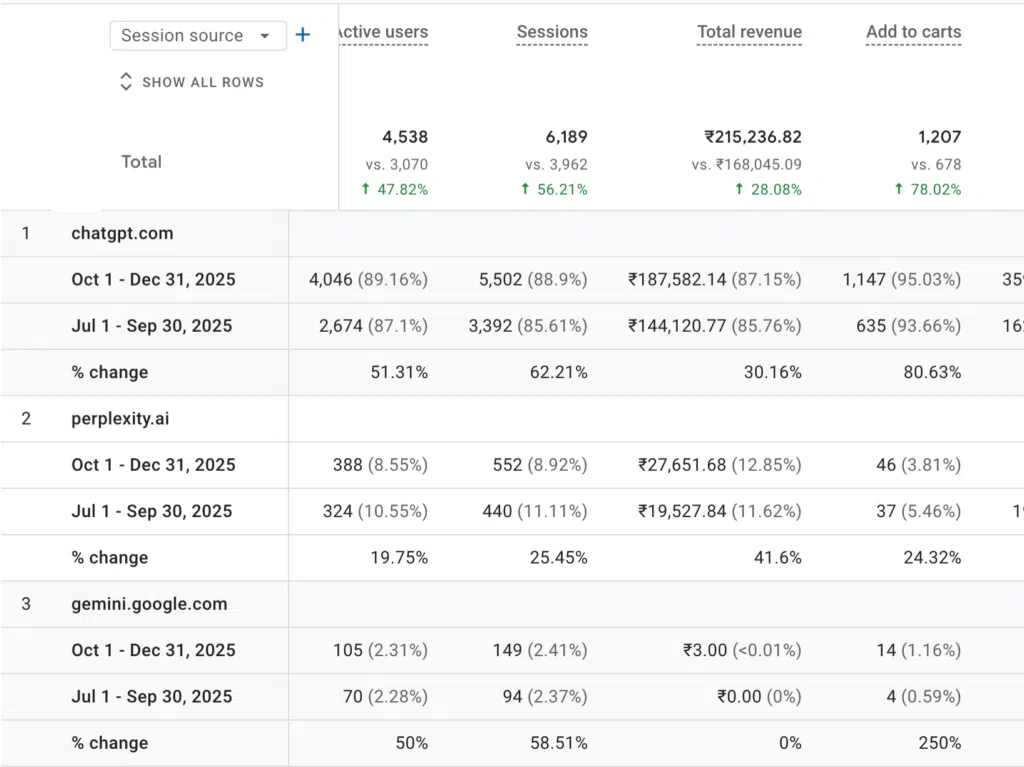
To attribute ROI to AI components, we isolated several streams: AI-assisted content refreshes for top categories, AI-supported internal linking suggestions, and AI-guided on-page tweaks. We then measured incremental session and conversion lifts for those page groups compared to control sets that did not receive AI-driven improvements in the same timeframe.
We treat AI as a productivity and insight multiplier. The ROI question becomes: did that multiplier help us create more effective category and product experiences at a lower cost per sale?
Case-Study Lens: Applying AI ROI Measurement To Ecommerce Stores
Our ecommerce consulting projects give a practical view of how AI ROI shows up in real numbers. In a baby products brand, for example, the team targeted non-branded queries, improved mobile performance, and strengthened product content using AI-supported research and content workflows. The result is as below. In May 2025 we haven’t had a single revenue from AI and in december, we have around 60,000₹ revenue.
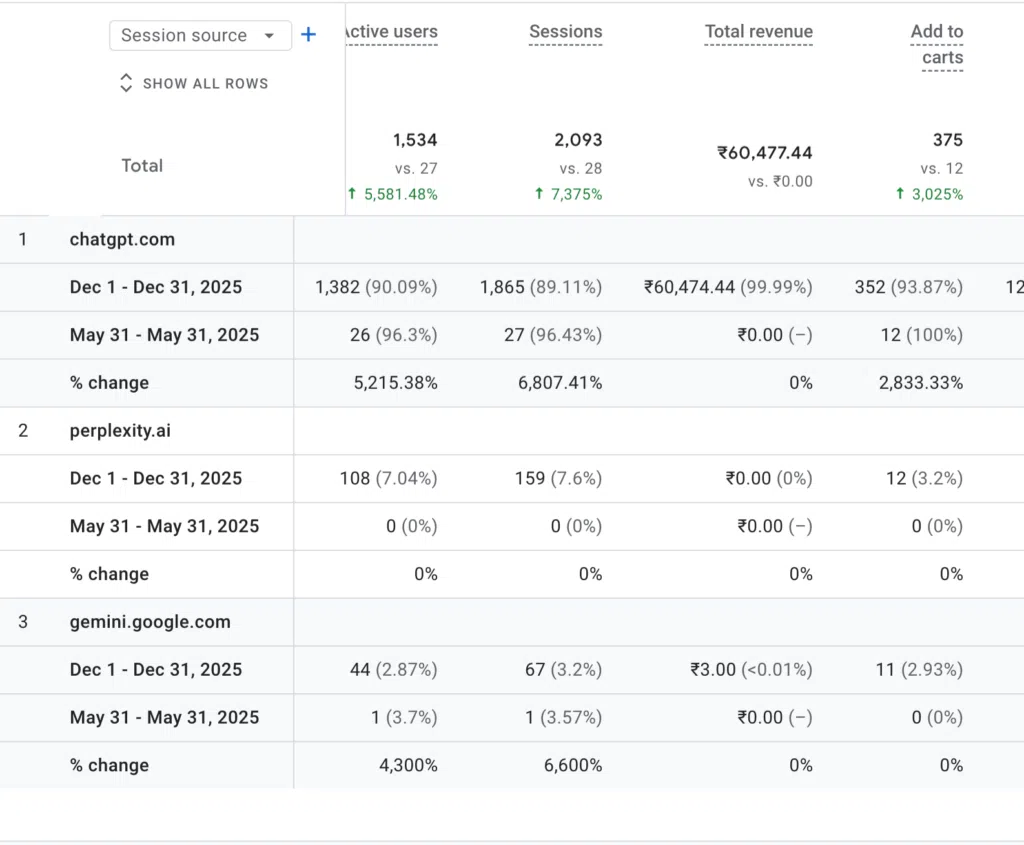
From an ROI standpoint, we looked at revenue change in core product categories, cost of AI tools and consulting, and time saved per page created or optimized. When the revenue uplift vastly exceeded the combined costs, the ROI case for AI became clear for leadership.
- Track revenue by category before and after AI-assisted work.
- Estimate content production time saved with AI drafting and briefs.
- Include AI-driven user experience tests that affect checkout and product pages.
Practical Steps To Start Measuring ROI Of AI In SEO Today
To make all this practical, we usually roll out AI ROI measurement in phased steps. You do not need a huge tech stack to start, just clarity and consistency. Focus on a few key page groups and AI initiatives, then expand once you see the patterns.
- Define goals: extra revenue, more qualified leads, or lower production costs.
- Set a baseline: capture 3–6 months of pre-AI metrics for chosen page groups.
- Pick one LLM visibility tracker: monitor AI answers for core topics and brand terms.
- Roll out AI initiatives: content updates, UX tests, or technical improvements guided or accelerated by AI.
- Measure impact: compare visibility, traffic, leads, and revenue before and after.
- Refine attribution: adjust the share of uplift you attribute to AI as you gather more data.
Conclusion
Measuring the ROI of AI in SEO is about more than proving that AI tools are “working”. It is about building a disciplined approach that ties AI-assisted activities to revenue, leads, and cost savings and then using AI visibility data to fill gaps that classic metrics cannot cover alone.
When we combine LLM visibility tracking, behavior analytics, and clear financial models, patterns emerge. Certain AI initiatives prove their worth rapidly, while others need adjustment or retirement. By starting with small, well-defined experiments and expanding from there, teams can treat AI not as a shiny object but as a measurable contributor to long-term organic growth.

Ankit Prajapati
Digital Marketing Professional | SEO Consultant | Teetotaller | Music Buff | Early Bird. "Love to do SEO for Humans, not for Bots." As an SEO Consultant, I will identify the opportunities to make your website user-friendly, improve visibility, traffic and leads. I also help SEO freshers and experienced SEO professionals in resolving their SEO errors and their queries for free, which extends my skill sets.
Comments are closed