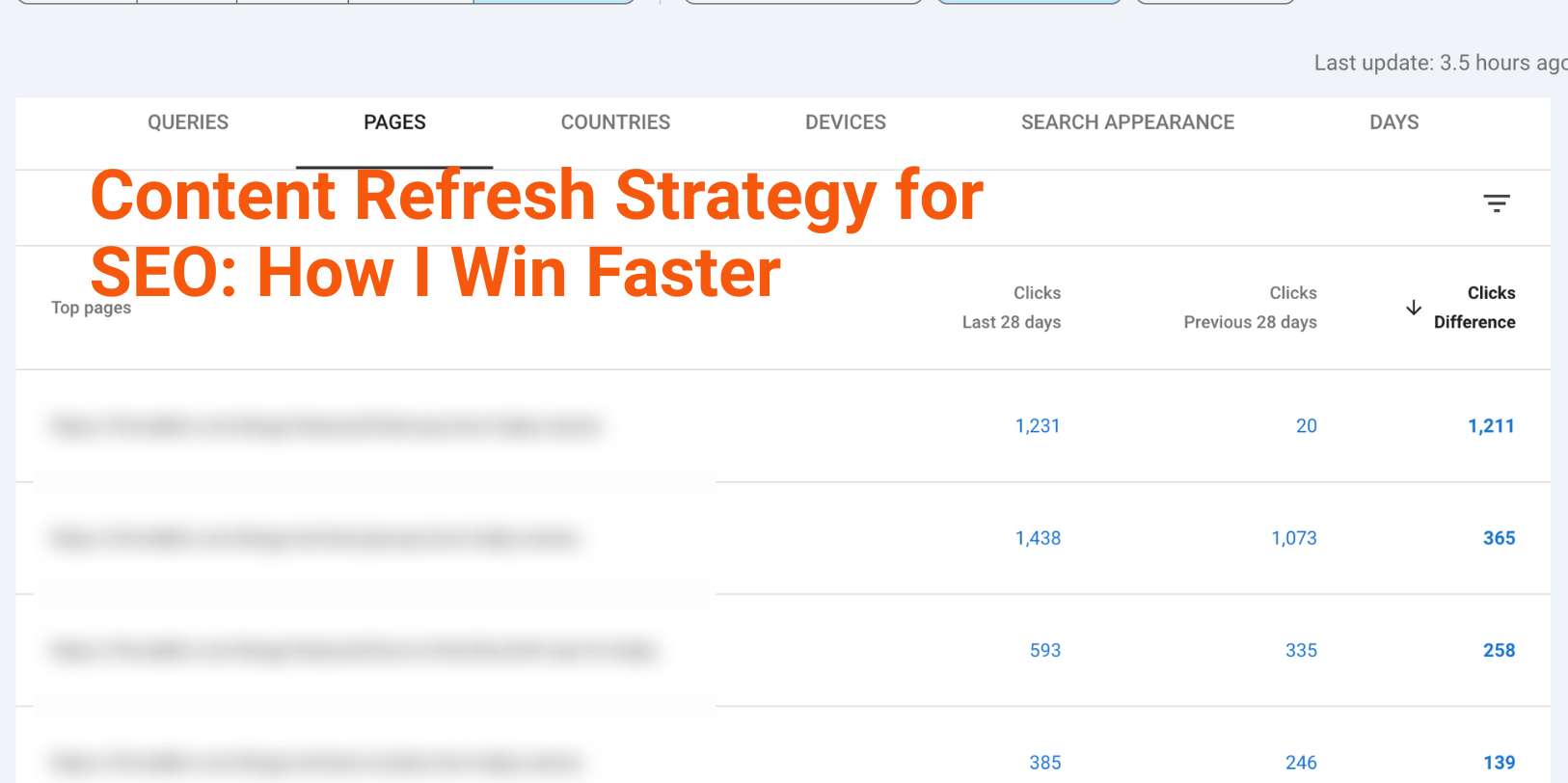
Every time I audit a new site, I see the same pattern. A few older articles quietly bring most of the organic traffic, while dozens of newer posts barely get any clicks. That is exactly where a content refresh strategy for SEO can turn things around fast.
Most teams keep pushing out fresh posts because it feels like progress. More blogs, more category pages, more landing pages. But if older content is sliding down from page one to page three, that new work sits on top of a weak base. Traffic decays, conversion rates fall, and at the same time Google and AI answer engines give more weight to pages that are current, deep, and backed by real authority.
Refreshing what is already live often brings three to five times more return than writing brand new content from scratch. You build on existing backlinks, index history, and brand trust, instead of starting from zero. I have seen eCommerce brands and Shopify stores recover 20–50% traffic losses on key pages in a single refresh cycle, without touching link building.
In this guide, I share the same content refresh framework I use in my SEO Consulting service after more than ten years of hands-on SEO work. By the end, you will know how to find the best refresh opportunities, how to update pages in a safe, structured way, and how to track clear gains in 30–60 days. This is not about fixing a typo and calling it a day; it is about turning underperforming content into assets that reliably bring revenue, not just clicks.
“The best place to hide a dead body is the second page of Google search results,” as the old SEO joke goes. A solid refresh plan keeps your best pages far away from that place.
Key Takeaways
- Refreshing existing content often beats starting from zero. It can bring three to five times more return than new posts because the page already has links and history.
- Stale pages that sit untouched for more than a year tend to fade in search and AI answers. Fresh updates send a strong signal of current value and keep your content in the mix.
- The best targets for a refresh are pages in positions eleven to thirty and pages with drops of twenty to fifty percent. These already show promise; a focused update can push them into real money territory.
- A strong refresh plan covers five areas at the same time: you review competitors, clean structure, deepen content, improve conversion paths, and fix on-page and technical issues. Leaving out one part weakens the whole effort.
- Clear wins often show within thirty to sixty days after republishing. Many sites see traffic lifts of twenty to forty percent on refreshed pages, which makes this work easy to justify to any stakeholder.
- Regular content audits, at least once per quarter, stop silent decay. They help you catch slipping pages early and keep search performance steady instead of spiky.
Table of Contents
Why Content Refresh Strategy Outperforms The Publish More Approach?

Most marketing teams live in a constant publishing cycle. New blog this week, new guide next week, a handful of product updates each month. On the surface, it feels like strong content marketing. Under the hood, the site often turns into a graveyard where older, high-potential pages quietly fade away.
Creating new content is expensive. It takes research, writing, design, reviews, development time, and promotion. A single new long-form article can consume the same resources as three or four strategic refreshes. When you refresh an existing page, you keep the URL, backlinks, and index history that Google already trusts. You are not asking search engines to bet on a brand new asset.
Content decay makes the problem worse. A page that once ranked in the top three spots starts sliding after a year or two—research shows that Content Refreshes: How Often to update varies, but page-one-ranking content for popular keywords typically gets updated within 1.31 years to maintain position. Competitors publish fresher guides, search intent shifts, and your stats and screenshots age. If you do nothing, traffic keeps dropping and those past wins turn into sunk cost. A focused refresh, on the other hand, gives the page new depth, aligns it with current intent, and reminds Google that this URL still matters.
There is also the AI search layer. Tools like ChatGPT and Perplexity prefer sources that feel current and complete. Pages that have not been touched for years are more likely to fall out of those answer sets. By refreshing content that already ranks in striking distance, smaller teams can punch above their weight, match or beat larger competitors, and grow revenue without trying to out-publish everyone on the internet.
Tip: Before you brief a new article, ask, “Do we already have a page on this topic that could be refreshed instead?” Often the fastest SEO win is buried in your archive.
Building Your Content Refresh Strategy: The Data-Driven Audit Process

A content refresh strategy for SEO starts with a clear audit. Guessing which pages to update leads to random wins at best and wasted effort at worst. A data-led review shows where traffic is slipping, where rankings are close to page one, and which URLs already tie closely to revenue.
I usually begin with a small toolkit:
- Google Analytics 4 (GA4) for traffic trends and engagement.
- Google Search Console (GSC) for impressions, clicks, and keyword positions.
- Optional tools like Semrush or Screaming Frog to uncover technical issues and deeper keyword gaps.
The goal is simple: find pages that already have signs of life but are underperforming.
During the audit, I sort content into a few key groups:
- Pages with traffic decay. They once brought much more organic traffic and now sit twenty to fifty percent lower. These are strong refresh targets because they already proved their value in the past.
- Pages in striking distance. They rank between positions eleven and thirty for high-value keywords. A better match to search intent, a stronger structure, or richer content can push them onto page one.
- Pages with many impressions but few clicks. Here the issue is often weak titles or meta descriptions, not the topic itself. A refresh can focus on improving how the page appears in search.
- Pages with traffic but poor engagement. Time on page is low, bounce rate is high, or users barely scroll. These signs tell me the content is not meeting expectations, even if it ranks.
- Business-critical content. These pages link directly to key products, categories, or lead forms. Even if they do not have huge traffic yet, improving them can shift revenue.
How you rank these groups depends on business stage:
- A startup may chase striking distance keywords first to build reach.
- A mature eCommerce store might start with category pages that tie closest to sales.
In both cases, I create a simple priority list with scores for traffic potential, business value, and effort required. That list then powers a steady content refresh cadence, often starting with a small batch of ten to twenty URLs.
The Five-Phase Content Refresh Framework

Once you have a list of target pages, the next step is a clear, repeatable process. Over the years I have refined a five-phase content refresh framework that balances search intent, content quality, conversion paths, and technical health.
Phase 1: Competitive SERP Analysis
I always start by looking at the current search results for the main keyword and key variations. The top ranking pages show what searchers expect right now. I check whether they are how-to guides, comparison posts, category pages, or definition-style pieces. If my client’s page is a definition and the top results are all step-by-step guides, I know the intent is off and no amount of keyword stuffing will fix that. I also note:
- Common subtopics that appear across multiple results.
- Content formats like videos, tools, or checklists.
- Angles or FAQs that show up again and again.
This gives me a live benchmark for search intent and depth.
Phase 2: Structural And Readability Optimization
Next, I improve how the page is organized. Clear H2 and H3 headings, short paragraphs, and simple language make it easier for both visitors and search engines to understand the content. I aim for a reading level around grade five or six so that more people can follow along. Above the fold, I want:
- A clear headline that matches the query.
- A short intro that tells readers they are in the right place.
- Key information visible without a long first scroll.
Instead of a giant image that pushes text out of view, I put the focus on fast answers and clean readability.
Phase 3: Content Improvement And Gap Filling
With a solid structure in place, I deepen the content itself. I replace outdated stats and examples, flesh out thin sections, and add new subsections to cover questions I saw in competitor content or in People Also Ask boxes. Where it fits, I add diagrams, short videos, or simple comparison tables to help people make decisions faster.
Whenever possible, I bring in original data, real client stories, or observations from my own work, because those are the details competitors and AI tools cannot copy. This is also where I weave in related keywords and synonyms naturally, instead of stuffing exact-match phrases.
Phase 4: Conversion Pathway Optimization
Traffic without action does not help the business. In this phase, I look at how the page guides people to the next step. That might mean:
- Adding internal links to high-value product or service pages.
- Turning a text mention of a product into a small featured block.
- Placing a clear, context-aware call to action near key sections.
For eCommerce clients, I often add small product carousels or comparison blocks so that shoppers can move from learning to buying without friction. The goal is a page that both answers questions and supports conversion rate optimization.
Phase 5: Technical SEO And On-Page Elements
Last, I clean up technical and on-page details. I avoid changing URLs unless there is a very strong reason, to keep existing backlinks and history safe. I craft title tags and meta descriptions that match the refreshed content and invite clicks. I also:
- Compress images and set descriptive file names and alt text.
- Add structured data such as FAQ, HowTo, or Product schema where it fits.
- Check for broken internal links or orphaned sections.
I pay close attention to which parts of the page have external links and keep the core meaning of those paragraphs, so that other sites do not end up pointing at text that no longer matches their context.
Tip: Treat each phase as a checklist. Skipping technical fixes or conversion paths can limit the impact of even the best writing work.
How I Execute Content Refresh Strategies at CoonsultantAnkit.com
In my SEO Consulting service, I do not treat content refresh as a one-off clean up. It is part of a continuous SEO and CRO system that keeps clients growing month after month. My starting point is always a full review of the site, Search Console data, analytics, and key competitors, so I can see exactly where content is slipping and where quick wins sit.
Every refresh plan is tied to clear business goals. For one Shopify store that might mean lifting organic sales for three core product categories. For a B2B SaaS company it might mean more demo requests from a set of buying guide pages. I group topics into clusters that match those goals, with strong pillar pages in the center and supporting articles around them. Refresh work then strengthens both the pillar and the spokes.
On-page SEO is baked into each refresh. I refine headings, rewrite intros, smooth out internal linking, and weave in primary and related keywords in a natural way. At the same time, I check load times, mobile layouts, URL patterns, and issues like duplicate content or broken links, so refreshed pages rest on solid technical ground. When a refreshed article starts to perform, I often repurpose it into checklists, short videos, email mini-series, or social posts, which extends its reach without extra strain on the team.
This approach has helped clients see triple-digit growth in organic sessions, purchases, and leads, even without heavy link building. My guiding rule is simple: SEO should work for humans first and search engines second, and content refresh is one of the fastest ways to prove that on the bottom line.
“If you want long-term SEO growth, treat your best pages as products you keep improving, not as posts you publish once and forget.”
Measuring Success: Key Metrics And Realistic Timelines

A content refresh strategy for SEO only feels real when numbers move. The good news is that refreshed pages often show clear signs of change within thirty to sixty days, as Google recrawls and re-evaluates the content.
I rely on a small set of core metrics:
- Organic traffic is the first check. I compare post-refresh sessions for each URL against both the recent low point and the past peak. A healthy refresh often brings a lift of twenty to forty percent within two months, and understanding How Often Should You Refresh Content? depends on your industry and competition dynamics, with most high-value pages benefiting from quarterly reviews.
- Keyword rankings show where the page now stands in search. I track movements for the main keyword and key variants, paying special attention to phrases that move from page two to page one, since those tend to bring the biggest traffic jumps.
- Engagement metrics tell me if visitors like what they find. I look for longer time on page, better scroll depth, and a lower bounce rate. Those signals show that the new structure and content are closer to what people need.
- Conversion performance connects the work to revenue. For eCommerce, that might be add-to-cart rate and purchases. For lead-driven sites, it might be form fills or demo bookings from refreshed URLs.
- AI visibility is a newer but growing signal. I sometimes test prompts in tools like ChatGPT and Perplexity to see whether client pages appear more often as cited sources after a refresh.
Google Search Console’s Performance report is my main dashboard for impressions, clicks, and click-through rate changes. I also set up segments in analytics to group refreshed pages, so I can report clean before and after views.
Even when a refresh does not hit first time, the data still teaches a lot about search intent and competition, and that insight shapes the next round.
Tip: Give each refreshed page at least one full crawl cycle (often four to eight weeks) before making big extra changes. Let the data build up so you are reacting to real patterns, not day-to-day noise.
Conclusion
Content refresh is not a side task to squeeze in when there is time left. For most sites with a few years of history, it is one of the highest return SEO strategies on the table. Instead of racing to publish more and more, you give your existing content the attention it needs to keep earning traffic and revenue.
By running regular audits, picking the right targets, and following a clear five-phase framework, businesses of any size can compete with brands that have larger content teams. Hidden in your blog, category pages, and guides are URLs that may be only one smart refresh away from strong rankings and steady sales.
As AI answer engines and search features shift, the brands that keep pages fresh, helpful, and grounded in real expertise will keep their edge. My advice is simple: start by reviewing your top twenty to thirty pages, pick three high-potential candidates, and run this framework on them in the next thirty days. When you see the lift, you can expand with confidence and outdo your own past results again and again.
Ready to Turn Your Underperforming Content Into Revenue?
If you’re tired of watching old pages slip down the rankings while pumping resources into new content, let’s talk. I help eCommerce brands and Shopify stores to recover 20–50% traffic through strategic content refreshes—without touching link building. Schedule Your Free Content Audit Now.

Ankit Prajapati
Digital Marketing Professional | SEO Consultant | Teetotaller | Music Buff | Early Bird. "Love to do SEO for Humans, not for Bots." As an SEO Consultant, I will identify the opportunities to make your website user-friendly, improve visibility, traffic and leads. I also help SEO freshers and experienced SEO professionals in resolving their SEO errors and their queries for free, which extends my skill sets.
Comments are closed