 View Markdown
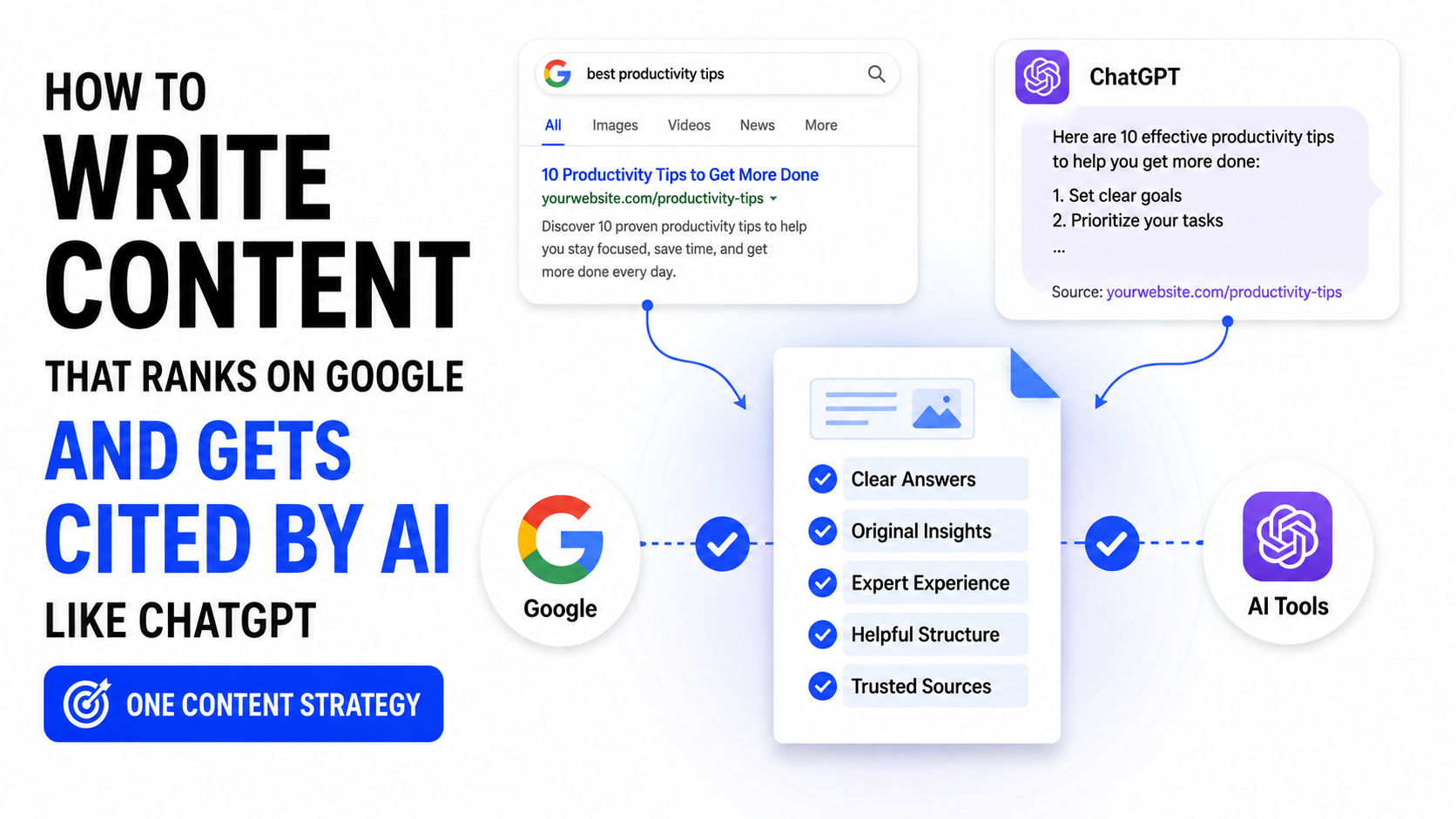
Writing content that ranks on Google and gets cited by AI tools like ChatGPT requires two things to work together: strong on-page SEO signals for Google, and extractable writing structure for AI engines.

To achieve both:

- Open every section with a direct, standalone answer
- Use question-style headings that match real search queries
- Keep paragraphs to 2-4 sentences so AI tools can lift them cleanly
- Add original data with real source links
- Write FAQ answers that work without surrounding context
- Allow AI crawlers (GPTBot, PerplexityBot) in your robots.txt

Google ranks pages. AI tools cite statements. The writing decisions that satisfy both are not the same - but they are compatible when you structure content with both in mind.
If your content ranks well on Google but disappears inside ChatGPT, Perplexity, or Google AI Overviews, the problem is almost always at the writing level, not the strategy level.
Here I explain exactly how to write content that satisfies both channels at once: how to structure your opening, build paragraphs that AI tools can extract, use original data that forces citation, and diagnose why your existing content might be getting ignored. No fluff. Just writing decisions you can apply today.
Table of Contents
Why Google and AI Read Your Content Differently?
Most writers treat Google SEO and AI search as two separate puzzles. They are not. But they are different enough that writing for one without understanding the other will cost you visibility somewhere.
The simplest way to put it: Google ranks pages. AI tools cite statements.
Google ranks pages, AI cites statements
When someone types a query into Google, the algorithm returns a list of pages it considers most relevant and authoritative. The page wins or loses as a whole unit. Backlinks, technical health, domain authority, on-page signals – all of these feed into a page-level verdict.
AI tools like ChatGPT, Perplexity, and Google AI Overviews work at a much finer resolution. They do not pick your page and send someone to it. They scan your content, identify specific passages that answer a query clearly, extract those passages, and weave them into a synthesised response. Sometimes they cite your URL. Sometimes they paraphrase without attribution. Either way, the decision happens at the paragraph level, not the page level.
That single difference changes how you should write.
How LLMs extract and quote your writing?
Large language models (LLMs) do not read your content the way a human does. They process it in chunks. When a model is building a response to a user query, it looks for text segments that are self-contained, factually grounded, and directly relevant to the question. Long, meandering paragraphs that take four sentences to reach a point get skipped. Short, direct passages that open with the answer get lifted.
According to research cited by WP Engine, topical depth and technical structure are the two primary drivers for citation within AI search systems. And content with clear heading hierarchies, short paragraphs, and answer-first formatting gets cited roughly 40% more often by AI platforms.
That is not about keyword stuffing or meta tricks. It is about how you write a sentence.
What changes at the writing level, not just strategy?
The strategic advice you will find on most blogs – use schema, allow GPTBot, build backlinks – is legitimate but incomplete. Those are setup tasks. Writing is the ongoing work.
The changes that actually affect whether your content gets cited are:
- Whether each paragraph opens with its main point
- Whether your headings match the way people actually phrase questions
- Whether your FAQ answers work as standalone quotes
- Whether you include verifiable data that no one else has
None of those require a technical audit. They require rewriting.
Start With the Right Keyword and Intent Mapping
Before you write a word, you need to know which version of your topic gets cited versus which version gets ranked. These are not always the same query.
How to find queries AI tools answer most?
Open ChatGPT or Perplexity and type your target topic as a question. Look at which sources they pull from. Look at how the answer is structured. Then do the same in Google and look at the AI Overview (if one appears) and the People Also Ask section.
What you are looking for is the question format that AI tools are already answering confidently. That confidence tells you the topic is well-covered in their training data and current retrieval index. Those are the formats you want to match and improve upon.
For content writing specifically, queries like “how do I write content that gets cited by AI” and “why does ChatGPT ignore my blog” are getting AI-generated answers consistently. That is a signal. If you write the clearest, most structured response to those questions, you have a real shot at citation.
Mapping one keyword to multiple search modes
Take your primary keyword and write down three things: the version someone would type into Google, the version they would ask ChatGPT, and the version that would appear in a PAA box. These are usually slightly different in phrasing but identical in intent.
For example, if your primary keyword is how to write content for Google and AI search, the Google version might be a longer-form guide. The ChatGPT version might be a direct definition or process. The PAA version might be a question like “does content structure affect AI Overview rankings?” Writing content that covers all three in one article is how you show up across all three surfaces.
Conversational vs transactional intent differences
This is a gap most content writers miss. Conversational intent queries – “how do I get cited by ChatGPT?” – want process explanations. Transactional intent queries – “best content writing tools for AI SEO” – want comparison and recommendation.
If you write a process-style article targeting a transactional keyword, AI tools will not cite it because the format does not match what the query expects. Match the writing style to the intent first, then worry about optimisation.
Write the Opening That Works for Both Channels
Your introduction is doing two jobs at once. It has to signal to Google’s crawlers that the page is relevant and authoritative. And it has to give AI tools a clean, extractable answer they can use within the first 100 words.
The answer-first opening, written correctly
Most blog introductions spend the first three paragraphs explaining why the topic matters. By the time the actual answer appears, the reader has left and the AI crawler has moved on.
Here is the difference in practice.
Weak opening (filler-first): “In today’s rapidly changing digital world, content marketing has become more important than ever. Brands are struggling to keep up with both Google’s algorithm updates and the rise of AI tools. If you are one of them, you are not alone…”
Stronger opening (answer-first): “If your content ranks on Google but never appears in ChatGPT or AI Overviews, the problem is structural. This article explains the specific writing changes – not technical fixes – that make content citable by both Google and AI tools.”
The second version answers the implicit question (what is this about, why should I read it) in two sentences. It gives an AI model a clean extractable passage. It sets expectations without lying about what the article delivers.
Why the first 100 words decide AI citation eligibility?
AI retrieval systems often weight the beginning of a passage more heavily than the middle. Research from CXL’s analysis of Google AI Overview citations found that if your answer is not in the first third of a page, there is a better than even chance it will not be cited at all.
That finding matters for how you write your introduction and the opening paragraph under each heading. Not just the article introduction. Every section introduction.
What to cut from introductions immediately?
Three things kill citability in the opening:
- “In recent years…” followed by nothing new
- Restating the title as a question and then not answering it
- Any variation of “Let’s get started” or “Without further ado”
Cut those. Open with the answer, then explain it.
Build Content That AI Tools Can Lift and Quote
This is where most content falls apart. The ideas are good. The research is real. But the writing is structured in a way that makes it almost impossible for an AI tool to extract a clean, usable passage.
Write self-contained paragraphs under every heading
After every H2 or H3 heading, write two to four sentences that directly answer what the heading promises. No context-setting. No throat-clearing. Just the answer, stated plainly.
Then you can expand with context, examples, or supporting evidence. But that first paragraph needs to work as a standalone quote. If someone read only those two sentences and nothing else, they should still understand the point.
This is the most commonly ignored advice in content writing for AI search, and it is the one that makes the biggest difference.
The 2 – 4 sentence paragraph rule and why it works
Long paragraphs are hard for AI tools to parse cleanly. A 10-sentence paragraph might contain three separate ideas. The model cannot extract one without including context from the others, which often produces a confusing or overly long citation.
Two to four sentences per paragraph forces you to make one point at a time. That is good writing anyway. It also means every paragraph is a potential citation unit – a clean block of text that makes a complete point and can be quoted without editing.
Use question-style headings that mirror real queries
Headings like “Content Structure Tips” tell a search engine almost nothing. Headings like “How do I structure content for AI tools to cite?” mirror the actual language users type into ChatGPT and Google.
AI tools use headings as entry points. When a model builds a response to “how do I structure content for AI search,” it looks for headings that match that phrasing and then pulls from the paragraphs that follow. If your headings are generic or vague, you are invisible even if the content beneath them is excellent.
This is not about keyword stuffing. It is about writing headings that represent the question your reader actually has.
When to use tables, lists, and comparison blocks?
Tables and lists are powerful when the content is genuinely comparative or sequential. They are a waste when they are just a way to pad a section or look organised.
Use a table when you are comparing two or more things across consistent criteria. Use a numbered list when the order matters. Use a bullet list when you have four or more discrete items that do not connect naturally in prose.
Here is a quick reference:
| Format | Use it when | Skip it when |
|---|---|---|
| Table | Comparing options across attributes | You only have two things to compare |
| Numbered list | Steps in a fixed sequence | The order does not matter |
| Bullet list | 4+ discrete, non-sequential points | You have 2–3 points that read fine as prose |
| Prose | Explaining a concept or process | You have more than 5 parallel items |
AI tools cite tables frequently because they are structured data that is easy to extract and reproduce. According to WP Engine’s research on AI citation patterns, AI systems actively scan for clear content hierarchies, and tables qualify as exactly that.
How to write a definition block AI tools quote directly
Definition blocks are short, boxed or clearly separated sections that define a key term precisely. They appear near the top of a section and give the reader (and the AI tool) an immediate, quotable answer.
Format: one to three sentences, no jargon, written as a direct definition. Example:
Answer-first writing is a content structure technique where each section opens with a direct response to the heading’s implied question before providing supporting detail. It improves both reader comprehension and AI citation rates by making the key point immediately extractable.
That block can be lifted by ChatGPT, Perplexity, or Google AI Overviews as a clean answer. Write one of these for any key term you introduce in the article.
Add Original Data That Forces AI Engines to Cite You
Here is something worth sitting with. AI tools are trained on existing content. If your article only restates what everyone else has already said, there is no reason for the model to cite you specifically. You are interchangeable with every other source covering the same topic.
Original data changes that. If you publish a specific finding, case study result, or data point that appears nowhere else, an AI tool citing that fact has no choice but to attribute it to your source.
Why AI tools cannot replace a unique data source
The core function of a generative AI is synthesis: it takes information from multiple sources and produces a unified response. Synthesis requires sources. If your content is the source – meaning it contains data that cannot be found elsewhere – you become a required citation rather than an optional one.
This is why posts like “I ran 100 Google searches and tracked AI Overview citations” consistently get cited across multiple AI tools. The data is unique. The finding is specific. The citation is unavoidable.
Small-scale data you can produce right now
You do not need a research budget. You need to document what you already observe.
If you are an SEO consultant, that might mean: auditing 20 client pages and recording which structural patterns got cited in AI Overviews. It might mean testing five different paragraph lengths and noting which got extracted. It might mean tracking AI referral traffic in GA4 across three months and publishing the numbers.
The data does not have to be peer-reviewed. It has to be real, specific, and documented with enough detail that a reader (and an AI model) can verify the methodology.
How to cite sources so AI trusts your claims
When you include a statistic or a finding from a third party, link to the original source – not a summary, not a roundup, not another blog post citing that same stat. The original study, report, or data page.
AI tools evaluate source quality when deciding what to cite. A claim backed by a link to an Ahrefs study, a Google report, or a peer-reviewed paper carries more citation weight than the same claim with no source or a low-authority link.
Also, be specific. “Studies show that structured content performs better” is worthless to a model trying to synthesise an accurate answer. “A 2026 study found that content with clear heading hierarchies gets cited 40% more often by AI platforms” is citable because it contains a number, a timeframe, and a verifiable claim.
Write FAQs That Both Google and ChatGPT Pull From
A well-written FAQ section is one of the most reliable citation magnets in content writing for AI search. Done right, it serves three purposes: it captures conversational queries that did not fit your main sections, it gives AI tools a structured bank of Q&A pairs to extract, and it targets the People Also Ask placements in Google.
Done wrong, it is just a list of questions with vague answers that add no value.
What makes an FAQ block actually work in 2026
The FAQ has to be written for extraction, not for decoration. That means each question should match a real query someone would type. And each answer should work as a standalone response – a reader should be able to read only the question and answer, with no surrounding context, and still get a complete, useful reply.
Most FAQ sections fail because the answers assume the reader has read the rest of the article. “As mentioned above, the key is structure” is not a citable FAQ answer. It is a reference to something that came earlier. AI tools cannot use it cleanly.
How to write FAQ answers that stand alone
Each FAQ answer should:
- State the direct answer in the first sentence
- Add one or two sentences of supporting context
- End without referring to other parts of the article
That is it. No preamble. No “Great question.” No transitions. Just a clean, complete answer in two to four sentences that could be pasted anywhere and still make sense.
FAQ length, placement, and schema pairing
Five to eight questions is the right range for most articles. Fewer than five often leaves obvious intent gaps. More than eight starts to feel like padding.
Place the FAQ near the end of the article, after the main content. This keeps the flow intact and still catches anyone who scrolls directly to questions.
Pair the FAQ with FAQPage schema markup so Google can surface it in rich results. For the full setup on schema implementation including how to structure the markup, the guide on optimising your website for Google and AI search covers that in detail.
Match Your Writing to How Each AI Engine Cites
Not all AI tools evaluate content the same way. There are real differences in what each platform favours, and small writing adjustments can close the gap.
What writing style ChatGPT favours when browsing
When ChatGPT browses the web (using Bing as its primary retrieval source), it tends to favour pages that are well-indexed in Bing, clearly structured, and factually grounded. It pulls from authoritative-sounding sources and prefers passages that are declarative – meaning they state facts rather than ask questions or hedge constantly.
Avoid writing like “it depends” without then explaining what it depends on. That hedge kills citability. Either commit to a position or present the conditions clearly: “This works well when X, and less so when Y.”
How Perplexity selects passages to surface
Perplexity is arguably the most citation-friendly AI tool for content writers right now because it shows sources visibly and often drives real traffic. It favours recent content, direct answers, and pages with clean reading experiences.
It also tends to cite pages that cover the full topic, not just one angle. A 1,500-word article covering one sub-topic will often lose to a 3,000-word article covering the full topic with strong structure.
What triggers an AI Overview citation on Google
Google’s AI Overviews lean heavily on pages that already rank well organically. This is the strongest argument for not abandoning traditional SEO in favour of AI-only optimisation. Google’s own guidance confirms there is no separate AI Overview ranking system – good SEO and well-structured content that directly answers queries is the path.
That said, Google specifically pulls from sections that open with direct answers, use FAQ markup, and include structured data. The on-page writing decisions matter on top of the organic foundation.
One content format that works across all three
A structured long-form article with: a direct answer in the first paragraph, question-style H2s and H3s, definition blocks for key terms, short paragraphs, a comparison table or two, and a standalone FAQ section. That single format covers the citation criteria for ChatGPT, Perplexity, and Google AI Overviews simultaneously. You do not need three different content formats. You need one well-structured article.
Build Author Authority That AI Engines Recognise
Content does not exist in isolation. AI engines build trust in a source based on the full picture of who wrote it and what else they have published. An anonymous 2,000-word article on a new domain has almost no citation probability, regardless of how well it is written.
What author signals LLMs use to trust a source
LLMs evaluate the credibility of a source partly through what is sometimes called entity recognition – whether the author appears as a known, consistent entity across the web. This includes LinkedIn presence, publication history on credible sites, and mentions of the author by name in other content.
It also includes whether the author bio on the page includes verifiable credentials. “Ankit Prajapati, SEO Consultant with 10+ years of experience” is more entity-trustworthy than “By the editorial team.”
How to write an author bio that builds entity trust
Keep the author bio short, specific, and linkable. Include:
- Real name and professional title
- A one-line statement of expertise (specific, not generic)
- A link to LinkedIn or another verifiable profile
- One or two credentials or outcomes that demonstrate real experience
Avoid generic lines like “passionate about digital marketing.” They add no entity signal. A bio like “Ankit Prajapati is an SEO and AI Search Consultant from Ahmedabad, India. He has helped D2C brands and tech companies grow organic revenue through technical SEO and content strategy. Connect on LinkedIn.” gives a model everything it needs to trust the source.
Off-page mentions that reinforce your content’s authority
Author authority is not only built on your own website. Guest posts, podcast mentions, expert quotes in industry articles, and community contributions (LinkedIn, Reddit, Quora) all feed the entity profile that AI tools cross-reference.
If you publish a well-structured article but have almost no presence outside your own domain, the citation probability drops significantly. The HEO framework covers the off-page side of this in detail – for context on how brand mentions and entity signals connect to AI visibility, the Hybrid Engine Optimisation pillar guide is the right reference.
Check if Your Content Is Getting Cited and Fix It if Not
This is the section no one writes. Most guides tell you what to do to get cited. Very few tell you what to do when you have done those things and it is still not working.
How to test your own content in ChatGPT and Perplexity
Open ChatGPT and ask the primary query your article is targeting. Note whether your URL appears. Then try three or four variant phrasings of the same query. If you are not showing up in any of them, the issue is one of three things: the content is not being crawled by the relevant bots, the structure is not extractable enough, or your domain does not yet have enough authority to compete.
Do the same in Perplexity. Perplexity is more transparent about its sources, so the gap analysis is easier. If you see competitors appearing consistently and you are not, look at the structure of their cited passages. They are almost certainly shorter, more direct, and more definition-like than yours.
Also check whether GPTBot and PerplexityBot are allowed in your robots.txt file. Blocking them by default – which some WordPress configurations do – will make you completely invisible to those engines regardless of how good your content is.
Signs your writing structure is blocking AI citations
A few honest red flags to check in your existing articles:
- Your H3 headings appear immediately under H2s without a paragraph in between (AI tools need that buffer paragraph to understand context)
- Your paragraphs regularly run longer than six sentences
- Your FAQ answers reference other parts of the article (“as discussed above…”)
- Your article opens with context about the topic before stating what the article actually covers
- Your statistics are vague (“research shows…”) with no actual source link
Any one of those will suppress citation rates. More than two and you have a structural problem worth fixing before publishing new content.
A simple rewrite checklist for existing posts
Run this against any article you want to revitalise for AI citations:
- Does the introduction answer the primary query in the first two sentences?
- Does every H2 and H3 section open with a direct, standalone answer paragraph?
- Are paragraphs broken into units of two to four sentences?
- Do FAQ answers work without surrounding context?
- Are all statistics linked to original sources?
- Is there at least one piece of original data or observation specific to this article?
- Is the author bio present, specific, and linked to a verifiable profile?
Seven checks. If you pass all seven, your writing is in good shape for both Google rankings and AI citation.
For tracking which tools are actually citing your site, the guide to top LLM visibility trackers covers the best tools available in 2026, including what each one measures and how to read the data.
Track AI referral traffic in GA4 for free
You do not need a paid tool to start. In Google Analytics 4, create a custom segment filtering referral traffic from chat.openai.com, perplexity.ai, gemini.google.com, and copilot.microsoft.com. That segment shows you how much traffic is coming from AI tools right now.
It will probably be small. That is expected. But watching it grow over three to six months as you apply the writing changes above gives you a real signal that the strategy is working. For a more detailed breakdown of how to measure AI search ROI, the post on how to measure the ROI of AI in SEO has a practical measurement framework.
FAQs:
-
How do I get my blog post cited by ChatGPT?
Write each section with a direct answer in the opening paragraph, use question-style headings that match how people phrase queries, include verifiable statistics with source links, and allow GPTBot to crawl your site via robots.txt. ChatGPT browses through Bing, so being indexed in Bing Webmaster Tools also helps.
-
Does content structure affect AI Overview rankings?
Yes, significantly. Google’s AI Overviews favour pages that already rank organically and use structured formats: answer-first paragraphs, FAQPage schema, and short, scannable sections. There is no separate ranking system for AI Overviews. Good on-page structure combined with solid SEO fundamentals is the path.
-
Can a small website get cited by ChatGPT or Perplexity?
Yes, especially by Perplexity, which is less dependent on domain authority than Google.
-
What word count is ideal for AI-cited content?
There is no magic number, but research from WP Engine found that AI systems prefer single pages that cover a topic deeply over multiple short articles on related subtopics.
-
How often should I update content to stay cited by AI tools?
Content updated within the last 30 days receives significantly more AI citations than older material, according to multiple analyses of citation patterns across Perplexity and Google AI Overviews. A quarterly review cycle – updating statistics, adding new context, and checking whether your answer still matches current search intent – is a reasonable minimum.

Ankit Prajapati
Digital Marketing Professional | SEO Consultant | Teetotaller | Music Buff | Early Bird. "Love to do SEO for Humans, not for Bots." As an SEO Consultant, I will identify the opportunities to make your website user-friendly, improve visibility, traffic and leads. I also help SEO freshers and experienced SEO professionals in resolving their SEO errors and their queries for free, which extends my skill sets.
Comments are closed